Friday, June 25, 2010

Ceviche? Why Not?


I am very busy here in Kraków as I am involved into some new projects. I do not have any spare time for cooking. I hope that it will change soon. Not only I want to invite you to read my interview with Mr Bajon (the translation is not finished), but I am going to work on new recipes using seasonal and regional products. I am also going to take a few trips around my region, Małopolska and other regions of Poland as well, to search for old and local specialties and producers.  I am not even mentioning my participation to culinary workshops about Jewish cuisine, organized during the International Festival of Jewish Culture in Krakow, which has just started. There are also other foodie events here during the summer, most of them designated to the promotion of small producers of regional products. I am going to visit those places, take pictures of people, food and places.

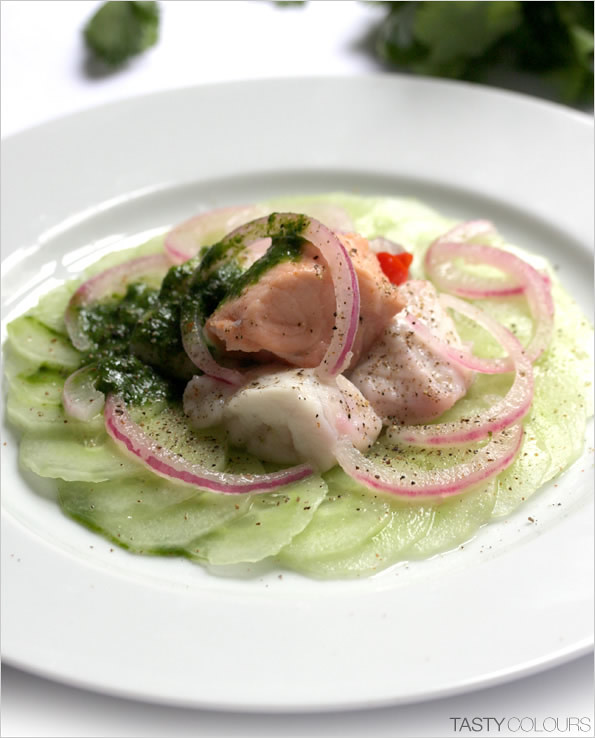
Today’s dish is far away from Central European traditions. I made this variation on Ceviche  several weeks ago, when my husband was in Warszawa. It is an extra refreshing starter or main dish for a hot summertime. I was hesitating to present it today, because again, the weather here in Kraków is far away not only from the tropics but from summertime in general. I should rather present Polish warming up barley soup, rich and savory Bigos or at least Aligot from Auvergne - my favorite region in France, except for Provence. But, at least theoretically there is a calendar summer. Perhaps in some places where some of you live, one suffers from sweltering heat and would enjoy having a few bites of this low fat and rich in proteins citrus-marinated seafood? I do not know about you, but except for fish tartar and sashimi it is one of my favorite seafood starters. Usually, during the week, I make a simplified and quick version of it with shrimps, which I marinade for a short time.

This time I “cooked” my fish for five hours. Despite the fact that the marinade is extremely acid, the fish, which changes its texture and color (like if it was cooked) keeps the flavor of the sea. Some advise a shorter “cooking” time – depending on the type of fish. I have never checked how much time a particular fish needs for “cooking”. Anyway, I was checking my fish, trying it every hour, and in my opinion, one or two hours for that size of cubes I cut the fish into, was not enough. However, we all have our preferences and the "cooking" time should be set accordingly.

I “cooked” the fish in quite a large amount of lime and lemon juice (the juice should cover the fish completely). As I mentioned it, the marinade itself is very acid, and in Peru it is served as a drink called "Tiger Milk". For me, it is too acid and I threw it away.  I also prepared on the side a simple dressing with the addition of some palm sugar, to balance the taste. You can experiment with other dressings, like for example this one that Cristina prepared, which I discovered just a few days ago. Check her recipe for dressing ; it sounds very appealing and I will definitely try it when I am back in Paris

I served it with cucumbers. You can add avocado (this is how I usually make the shrimp “Ceviche”) and cherry tomatoes or tomatoes. If you want to serve it as a full meal, add some tortilla chips on the side or some rice, or even potatoes. As regards herbs – feel free to experiment and use your favorite: chives, basil, scallions, mint or parsley (I used coriander like in the classical version). 

Serves 4

Ingredients:
200 g salmon, cut into 2-3 cm cubes (you can use any other sea fish, shells or shrimps)
200 g cod loin cut into 2-3 cm cubes
1 medium red onion, peeled, washed and cut into thin slices
3 limes
3 lemons
1 cucumber (around 300 g)
1-2 handfuls of coriander, finely chopped 
5-6 tablespoons olive oil (or as much as you want)
1 small red chili pepper, finely chopped (if you are tempted to have your Ceviche spicier, feel free to add as much as you can stand)
1 tablespoon palm sugar
Salt

Preparation:
Place the cubes of fish in a medium size bowl.
Cut lime and lemons into halves (wash them firstly, of course) and squeeze their juice. Pour the juice on the fish (it should be covered).  Add onions and chili, mix well. Cover the bowl with a plastic film and place it into the fridge for a few hours.
Once the fish is cooked, strain the juice. If you want to serve the marinade as Tiger Milk in small glasses, keep it. Or simply throw it away.
Peel cucumber and cut it into very thin slices.
In a mortar, mash coriander with some olive oil and sugar (if you do not have a mortar, simply mix those ingredients thorough fully). Add a bit of salt, to taste. You can add a tiny bit of sesame oil, too, if you like it.
Place the cucumber onto a plate then lay the cubes of fish with onion and chili. Pour the coriander dressing on top.
I did not add any accompaniment to this dish (as I wanted to enjoy the taste of the fish), but it will go deliciously of course with some cherry tomatoes cut into halves, avocado,  rice  and so on…


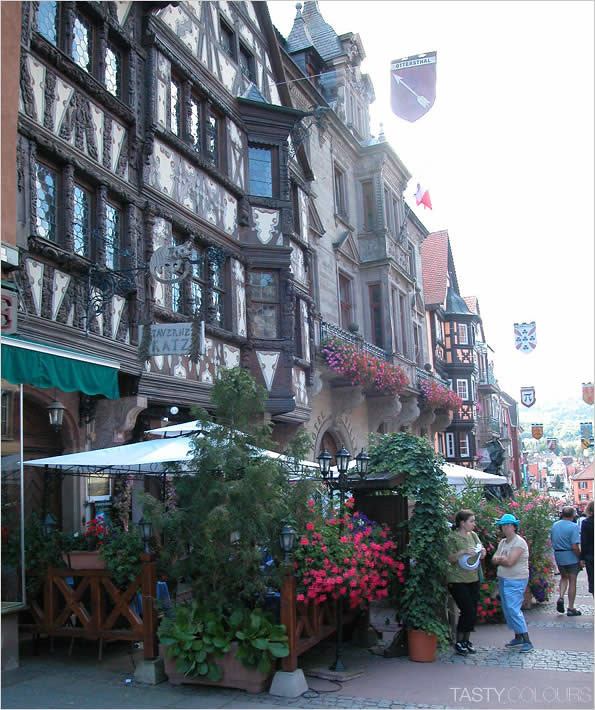
And at the end I present my 10th picture stored in my PC. Just before leaving Paris I was invited by Lidka to a bloggers’ play (nobody knows what it is about except for a fact that you should present the 10th picture from you computer).

So here it is – made in summer 2005, probably in Colmar, in Alsace, but I am not quite sure.

Now I invite Karolina.

Thursday, June 17, 2010

From a Snob to Foodies – with Love

A couple of weeks ago one of my friends, sipping wine at three o’clock in the morning, made a joke that we were snobs because we live in the sixth arrondissement in Paris. I am not going to explain why do we live here, except for the fact that, by chance, we found this nice (although tiny) apartment for a price lower to those offered in theoretically less snobbish and less expensive Parisian neighbourhoods. But as a theoretical snob I prepared for you a short guide of some foodie places (but not restaurants) that I recommend to visit in our snobbish neighbourhood.


1. For foodies crazy about organic food,

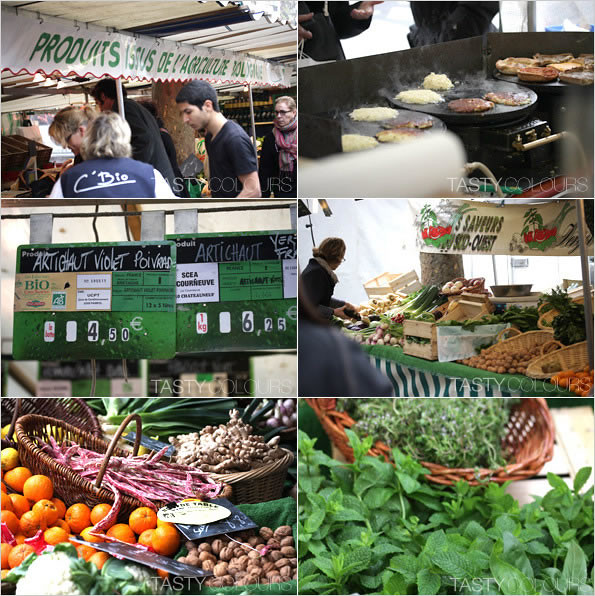
A posh organic food market at Boulevard Raspail. This market is famous especially amongst American and Japanese tourists. If you are there around noon, it is very probable that in the crowd you will hear people speaking English and Japanese rather than French. The vendors do not protest about having pictures taken as they are used to foreigners and their cameras. Be prepared to see some famous actors and bobos, and so on. There is a wide range of organic vegetables, fruits, herbs, milk products, cheeses, fish, vegetarian and vegan dishes; meat, dried fruits, beauty products, wines, olive oils and so on. Some genuine Parisians do not advise to do your shopping there, as allegedly certain vendors sell identical products on the regular food market taking place exactly at the same place on Tuesdays and Fridays, but for less money. I do not believe it is entirely true though. Be aware of pickpockets. Before you start your shopping, I advise you to buy and taste some “Potato Pancakes with Gruyere” sold by two guys who have their stall close to Rue du Cherche-Midi. Eating a fat and warm potato pancake before you start shopping will somehow cut your appetite and will prevent you from buying too many unnecessary, though appealing products (one disadvantage: the long line and the guys are absolutely slow).


2. For meat lovers,

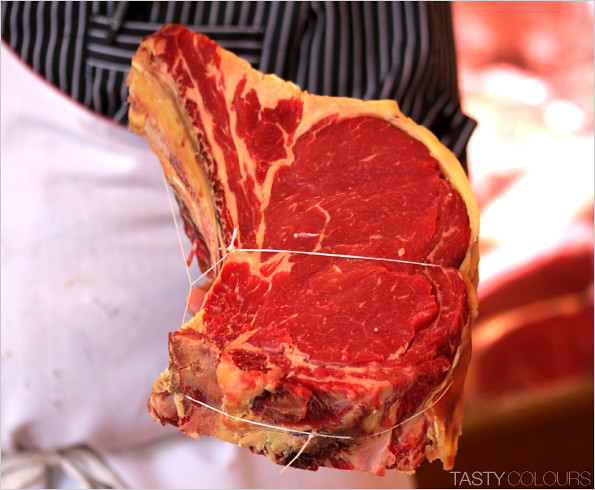
A charming place to visit is an artisan butcher shop, or rather a tiny elegant boutique in retro style of Mr Jean-Pierre Bajon located at 29 rue de l’Abbé Grégoire, between rue de Vaugirard and rue du Cherche-Midi. This nice guy, who has a smile of a Hollywood star, sells top quality meat, poultry, hams, sausages and “produits traiteurs”. “Everything’s natural here” he told me once.  Not only they will slice your meat like a masterpiece, but will also indicate its perfect cooking time and temperature. In addition, one can place special orders. Do not be surprised if you bump into some ex Prime Minister there doing his shopping. In plus, Bajon has a sentiment for Polish people, as two of his interns were from Poland. If you are lucky, you can try his products during “degustations” organized outside his shop. Be cautious when taking pictures, as sometimes Mr Bajon gets a bit tired of his fame and complains about cameras... More about Mr Bajon in one of my coming posts.

If you like old fashioned meaty preparations, you should visit Gilles Verot, the famous traditional charcuterie located at the beginning of rue de Notre-Dame-des-Champs. His sales staff will help you to discover the classics of traditional French charcuterie. I already was mentioning this guy here. Famous for his traditional “Fromage de Tête” for a certain time now, Verot’s charcuterie products can also be found in New York City, in the trendy Bar Boulud on Broadway. Try his rillettes and terrines, too.


3. For amateurs of culinary news, trends and gadgets,
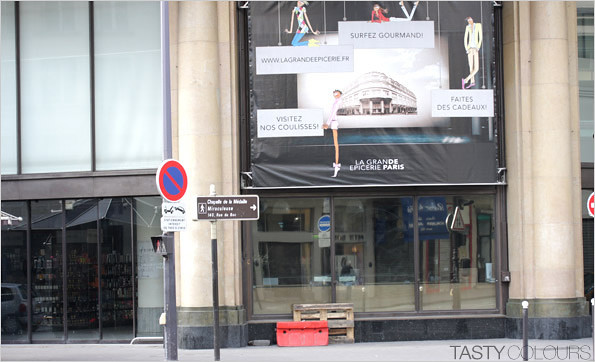
La Grande Epicerie de Paris, 24, rue de Sèvres. It is a large grocery store and it is said to be one of the best in Paris. It will provide you with a great collection of expensive and fancy products. If you want to buy some culinary eatable gadgets for your friends, like funny cookies, fancy fusion soups in jars and cartoons, chocolates, fancy sauces, coffee, tea, spices and foie gras, it is a perfect place to spend 200 € and to leave the store with just a small shopping bag (by the way, Clotilde, the author of “Chocolate and Zucchini” lately wrote that “Parisian grocery stores may hide themselves in comparison to what one can find in Japanese ones”).
I like this shop for its outstanding wine selection at reasonable prices, for example, but on the other hand it becomes more and more mysterious to me why, when I search for a particular item, I do not find it there. That was the case with Italian flour for Italian pasta, Italian cotecchino sausage and graham crackers. They have, however, a great “Traiteur” department, which will provide you with prepared food items from all parts of the World. The Italian corner is good (but why don’t they have this pasta flour - was I mentioning this already?). I never buy fish there (as it is much more money than on the food market), meat (Mr. Bajon is better and besides, their meat department sales persons are masters in ignoring clients); cheese (our “fromager” at the food market is better and cheaper). Be aware that taking pictures is not allowed there.
Further, keep in mind that you actually will get more for your money when shopping on Tuesday or Friday mornings on the market boulevard Raspail. And the quality there is unbeatable.


4. For fans of pastries,

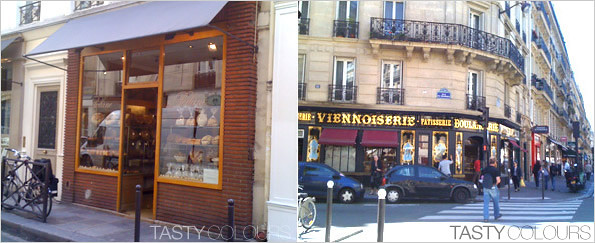
Gérard Mulot pastry shop at the corner of rue de Seine and rue Lobineau (close to boulevard Saint-Germain). This well known, although not glamorous, shop is always open on Sundays. We go there to buy their excellent “pain au levain”, which reminds me of Polish breads. Usually I am so hungry that I also take a “Sandwich Club”, which I eat on my way back home. Gerard Mulot does very good macarons but the range of products is much wider: bread and viennoiseries, savoury items like quiches and tarts, salads, sandwiches, chocolate, ice cream and absolutely fabulous cakes.  Mulot is not as a media-friendly person as Pierre Hermé and his shop is more discreet than for example “La Pâtisserie des Rêves”, which is a new pastry / concept store.

Pierre Hermé at 72, rue Bonaparte: what can I say. Mr Hermé is one of the most famous pastry chefs in France. Everybody should love him and his products. I do not have such a taste for ultra sophisticated confections and I tend to prefer more simple and hearty classical pastries. Besides, although his macarons are quite excellent, I have found my favourite, macaron au caramel et beurre salé, somewhere else…But once in Paris, visiting one of his shops is a must.

La Pâtisserie des Rêves: at 93, rue du Bac (in the 7th arrondissement, actually). This is a new concept of pastry shop opened by the very famous Pastry Chef Philippe Conticini. The place was already a legend before its opening in September 2009 as numerous articles in the Press and on the web prepared Parisian foodies to rush there. Old fashioned, or rather, classical cakes have endured a huge lifting (or plastic surgery?).They are displayed under glass cloches. Whoever wishes to follow trends in pastries should visit this place and try one of their confections.

Ladurrée at 21, rue Bonaparte. I believe I do not have to introduce them. Famous for their macarons, which I like a lot, the rest of the products, in my opinion, do not always offer the same quality. In particular, their millefeuilles look nice but do not taste as deliciously as they appear.

For fans of bread,

Gérard Mulot mentioned above. Try his “pain au levain”, which reminds Polish breads.

Pain Poilâne at 8, rue du Cherche-Midi. Probably the most famous Parisian sourdough bread; you can buy a whole loaf or just a few slices. Try their delicious small rustic apple tarts and croissants. You can “steal” one or two small “sables” (cookies) which are always waiting for you by the cash desk. Following the sudden death of Lionel Poilâne, his daughter, Apolonia, has been running the business. Right next door, the company opened a small Tartine & Wine bar, which is packed like sardine cans during lunch time (despite the fact that their chairs are not comfortable).

Eric Kayser at 18, rue du Bac (at the corner of rue de Verneuil). Baker and Pastry Chef, Eric Kayser is internationally known and operates several shops abroad (Japan, Russia, Greece, Ukraine and so on). His buckwheat bread and baguettes are very good.

Small boulangerie at the corner of rue de Mézières and rue de Rennes: This is my favourite daily bakery shop. Great baguette tradition and excellent pain brioché to accompany foie gras. “They have gold in their hands”, as my husband uses to say. Always a line.


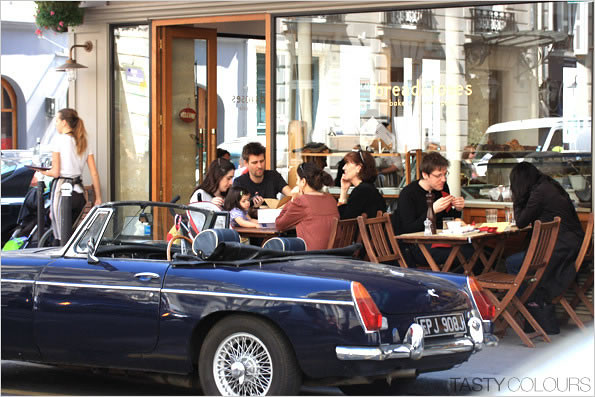
Bread & Roses, a bakery (selling organic breads), lunch restaurant (tarts, quiches and salads) and small grocery store close to the Luxembourg Garden, at 7, rue de Fleurus.

Friday, June 11, 2010

Bye Bye Paris, and Welcome to Kraków


I would like to apologize to my first subscribers that the e-mail subscription to my blog does not work properly. We will try to fix it as soon as possible; however we are leaving to Kraków tomorrow (we will spend there a good few weeks). 1,600 km of driving in front of us, and depending on the weather and traffic, we should arrive there in one or two days.
Before I get my internet connection in Kraków, a few days will probably have passed so I will reactivate my blog only by the end of next week.
You will find new recipes, some culinary reviews from Paris, in particular a photo-reportage and an interview with one of the most famous Parisian artisanal butcher shops, the great Monsieur Bajon in the Sixth Arrondissement!
I also invite you to check some news from the International Festival of Jewish Culture, which will take place at the end of June in Kraków.

Take good care, people !

Friday, June 4, 2010

Dumplings (Pierogi) with Lamb, Morels and Demi-Glace


“Following a recipe is like building a house without adequate foundations, architectural plans or professional builders. In the dark”.
Michael Booth, “Sacre Cordon Bleu. What the French know about cooking”

Around 2 years ago in one American bookstores in Paris (Village Voice), I found a book, the title of which caught my eyes straight away:  “Sacré Cordon Bleu. What the French know about cooking”  by Michael Booth, a travel writer and journalist. Michael had moved to Paris to study at Le Cordon Bleu,  after having burnt all cookbooks except for Ma cuisine of Auguste Escoffier's. This intelligently, very informative, non pretentious and funnily written book describes his culinary adventures in Paris and in this cooking school. He decided to study the Culinary Art Program, after numerous failures in following cookbooks’ recipes which did not help him to acknowledge techniques and had not empowered him to cook.

Do you share this opinion that, if you strictly follow a recipe, you have a great chance of failure to burn your meat, to dry out your chicken in the oven, to spoil your crème patissière and to overcook your risotto? But in particular, as regards complicated preparations and complex dishes, cookbooks are even less helpful; because they fail to explain the recipe exactly at the moment where a problem starts (it is the same with books for lawyers usually). Why it is that, beginner cooks so often complain about their failures when following cookbooks’ recipes? In my case, the biggest practical knowledge I gained comes from my husband, who, when he was younger, spent years as a cook and a pastry chef in French restaurants in Los Angeles and New York City. He taught me such obvious and non obvious things like to put a dump paper towel under your cutting board once you chop and slice; he showed me professional cutting techniques and some preparations; he supervised me on how to organize your working table and kitchen without making a mess (although, still, it does not always work) and he gave me lessons of homemade veal stock, for example.

Those few ideas that Michael Boot gives in the introduction to his book, are remarkable.
“…The failings of recipe books are inevitable; however it is not the writers’ fault.
Most cookbooks are written with the best intention at heart, usually by highly skilled cooks, and their recipes are properly tested, but how can Jamie Oliver possibly know the exact condition, size, ripeness, tenderness or colour of the ingredients you will be using?
How they can know how efficient your oven is or how cold your fridge is? How they can know how thick your frying pan is, or the quality of meat you are using?
How do they know temperature of your kitchen, or whether you like to cook with a window open, that your Kenwood has seen better days and doesn’t quite whisk the gusto it once had, or that your grill is so caked in grime  that it can barely muster half the heat it ought to?...
….And these are merely the issues that plague the well – written, thoroughly tested recipe books. What about all those cobbled together recipes in the back of women’s magazines and the Sunday supplements, or those dodgy posting on the Internet, on blogs and notice boards that many home cooks have started to use more and more?
Some times recipes do work, of course, but those occasions are, I suspect, more to do with a blessed alignment of the culinary planets than any rigorous intent on the part of the cookbook writer. But even when recipes do work, cookbooks rarely, if ever, empower you to cook. It took me years of harrowing kitchen failures to realize that this, but a proper cook knows techniques rather than formulas; a proper cook can look at a plate of raw ingredients and conjure an infinite repertoire of dishes. A proper cook, I eventually convinced myself, needs just one cookery book: Auguste Escoffier’s Ma cuisine…”

And as regards today's recipe: at the beginning of my blogging experience I wrote about Pierogi and I presented two popular and rustic versions of this dish: a savory cheese-potato-onion version “Pierogi Ruskie” and a sweet version  "Pierogi with Bilberries".

The Pierogi concept, or rather the idea (like Italian raviolis, for example), has endless opportunities for experiments with various stuffing. But during decades of a communism regime we could only “enjoy” their more simple rural versions. Pierogi with meat fillings are one of the most common versions and you will find them in nearly every food shop (frozen or cooked), fast food bars at gas stations, cantinas and restaurants. Pork meat is often used for stuffing, but beef and veal are used as well. However you can use any type of meat you desire: chicken, turkey, duck, lamb. You may even use fish as well. Traditionally, meat is firstly baked or cooked (you can use leftovers from dinner), and then grind it before stuffing. When I was a teenager, I called Pierogi with meat “a review of a week”. One could never be sure what type of meat leftovers had been used for stuffing in a school cantina or a low quality bistro at a railway station.

For a long time, I had in my mind the idea of Pierogi stuffed with lamb’s meat (easy to buy in France) and served with fresh morels (or at least, frozen ones - those one can find in every Picard store). So when the morel season started last month and when I saw those fresh mushrooms at our food market on boulevard Raspail, I agreed to ruin my daily food budget and decided to buy a small quantity of them (because they are so expensive, if I remember well, around 120 € per kilo). The season for fresh morels is short. That’s why you can use frozen or dried ones (dried morels can be reconstituted by soaking them in water). Eventually, you can experiment with other forest mushrooms.

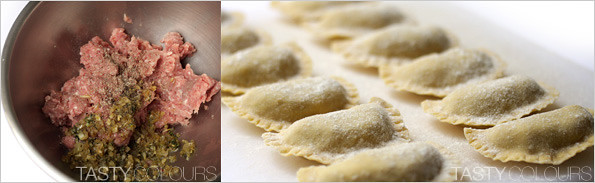
This time, instead of preparing my Pierogi the traditional way, I stuffed my dumplings with raw, ground meat, the way Russian Pelmeni are done. The main reason for doing so was that I wanted to avoid spoiling this delicious lamb meat by cooking it twice.

We served them with a homemade Demi-Glace  (I will share with you this great recipe in one of my following posts).  I realize that veal stock is a kind of preparation that it is difficult to make at home (for example, in some countries you will not get any veal bones in any store) and those industrial powdered stocks are hopeless. The authentic, homemade veal stock itself may not be very interesting in taste. But what is fascinating about it, once you combine it with other flavors, like for example, the juice from these lamb’s pierogi, it becomes something absolutely outstanding. If you do not have homemade veal stock, feel free to use just mushrooms, some extra melted butter, some more fresh thyme and some hard, grated cheese (I used some Oscypek, but every hard,  sheep’s cheese, will be good). You can serve them eventually just sprinkled with some fresh, chopped mint, if you do not like mushrooms.

Dumplings (Pierogi) with Lamb, Morels and Demi-Glace

Serves 4 (makes between 30-40 Pierogi depending on their size)

Ingredients:
500 g ground raw lamb meat
3-4 medium shallots, peeled and finely chopped
2 garlic cloves, peeled and finely chopped
2 tablespoons fresh thyme
200 g fresh morels (optionally, you can use dried or frozen)
50 g grated Oscypek or any other hard, salty sheep’s cheese (optional)
200 ml homemade veal stock (optional)
3 tablespoons olive oil
2 tablespoons butter
Salt
Pepper

Preparation:
Start with the preparation of morels. Clean them delicately, wash them and dry them out with a paper towel.
In a hot frying pan, add olive oil and fry shallots, after five minutes add garlic and thyme and fry until gold on a medium flame. Mix often and do not let them burn.
Put aside.
In a bowl, mix lamb’s meat with fried shallots, garlic and thyme. Salt and pepper.
Mix everything delicately and taste.
Put the filling aside and, in the meantime, prepare pierogi dough as described in the basic recipe. You can roll out the dough a bit thicker (you will stuff your Pierogi with raw meat and they have to be cooked a bit longer than normally).
Once Pierogi are ready for cooking, put them aside (be careful, they should not stick to each other) and cover them with a dish towel (so they will not dry out).
In a large saucepan, bring to a boil 4 liters of water and add a bit of salt.
In the meantime, in a hot frying pan, melt butter and add a bit of olive oil. Fry mushrooms on a quite high flame, until gold.
Pour the veal stock into a small saucepan and reduce it to around 2/3 of its volume. To intensify the stock’s flavor, you can put one or two morels into it few minutes before the end of reduction.
Once your sauce and mushrooms are ready, add Pierogi (but remove the table cloth, of course) into boiling water (10 to 15 pieces at a time). Cook Pierogi about for 5 minutes. The best way to check whether the meat is cooked is to take one dumpling and simply taste it.
Serve immediately with the warm veal stock and morels, sprinkled with a bit of grated cheese. These Pierogi also taste wonderful when grilled for a few minutes after cooking.

Cost:
Lamb – 11 €
Morels – 24 €
Remaining ingredients (flour, eggs, thyme, shallot, garlic, a bit of cheese) - 2 €
Veal stock – we had some in stock in our freezer (anyway, you do not buy bones in France, you get them for free)

Wednesday, May 26, 2010

“S” Like Sandwich and Sandwich Spread


Sandwich is a very popular type of food preparation in Poland. Already in 1860, the author of the first famous Polish cookbook, Lucyna Ćwierciakiewiczowa, mentioned small tartines topped with baked venison, pâtés, hams, salmon and sardines, served on elegant parties.

Now, in Polish we use the word “kanapka”, which describes a sandwich made of two slices of bread with one or two fillings between them. It is also used to describe one slice of bread with a topping or several toppings, which is called an open sandwich.

One can find more sophisticated or expensive toppings in fancy stand-up parties nowadays too. But first of all, simple sandwiches, using ingredients that are with easily accessible, are served on a daily basis in nearly every Polish home. It is a fact that slices of bread topped with cheese, sausages, ham, pâtés, or spreads (curd cheese, other cheeses, eggs or smoked fish mixed with favorite ingredients and placed on a sandwich) and some vegetables is the most popular version of Polish style breakfast ("śniadanie"). In many homes, especially those where families follow the traditions, people often eat sandwiches for supper as well. This is due to the fact that “obiad”* is the main meal whereas dinner is not. Obiad usually is eaten between 2 p.m. and 3 p.m. Of course, the younger generations living in large cities often adopt different culinary habits, closer to those one can find in Western European states. They eat lunch in place of “obiad”, and a hot dinner as a main meal, which slowly replaces traditional Polish sandwich dinner.

I grew up on Polish style sandwiches. When I was a kid, breakfast usually consisted of open sandwiches. They were followed by a second sandwich, a closed one, which was eaten at school as a “second breakfast” ("drugie śniadanie" - as we say in Poland), around 11 am. This sandwich was prepared by the parents, was wrapped in paper and often accompanied by an apple. In the seventies and in the early eighties I did not know hamburgers, the only fast food I knew was French frites or hot dogs, but they were not served in schools (and I believe, they still are not).  Bananas were not available at that time, as they were luxury products. Oranges were usually coming from Cuba, and they were sour, green and often non-eatable.
In high school (or rather, lycée), a sandwich was as valuable as a U.S dollar because nobody would survive until “obiad” without one, and only a few parents were still preparing sandwiches for their kids.
Then, often the third set of sandwiches was served for dinner (in Polish “kolacja”), around 6 or 7 p.m.

At the beginning of the eighties, my family became the happy owner of a miniscule Fiat 126P (by the way, it had been stolen one day and found on the following day) and thanks to that, we could travel all over Poland during the holidays without using any trains, which were dirty and overcrowded. My mom was always preparing a provision of tens of sandwiches and hard boiled eggs.

Besides, sandwiches (or "canapés") were mandatory served not only at family meetings, but also on special occasions: birthday parties, name day celebrations (which are important in Poland, too), office’s conferences and trips. It was incredible, even a one or two hour train trip required extra food, and right after a train left a station, one could hear around rustling of paper coming from unwrapping sandwiches. Some older people kept this sandwich habit until today.

When I was working as a corporate lawyer in Kraków, we had been spending hours on preparation of due diligence reports outside the law firm, having sandwiches served for an early lunch, by local canteens. Fixing some businesses in public administration offices or courts’ administration buildings, I could easily notice that a sandwich, like a client, was an inseparable “part” of the office ambience, presenting itself proudly on plates next to a cup of tea or coffee, sipped all day long by office clerks.

In these circumstances, it rather is not easy not to have any sentiment for sandwiches. Well, I do not eat them, now, three times per day, like when I was a kid, but still quite often I have them at least for breakfast. As opposed to my French husband, who is a pain-au-chocolat guy, I prefer salty breakfasts and bread with savory toppings than tartines with fruit preserves. And when we’re travelling with our car from Paris to Kraków, I always prepare a whole box of various sandwiches.

The most popular topping for Polish style sandwiches is cheese and charcuterie: sausages and hams, tons of which you will find in every food store. I only wished that the quality of charcuterie (Poland has great traditions in preparation of smoked hams and sausages), did not become a victim of industrialization after the collapse of communism. Unfortunately, there exist thousands of industrially made hams and sausages with artificial flavors and chemical additions, meaning products of a lower quality. Good quality charcuterie costs a lot of money. Products from the best producers, using traditional methods, are very rarely available in shops, as usually most of their production supplies good restaurants.

And despite many chefs whose opinion is that sandwiches are like “a drug for a hungry crowd”, I like sandwiches. What about you?

Today’s proposition of sandwiches is based on other Polish flavors and ingredients: Polish style curd cheese (tvarog) which may be replaced by cottage cheese; this cheese is mashed and may be mixed with chopped ham, sour cucumbers, raw spring vegetables, crayfish, smoked fish, horseradish, fresh herbs and eggs (this is what we call spread – “pasta” in Polish). They usually are seasoned with some fresh herbs, salt, pepper, caraway and powdered paprika. You can mix all those ingredients according to your liking.

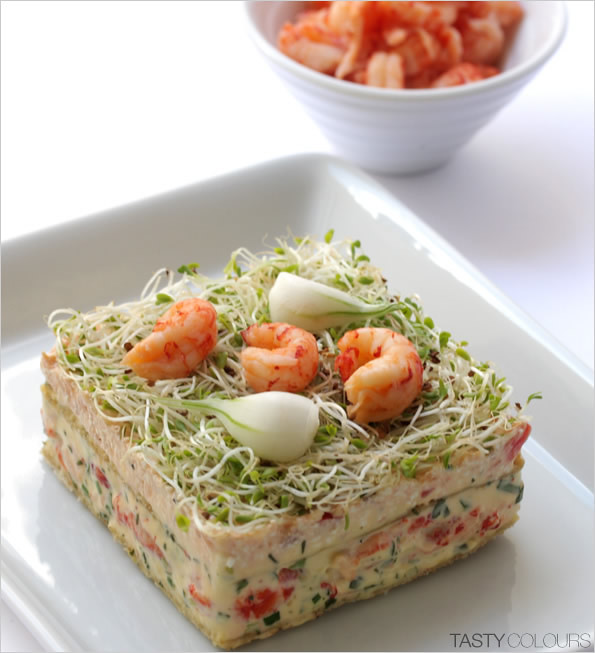
I prepared my sandwiches using professional rings, which I bought a couple of weeks ago since I really wanted to use them. However, do not think that I usually spend hours preparing sandwiches like these. I rather prepare them in a couple of minutes, mixing quickly my ingredients.

You will find below some ideas for Polish style sandwich spreads. In general, they consist of easy-to-find ingredients (except for crayfish and bryndza). The proportions that I am using are for 1 huge sandwich or 2-3 small ones. You can use this spread idea to make one layer simple sandwich (this is how I usually eat them), just topped with some chopped vegetables and herbs.
The method of preparation of spreads is very easy: in a bowl, just mix all ingredients until the mixture is homogenous. Finally, season with salt and pepper, or other spices, according to your taste.

I decided to play a bit with my rings and here you have three examples of double layered, a bit posh (that’s what I have heard), sandwiches.

I did not calculate any cost for these recipes. Usually you use a bit of this and that to do your sandwich.

Polish Style Sandwich Spreads


Cucumber – radish

Ingredients:
2 heaped tablespoons Polish style curd cheese (to buy in stores carrying Polish or Russian food), or cottage cheese**
1 tablespoon natural yoghurt or cream
1 tablespoon radishes, finely chopped
1 tablespoon peeled cucumber, finely chopped
1 teaspoon chives, finely chopped
Salt
Pepper
A few drops of lemon juice

Smoked Mackerel

Ingredients:
3 heaped tablespoons smoked mackerel (or sprats or sardines)
1 tablespoon good mayonnaise
1 teaspoon Dijon mustard
1 teaspoon chopped green onions
Salt

Hard Boiled Egg – Horseradish

Ingredients:
3 heaped tablespoons chopped hardboiled egg (1 big or 2 small eggs)
1 tablespoon natural yoghurt or cream
1 teaspoon shredded horseradish
1 teaspoon finely chopped shallot
1 teaspoon finely chopped dill
Salt
Pepper

Tomato - Bell Pepper

Ingredients:
2 heaped tablespoons Polish style curd cheese (to buy in stores carrying Polish or Russian food), or cottage cheese**
1 tablespoon natural yoghurt or cream
½ teaspoon tomato concentrate
1 teaspoon finely chopped, fried onion
1 teaspoon red bell pepper, finely chopped
1 teaspoon tomatoes, finely chopped
2-3 drops of Tabasco
Salt
Pepper

Green Herbs

Ingredients:
2 heaped tablespoons Polish style curd cheese (to buy in stores carrying Polish or Russian food), or cottage cheese**
1 tablespoon natural yoghurt or cream
1 tablespoon delicate mustard
1 teaspoon dill, finely chopped
1 teaspoon chives, finely chopped,
1 teaspoon fresh estragon, finely chopped
A few drops of lemon juice
Salt
Pepper

Ham – Cucumber 

Ingredients:
2 heaped tablespoons Polish style curd cheese, or cottage cheese*
1 tablespoon natural yoghurt or cream
1 tablespoon ham, finely chopped
1 tablespoon sour cucumbers (see page XX), finely chopped
1 teaspoon chives, finely chopped
Salt
Pepper
A pinch of powdered chili

Bryndza  - Chives

Ingredients:
2 heaped tablespoons Polish style bryndza cheese
1 tablespoon natural yoghurt or cream
1 teaspoon finely chopped, fried onions
1 teaspoon chives, finely chopped
Pepper


Lemon – Estragon Dressing (best for crayfish, ham and salmon)
Ingredients:
1 heaped tablespoon, good mayonnaise
1 teaspoon finely chopped fresh estragon (you can use dill)
1 teaspoon lemon juice
1 tablespoon crème fraiche épaisse
A pinch of sugar
Pepper

Preparation:
In a bowl, mix all ingredients until dressing is homogenous. Season with salt and pepper according to your taste.
Green Polish – Style Dressing for Sandwiches (makes around 150 ml)

Ingredients:
3 tablespoons natural yoghurt
1 tablespoon shredded horseradish
1 egg yolk (hardboiled)
1 teaspoon mustard (preferably delicate)
1 tablespoon crème fraiche epaisse
1 tablespoon Polish style curd cheese (optional)
1 tablespoon parsley, finely chopped
1 tablespoon green onions, finely chopped
1 tablespoon chives, finely chopped
1 tablespoon dill, finely chopped (optional)
A few drops lemon juice
A pinch of sugar
Salt
Pepper

Preparation:
In a bowl, reduce with a mixer all ingredients until dressing is homogenous. Season with salt and pepper according to your taste.


Double Layered Polish – Style Spread Sandwiches (few ideas)


Cucumber-Radish Spread Sandwich with Hard Boiled Egg

Ingredients (in order of placement starting from a bottom):
1 medium slice of bread
2 tablespoons cucumber – radish spread
Few thin slices of fresh cucumber
1 hardboiled egg, finely chopped
1 tablespoon green herbs dressing
1 medium slice of bread
1 teaspoon mayonnaise
A few slices of radishes
1 coffee spoon scallions, chopped
A pinch of alfalfa sprouts for topping

Mackerel Sandwich with Tomato-Bell Pepper Spread

Ingredients (in order of placement starting from a bottom):
1 medium slice of bread (preferably whole rye)
2 tablespoons smoked mackerel spread 
1 tablespoon chopped red bell pepper
1 medium slice of bread (preferably whole rye)
2 tablespoons tomato – bell pepper spread
1 tablespoon chopped tomatoes
1-2 slices of smoked mackerel
1 teaspoon shallots
One or two pinches finely chopped chives

Crayfish Sandwich with Tomato – Bell Pepper Spread

Ingredients (in order of placement starting from a bottom):
1 medium slice of bread
50 g crayfish meat mixed with 2 tablespoons lemon-estragon sauce 
1 medium slices of bread
2 table spoon tomato-bell pepper spread
1 table spoon alfa alfa
1-2 scallions, chopped


* obiad – a main meal in traditional Polish culinary tradition – usually consisting of a soup, a second course (non-vegetarian and vegetarian dish)
**if you use cottage cheese, do not like yoghurt – it will be too liquid
Related Posts Plugin for WordPress, Blogger...