Tuesday, January 11, 2011

About Parisian Swimming Pools and One Beef Which “Likes to Swim in White Wine”

Firstly I would like to inform Polish speaking readers that, from now on, I will publish, in every new post, a Polish version of each recipe, however, I cannot start working on a full Polish version of the blog for the moment and I hope that you will forgive me for that.
Do polskich czytelników: od dzisiaj w każdym poście, będę umieszczać również przepis w języku polskim. Niestety nadal nie jestem w stanie uruchomić polskiej wersji bloga i mam nadzieję, że mi to wybaczycie.
Well, I have to complain a bit today. I love to swim. This is the only sport that I like and that I practice frequently.  Every time I am back in Paris I am exposed to a danger: swimming in public pools in Paris is a risky activity. As I cannot afford to belong to a private club, I am doomed to use those pools maintained by local authorities. There are three public pools in my neighborhood. Two of them are so hopeless that I resigned using them after one visit. The third one, under the Montparnasse Tower, is acceptable, although far, far away from being ideal. First thing – one cannot be sure whether the pool is open or closed. The opening hours for the public are displayed on their web page but in last two weeks, I kissed the locked door three times when I arrived there. For example, the pool was closed at 4 p.m. instead of 22 p.m. due to “the risk of snow”, as they said. It was not snowing, but just raining, but “the risk” was apparently high enough for the staff to just decide to close the establishment. Well, once you are lucky enough to enter the pool, there are some “surprises” waiting. Firstly, it is not very clean there. Actually, I could hardly see anyone wiping the floors there. Finding water and hair in cabins is the less shocking stuff one might experience. I like French for the fact that they are not a prudish nation in general. But why their non-prudish mentality must be shown in a situation where both men and women have no other choice but to use common showers? The pool is extremely crowded. Rough behavior, kicks and dangerous racing between people is what you can expect there. But still, I continue to go there three to four times per week.
Writing about swimming reminds me of one dish that we recently cooked - meaning beef “swimming” in huge amounts of white wine and veal stock. The recipe comes from Gerard Depardieu, who is not only famous for being an excellent actor, but also for his love for food and wine as well as for his hot-blooded temperament. Some time ago, for example, I read about his latest excesses in Paris: he bumped a car, which was allegedly parked on “his” parking place, rue de Cherche-Midi, where he bought a building, currently under renovation, which will be dedicated, in a close future, to young artists. I decided to go for the recipe because of the white wine, which is quite unique, as beef is usually cooked in red wine.
A few years ago Depardieu published in France his own cookbook titled “Ma Cuisine. The book is now available on Amazon only; I do not have it at home. However, I found the Depardieu’s recipe in Michael Booth’s book, which I made a review of a few months ago. I do not know whether Michael made any changes to the original Depardieu’s recipe. I was tempted to make the dish a long time, but did not find any occasion - as you might remember, I was so busy lately that I was eating simple stuff. The right time came for the dish two weeks ago, when my husband and I were having a hard time to invent a menu for Christmas lunch, for our family. You should have seen his face (my husband’s of course), when I showed him the recipe: “I do not like this recipe”; “it is not appropriate to cook rump for four hours”; “it will not work”, “it is not possible to cook the meat without lifting the lid because you cannot see what’s going inside of the pan” and so on, and so on. 
Finally, I convinced him. That was a good decision - the meat was excellent. A few remarks: we cooked the meat a bit shorter (for around 3 h 15 minutes) but I agree that if cooked for four hours, it would have been be even greater. Contrary to what is indicated in the recipe, I lifted the lid two or three times to check whether the meat was covered with juices. We did not use rump, but a piece form the shoulder (called macreuse) which is a bit cheaper and very suitable for braising; further, we used only one type of bacon (we could not find the bacon with rind, as advised in the recipe). And yet, on the second day, we reduced the sauce a bit more, because in our opinion it was a bit too liquid, which is a matter of individual taste really. The meat was pretty delicious when we served it to the family, but I have to admit that it was better on the next day, and even on the third day (we had a lot of leftovers). We served it with boiled potatoes, cut into cubes, with butter, a bit of olive oil, fresh thyme, lemon juice, salt and pepper.
Here’s the recipe according to Michael’s book. The picture, however, is not great. I made it on the fourth day, when I had two pieces of meat left. It should not discourage you. Bon appétit! Que c’est bon!
Gerard Depardieu’s Beef in White Wine Sauce
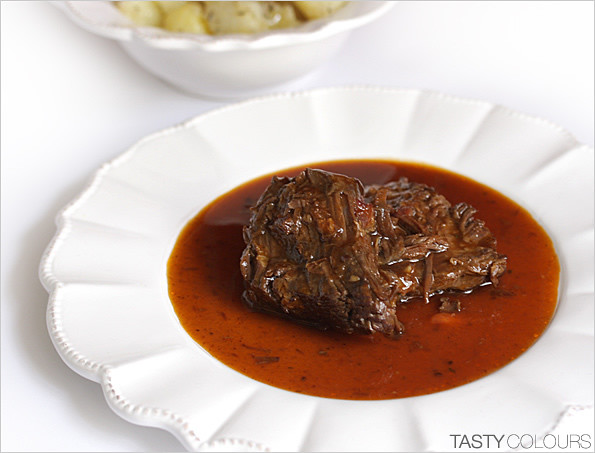
Ingredients (according to Michael: serves 4; in my opinion it will serve 6 quite hungry people)
250 g streaky smoked bacon
1 kg beef, rump or shoulder
60 ml brandy
4 small carrots
4 shallots
2 garlic cloves
Half a calf’s foot, cut into slices by your butcher
1 onion, peeled and studded with 2-3 cloves
Bouquet garni (thyme, laurel – preferably fresh)
Salt and freshly ground black pepper
400 ml dry white wine
Freshly ground nutmeg (according to taste)
500 ml veal stock
A bunch of parsley
1 Cut the fatty bacon into strips and briefly freeze. Using a sharp knife, make holes in the beef and insert the bacon strips into them (you will not use the whole bacon; use the rest according to the recipe). Place the meat in a bowl and pour over the brandy, then cover and leave to marinate in the refrigerator for about two hours, turning frequently (well I did not do that, because I left the meat in the fridge overnight).
2 Cut the rind from streaky bacon and set aside. Finely dice the bacon, peel and slice the carrots and shallots. Peel and finely chop the garlic.
3 Brown the diced bacon in a large frying pan until crispy, without using additional fat (but be careful not to burn it). Remove the beef from the marinade, pat dry and add to the bacon with the calf’s foot. Brown the meat well on all sides. Remove the pan from the heat and remove the contents of the pan.
4 Place the carrots at the base of the pan. Return the diced bacon, beef and calf’s foot to the pan, then add the shallots, garlic, onion studded with the cloves and the bouquet garni. Season with salt (but not too much), pepper and a pinch of nutmeg. Pour over the wine and veal stock, then cover and simmer gently for four hours. Do not lift the lid during cooking (I did few times and nothing wrong happened).
5 Wash the parsley and shake dry, remove the leaves and chop finely. Before serving, remove the onion studded with cloves and the bouquet garni from the sauce, then take the beef and the slices of calf’s foot in slices. Arrange both kinds of meat (to be frank, we threw away the pieces of calf’s foot as they did not have meat) with the vegetables on a warmed serving dish and sprinkle them with the parsley. Skim any fat from the sauce, using a slotted spoon or a chinois and other remaining, then either pour over the meat or serve separately.
We served it with boiled potatoes, cut into cubes, mixed with fresh thyme, butter, a bit of olive oil, salt, pepper and lemon juice.

Polish version
Wołowina duszona w białym winie według Gerarda Depardieu
Przepis Gerarda Depardieu, autora książki „Ma cuisine”, opublikowanej kilka lat temu, pochodzi książki z Micheala Booth’a, o której pisałam kilka miesięcy temu. Do sporządzenia dania potrzebny jest fond de veau (veal stock) (przepis w języku polskim zamieszczam poniżej)
Składniki (według Michaela – 4 porcje; według mnie – 6 porcji dla średnio głodnych osobników)
250 g wędzonego boczku
1 kg wołowiny (rumsztyk, łopatka) lub inna część, nadająca się do  duszenia
60 ml brandy,
4 małe marchewki
4 szalotki
2 ząbki czosnku
½ ratki cielęcej (w kawałkach)
1 cebula, obrana naszpikowana paroma goździkami
Bouquet garni (tymianek, liść laurowy – w miarę możliwości świeże)
Sól i świeżo zmielony czarny pieprz
400 ml wytrawnego, białego wina
Świeżo starta gałka muszkatołowa (według gustu)
500 ml veal stock – skoncentrowanego bulionu z kości cielęcych przepis poniżej)
Pęczek natki pietruszki
1 Pokrój boczek w cienkie słupki i włóż na kilkanaście minut do zamrażalnika, aby stężał. Ostrym nożem ponacinaj mięso i naszpikuj je słupkami boczku. Włóż mięso do miski i polej brandy, następnie umieść w lodówce na dwie godziny, aby się zamarynowało. Mięso  powinno się dość często obracać, ale ja je zostawiłam po prostu na noc w lodówce.
2 Obierz marchewki i szalotki, a następnie pokrój je w plasterki. Obierz czosnek i drobno go posiekaj.
3 Na patelni zezłoć pozostały boczek (nie dodawaj innego tłuszczu, ale uważaj, aby boczek się nie przypalił). Wyjmij mięso z marynaty, osusz, włóż na patelnię (lepsza jest patelnia nie z teflonu lub rondel o grubym dnie) razem z kawałkami ratki i obsmaż ze wszystkich stron na dużym ogniu. Zdejmij patelnię z ognia.
4 Ułóż marchewkę na dnie sporego garnka. Dodaj boczek, mięso oraz kawałki ratki, a następnie szalotki, czosnek oraz cebulę i bouquet garni. Przypraw solą (umiarkowanie), pieprzem oraz szczyptą gałki muszkatołowej. Wlej wino i bulion cielęcy, a następnie duś na wolnym ogniu pod przykryciem przez cztery godziny. Zgodnie z przepisem w czasie gotowania nie powinno unosić się pokrywki, ale ponieważ robiłam to danie po raz pierwszy, musiałam sprawdzić, czy wszystko jest w porządku i parę razy odkryłam mięso.
5 Umyj natkę pietruszki, osusz i posiekaj drobno listki, następnie przełóż mięso i kawałki ratki (ja wyrzuciłam ratki – nie zawierały mięsa) oraz warzywa na ciepły półmisek. Odcedź sos (łyżką cedzakową lub na sitku o małych oczkach, np chinois)  z nadmiaru tłuszczu i innych pozostałości i następnie polej nim mięso lub przelej do sosjerki.
Danie to serwowaliśmy z gotowanymi ziemniakami, pokrojonymi w kostkę, wymieszanymi ze świeżym tymiankiem, masłem, odrobiną oliwy, solą, pieprzem i sokiem z cytryny.
Oryginalny przepis został odrobinę zmodyfikowany: mięso duszone było  nieco krócej (około 3 godzin i 15 minut), lecz zgadzam się, że smakowałoby jeszcze lepiej, gdyby było duszone 4 godziny, jak wskazuję w przepisie. W przeciwieństwie do wskazówki w przepisie, kilka razy zdarzyło mi się unieść na chwilę pokrywkę aby sprawdzić, czy mięso jest równomiernie pokryte sosem. Na drugi dzień zredukowaliśmy sos (naszym zdaniem był zbyt płynny), choć to akurat jest kwestią gustu. Wołowina smakowała wyśmienicie, jednak była jeszcze lepsza następnego dnia, jak również na trzeci dzień (nie daliśmy rady zjeść wszystkiego w Święta).  Zdjęcie nie jest rewelacyjne, ale robiłam je cztery dni później, kiedy zostały mi dwa kawałki mięsa. Nie powinniście się tym zrażać. Bon apetit !
Veal stock (fond de veau) – zredukowany bulion z kości cielęcych – krok po kroku (zdjęcia znajdziecie tutaj)

We wrześniu prezentowałam na blogu przepis na skoncetrowany bulion z kości cielęcych – zwany „fond de veau” lub „veal stock”, który każdy mięsożerca może zrobić w domu. Zredukowane buliony są podstawą klasycznej francuskiej Haute Cuisine. Dosłowne tłumaczenie słowa “fond: oznacza “podstawę”, “bazę”. Konkretnie – bazę do sosów. Tym, którzy mają dostęp do kości cielęcych, szczerze polecam ten przepis i parugodzinną mękę -  domowy koncentrat nie jest trudny, jest tylko czasochłonny. Plusem jest to, że koncentrat pokrojony w kostki mozna mrozić.  Sam bulion nie ma smaku – natomiast jego dodanie do sosów zdecydowanie podnosi ich walory smakowe. Przepisów na veal stock są tysiące - ja prezentuję przepis mojego męża na klasyczny bulion, bez dodatku tymianku, czy grzybów. W braku kości cielęcych można je zastąpic koścmi wołowymi, ale koncentrat nie będzie tej samej jakości – kości wołowe zawierają mniej subtancji kleistych.

Składniki:
ok 3 kg swieżych kości cielęcych dobrej jakości, porąbanych na mniejsze kawałki, przepłukanych pod strumieniem zimnej wody i osuszonych
4 duże cebule, umyte i osuszone, ale nieobrane; przekrojone na połówki
2 małe puszki koncentratu pomidorowego
2-3 łodygi selera naciowego, umyte i pokrojone w plasterki
3 marchewki, umyte i pokrojone w plasterki
1 duża patelnia o grubym dnie (lub prostokątna blacha o wysokich brzegach)
1 garnek (ok 10 l objętjości – najlepszy jest wąski, lecz dość wysoki garnek)
1 durszlak
1 sitko o bardzo drobnych oczkach (najlepsze chinois, ew gaza)

1. Rozgrzej piekarnik do 220° Celsjusza. Ułóż kości na nieteflonowej patelni lub blasze o podwyższonych brzegach. Włóż kości do piekarnika i opekaj je przez około do półtorej godziny. W czasie pieczenia trzeba uważać, aby kości opiekły się równiemierne ze wszystkich stron, ale nie przypaliły. Dlatego sporadycznie trzeba wyjąć blachę z piekarnika i je obrócić.

2.Gdy kości się zezłocą (po około godzinie), ułóż na wierzchu cebule i piecz wszystko jeszcze około 15 – 20 minut (uważaj, aby cebula i kości się nie przypaliły).W międzyczasie do przygotowanego wcześniej garnka, w którym bulion będzie się gotował, włóż marchewki i kawałki selera.

3. Wyjmij blachę z piekarnika. Włóże cebule i kości do garnka i dodaj koncentrat pomidorowy. Uwaga: podczas pieczenia z kości wytapia się tłuszcz – trzeba go odcedzić najdokładniej jak się da uważając, aby nie wyrzucić cennych skarmelizowanych kawałeczków, które zebrały się na dnie blachy lub patelni. Następnie przystąp do deglazowania: wlej odrobinę wody na dno blachy, następnie na dużym ogniu zeskrob wszystkie pozostałości drewnianą szpatułką. Wlej tę miksturę do garnka z koścmi i warzywami.

4. Nalej wody do garnka (kości powinny być przykryte na około 5 cm – lepiej używać wyższego, lecz węższego garnka) i zagotuj. Następnie zredukuj ogień do minimum i gotuj około 5-6 godzin, tak aby kości oddały cały smak. Sporadycznie wybieraj łyżką cedzakową nieczystościo zbierające się na powierchni (głównie tłuszcz).

5. Używając łyżki cedzakowej, odcedź bullion na durszlaku. Wyrzuć kości, warzywa i wszystkie pozostałości. Następnie, używając sitka o drobnych oczkach (najlepiej chinois) lub gazy, odcedź bulion po raz drugi, aby pozbyć się wszelkich nieczystości. Bulion jest gotowy do użycia. Powinien mieć brązowawo – złoty kolor, coś pomiędzy czekoladą mleczną a karmelem. Na tym etapie możesz przelać bulion do małych plastikowych pojemników i zamrozić go na później.

Możeśz też zredukować bulion jeszcze bardziej, aż powstanie koncentrat zwany demi-glace (instrukcja poniżej) . Wiem, że sosy na bazie demi-glace nie są specjalnie dietetyczne, ale też nie jadamy ich w naszym domu codziennie, a raczej od święta.

6. Jeżeli chcesz zrobić demi-glace, działaj następująco: wlej bulion do mniejszego garnka i zagotuj. Następnie zmniejsz gaz do minimum i redukuj na takim wolnym ogniu około godziny – czas redukcji zależy naprawdę od gęstości bulionu – niekiedy wystarczy godzina, niekiedy trzeba redukować nieco dłużej. Okazjonalnie wybieraj łyżką tworzącą się na powierzchni pianę. Demi-glace jest gotowy, gdy zgęstnieje. Najlepiej przelać odrobinę do kubka, włożyć do lodówki i sprawdzić, czy tężeje. Jeżeli tak, jest to znak, że koncentrat jest gotowy. Demi-glace można przelać do małych, plastikowych kontererków i zamrozić.

Na koniec jeszcze parę wskazówek:

Używaj tylko kości dobrej jakości (im świeższe, tym lepsze). Używaj super świeżych warzyw (mieszanka marchewek, cebul, selera naciowego, czasami również czosnku i szalote. Mirepoix nie powinno zdominować smaku bulionu, tak więc nie dawaj zbyt dużo warzyw (maksymalnie 20 procent w stosunku do wagi kości). Można dodać bouqet garni (świeży tymianek i liście laurowe, czasami z natką pietruszki). Do bulionu nie dodaje się w trakcie gotowania soli ani pieprzu, z uwagi na to, że stanowii podstawę do innych sosów, które będą potem redukowane i przyprawiane (ryzykujesz, że po redukcji bullion będzie za słony). Ważne jest gotowanie bulionu na wolnym ogniu minimum kilka godzin - zbyt krótki czas gotowania sprawi, że będzie wodnisty i bez smaku; natomiast przegotowany bulion stanie się gorzkawy. Nie używaj teflonowych garnków i patelni do pieczenia kości – najlepsza, w przypadku braku specjalnej patelni, będzie blacha o podwyższonych brzegach.

Friday, January 7, 2011

Kulinarny spacer po okolicach Saint-Germain-des-Prés

Dzisiaj zapraszam do lektury mojego artykułu w języku polskim, który został publikowany na vinisfera. pl - portalu o winie i kulinariach. Artykuł inspirowany jest postem, opublikowanym w czerwcu na moim blogu w j. angielskim.  Możecie go znaleźć tutaj
A już w najbliższych dniach o "wołowinie, która lubi pływać w białym winie".

Today, I invite Polish – speaking readers to discover my article published in Polish language on vinisfera.pl –  a portal designated to wine and food. You can find it hereThe article has been inspired by my post published last June on this blog.  And, in coming days, you will be able to read about "the beef, which likes to swim in white wine".

Friday, December 24, 2010

Merry Christmas!


Should you ask me what is my most memorable episode from Polish Christmas when I was a kid – I would not mention a Christmas tree (we always had one, of course), or gifts (which we were offered), or the extraordinary cleaning of the apartment one month in advance, or the preparation of the Christmas dinner for three days in a row (which was actually the case), or not going to school and even not playing and singing Christmas carols, handling family meetings and so on – but rather « hunting » a carp, a soft water fish probably most appreciated in our region, and maybe in China.

In the eighties, when I was a kid, we had been suffering from food shortcomings - I mentioned this to you already. The preparation of tasty Christmas meals was - for a family living in a city like Krakow - a challenge. We had to spend long and boring hours in lines at food stores. A lot of basic food products, like sugar and meat, were in limited supplies. Even to purchase a carp fish was not easy. Additionally, the poor fish were taken home a few days before Christmas Eve and they were being kept alive in.... bathroom bathtubs. This may be the most common picture of any Polish home before Christmas: fish in the bathtub! .... Then the fish was murdered by the parents one or two days before the Christmas Eve. A blister of the fish was placed on a heater so it could explode with a noise to children’s pleasure. The fish's scales were washed, dried and placed in wallets - for good luck in the coming year. Indeed, that was a cruel habit – the animal was killed in a non humanitarian way, which nowadays is stigmatized in some Polish TV campaigns.

As far as I know, the carp was, in old times, a fish for poor people; then, it became an eminent part of Polish culinary traditions after the World War II and a proletariat king on Christmas tables. It replaced nobler soft water fish like sander, eel or pike. On the other hand, due to the development of Polish species of carp (for example, karp zatorski), the carp remained an eminent ingredient of our Christmas traditions. And you know what? I like to eat it once a year.  If you visit Poland right before Christmas, you will notice in nearly every food store a huge bathtub or a plastic pool with carps swimming inside it.

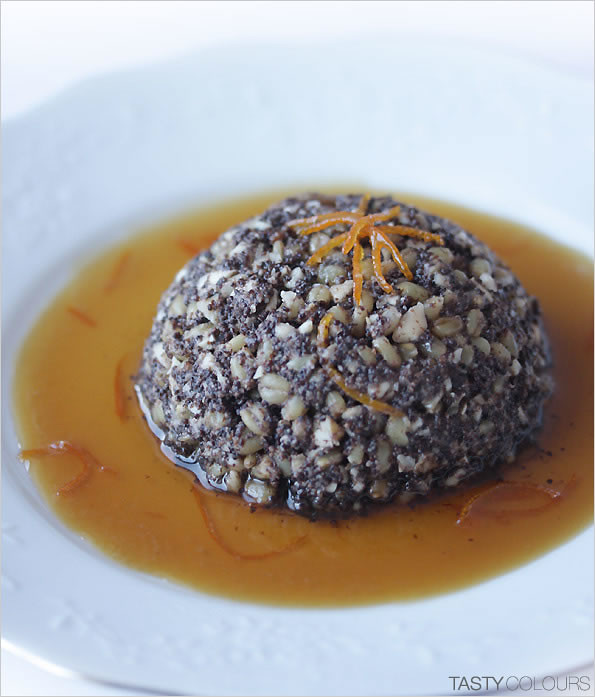
The Polish Christmas Eve (“Wigilia) menu is very traditional. I know of some atheistic families whose Christmas menu is the same as in families practicing the Christian religion (which dictates for example, that absolutely no meat should be eaten during the Christmas Eve dinner). There are some dishes that we (or I) eat once per year, the preparation of which often takes a lot of time. Despite historical changes (like for example the expatriation of people whose families lived behind the Bug river), those dishes will probably be served for the Christmas Eve dessert in some regions of today’s Poland - kutia (a dessert having its origins in the Ukrainian territory).


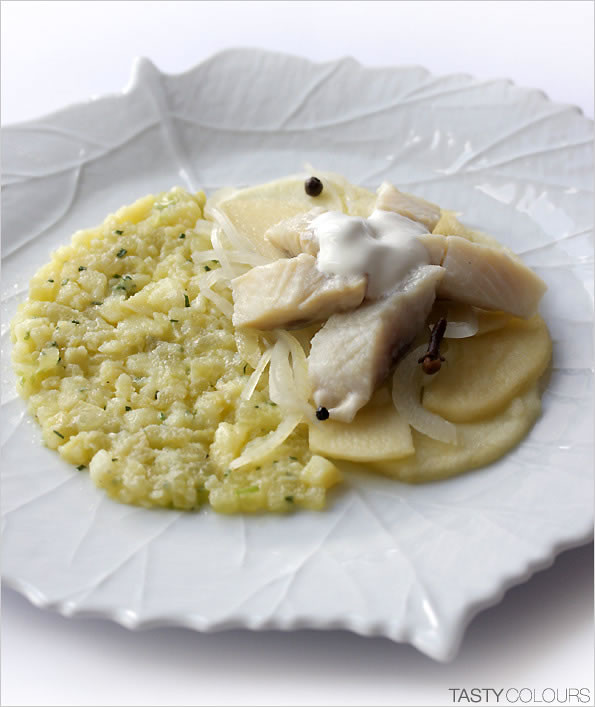
Christmas Eve in my family was preceded by a fast, meaning that we did not eat meat on that day. A light lunch consisted of tasty herrings marinated for a day or two in boiled, white vinegar, spices, onions, sour apples and then served sprinkled with thick cream, accompanied by a potato salad, with  sour cucumbers and chives.


Christmas Eve dinner in many Polish homes and in my family started with a beetroot soup (borscht). In some families, the vegetarian version of a mushroom soup made from dried forest mushrooms is also served; however, the Christmas version of the borscht in my family home varies a lot from a regular one which is made from cooked beets. In general, everything as regards the traditional Polish Christmas Eve may be summarized in a few words: sauerkraut, dried forest mushrooms, carp, beets, dumplings, herrings and poppy seeds.

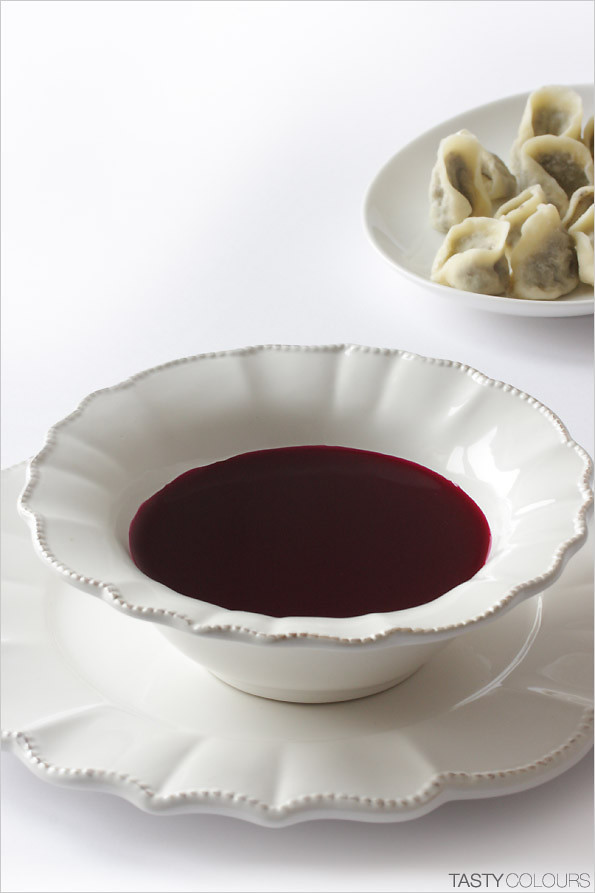
The Christmas borsht soup has been made from a base that had to be prepared a few days in advance (you will find the recipe in this post). The base consists of raw beets, peeled and cut into slices, pickled in boiled, chilled water with garlic, for four to five days. Then this « starter » is mixed with a light broth made from dried ceps and vegetable broth. The soup cannot be boiled; otherwise its color and taste will change. First records about the soup probably date from the beginning of the XVIth century. So, people – eat beets, eat beets! They are not so awful. Even nowadays, the soup in its luxury version is often served in elegant parties, weddings and occasional feasts, although usually with some meat stock.

The common, daily version, usually served with potatoes or hard-boiled eggs, can easily be made within a few hours by simply cooking the ingredients and adding vinegar or lemon juice. However, the traditional way is to prepare the soup several days in advance and to allow it to get a natural sour taste. Of course it is possible to buy a concentrate in shops or on local markets, but homemade base is always better, as you can control the taste and the level of fermentation.

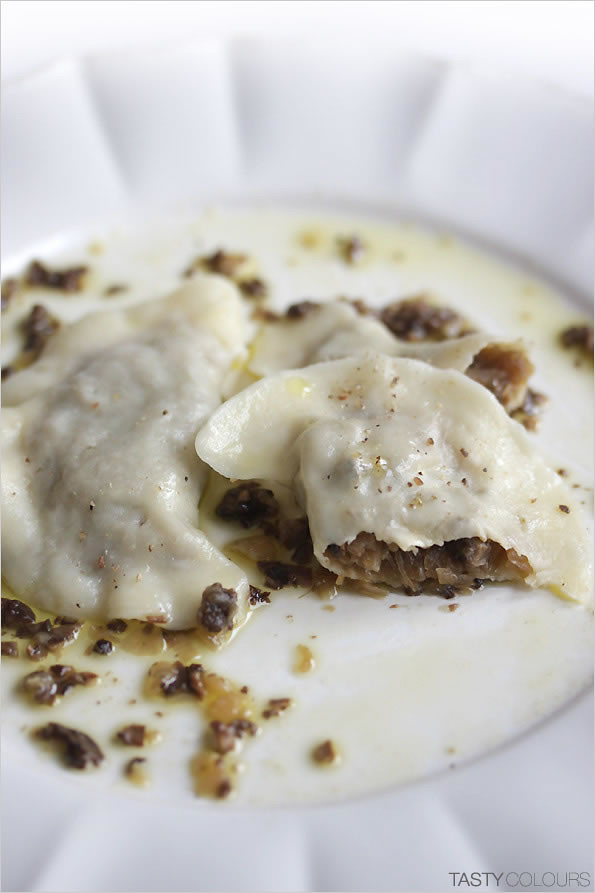
In my opinion, traditional Christmas borscht goes best with tiny dumplings stuffed with a preparation of soaked dried ceps and fried onions. These are called « uszka » in Polish. A direct translation means “little ears” and that is the shape you are aiming for. Some of the secrets to prepare really delicious uszka is to roll-out the dough as thin as possible, to shape them as small as possible, and then, finally, to use dried ceps of a good quality.
It is a pity that those delicious dumplings are practically unknown abroad. Although it is a lot of precious work to do them, I really like to make them (maybe because I do this only once per year). You can order uszka all year round in almost every restaurant serving Polish food. However, they may not be good everywhere. First of all, the uszka dough usually is much too thick, and secondly, cheaper restaurants use a mixture made of cheap button mushrooms and of a small quantity of dried bolets. Therefore, before ordering this dish you should ask first what kind of mushroom has been used for the filling.

After the soup, pierogi (dumplings) stuffed with braised sauerkraut and/or sauerkraut and dried mushrooms often appeared on our table. This is a type of pierogi that one can meet quite easily all year round in Poland, however I eat them usually around Christmas time. In some homes, people eat pierogi with poppy seeds.


Since the early nineties we had been invited to spend Christmas Eve at my mum’s closest friend, Ewa and her family.  This is where I acquired the habit of eating a vegetarian version of the popular “gołąbki” (stuffed cabbage rolls with kasha or rice and dried mushrooms in its vegetarian version).


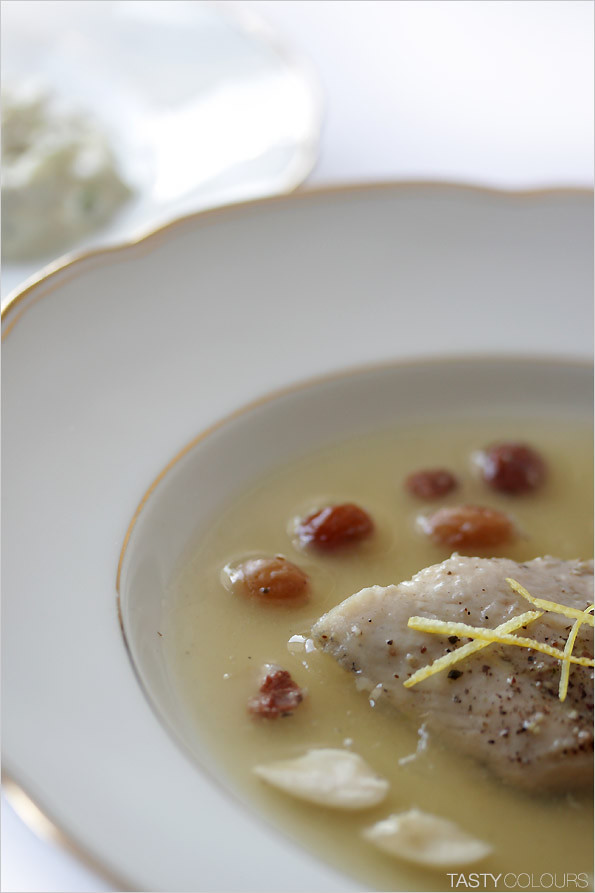
Both at Ewa’s place and in our home, the carp fish was served in two different versions. The first one is a cold fish in jelly, often called Carp Jewish Style – a dish which probably finds its origins in the cuisine of Eastern European Jews. Pieces of fish are cooked slowly with almonds and raisins in a fish stock, then eaten cold with natural jelly and soft bread.
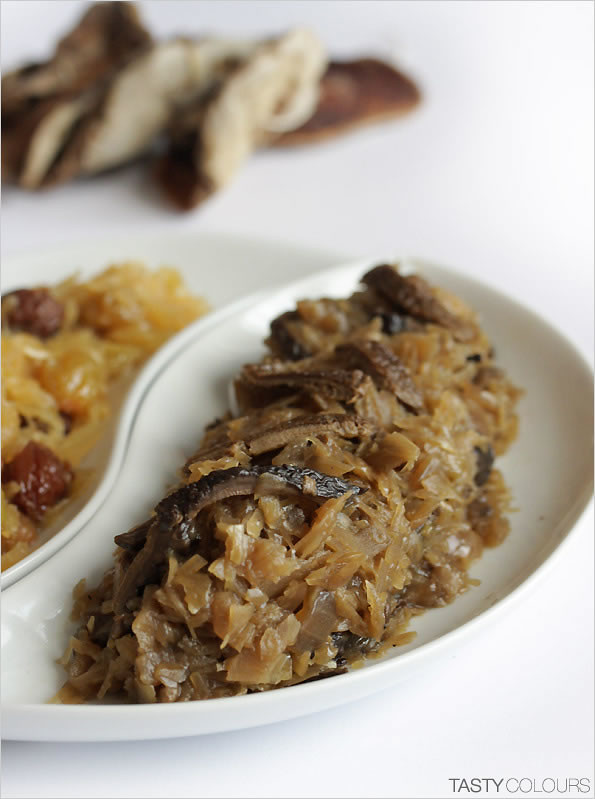
The second carp dish was served very simply, breaded and accompanied by hot sauerkraut with dried mushrooms and raisins, a vegetable salad or a potato salad – and usually nobody spoke a word when eating this fish, as it has a lot of bones.


Christmas Eve’s desserts were less important to me as I do not like sweets too much. Except for one thing: small, buttery pastry dough cookies made from whipped egg whites and from the addition of lemon juice on top, according to my grandma’s recipe. Besides that all those traditional cakes with poppy seeds, dried fruits or candied fruits, as well as kutia - a dessert which came to us through Polish people who were expatriated, after the War, from today’s Ukrainian territories, had no existence for me.


At the end of Christmas Eve, my mum used to serve compote - kompot - a drink made from cooked dried, smoked fruits: plums, apples, pears, raisins, apricots, the purpose of which is to speed-up digestion.

Christmas Days

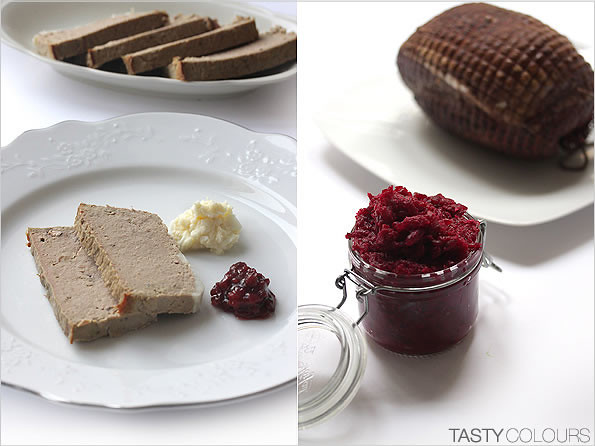
In Poland, Christmas lasts for nearly three days: Christmas Eve (Wigilia), starts at around 5 p.m. (when the first star appears in the sky), it then continues for two more days. A typical and traditional Polish Christmas Day breakfast, which was celebrated in my family, consisted of a good assortment of charcuterie - cooked hams, sausages, pates, served with accompaniments such as pickled ceps, horseradish with eggs, tartar sauce, a spicy and cold beet-horseradish salad called “ćwikła” and lingonberry preserves.


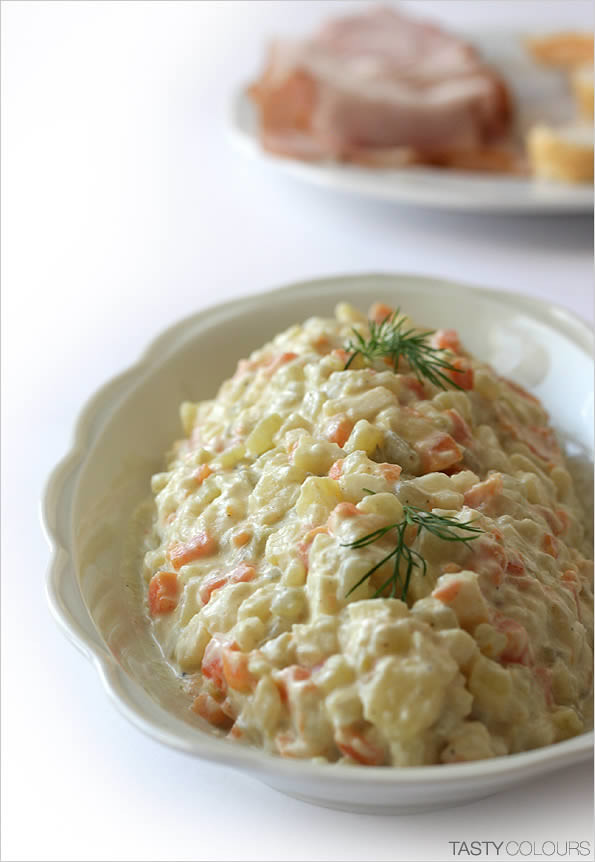
A traditional vegetable salad also comes with all that. It is made from cooked root vegetables like parsley, carrot and celery root as well as potatoes, sour cucumbers and apples.


Then cakes always appeared on our Christmas table. Contrary to Christmas Eve, when meat is not allowed, on Christmas day the main course (obiad) consisted of meat like duck, veal, beef, goose or leftovers of fried carp from the previous day, served with cabbage or with some other accompaniments, followed, again, by cakes and cookies. Then, for dinner, cold charcuterie and accompaniments were served, as they were for breakfast.
In Poland, the second day of Christmas is celebrated as well, and people do not work, so the gluttony continued for one more day, interrupted by family visits and walks.

New Years Eve

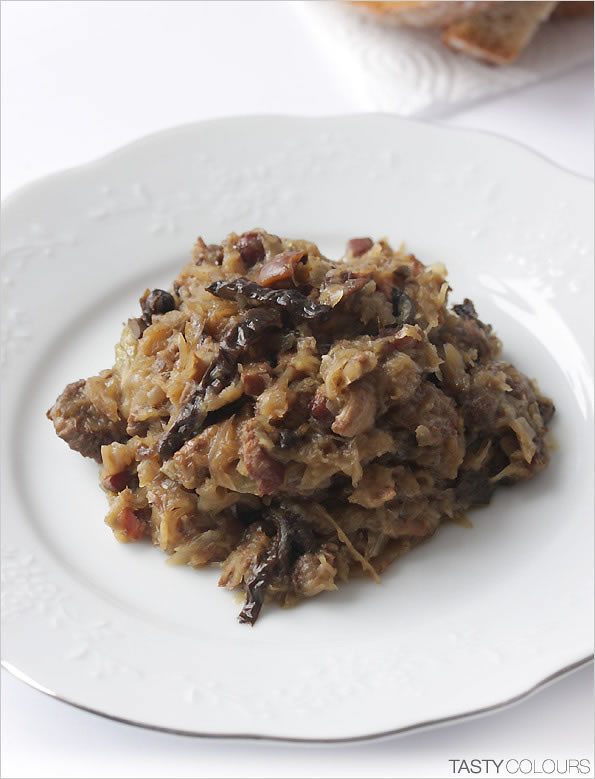
The meaty leftovers from Christmas meals are used to prepare bigos – a hunter stew cooked very slowly (most preferably, for two or three days) using several types of meat, sauerkraut, dried mushrooms, dried plums, red wine and a lot of spices. In its extraordinary version a bigos is cooked in my family between Christmas and New Years Eve, and is eaten on New Year’s day – as a good solution for hangover, should anybody had one.


Bigos is a traditional stew typical of Polish and Lithuanian cuisines. Many consider it to be the Polish national dish.  Indeed, bigos has a long tradition in Poland. Some say that first traces about bigos can be found in the middle ages. It is said that bigos has been introduced to Poland by Jagiełło, a Lithuanian prince who became king of Poland in the XIVth century and founded the long-lasting union between the two states. However, Polish linguists trace the word bigos to be of a German origin rather.
In old times, bigos was stored in every household’s pantries in big stone pots, ready to be served to unexpected guests or as a provision for long trips. Should anyone ask me about the most traditional and the most pauperized Polish dish during the communism – the answer is bigos.  As nearly everything in Polish cooking after the Second World War, this old and rich dish was brutally simplified due to, inter alia, food shortcoming and political concerns. I can remember a version of bigos served in my school cantina as a few slices of meat of poor quality swimming in half-raw sour cabbage. This has nothing to do with real bigos, which needs many ingredients and a long cooking time.  Even today, in many cheap restaurants or “milk bars” you can order an ersatz of bigos, which usually translates into a preparation of cooked cabbage with a bit of sausages. 

There exists many variations of this dish and the one that I present in my book is the one I learnt from my mom.

There is no standard recipe for the dish. There are, however, certain rules to make it properly: it requires a long cooking time; different types of meats are to be used; the addition of dried plums, mushrooms and spices is required. Recipes vary between regions and families. Typical ingredients include sour cabbage, sometimes as well white cabbage, various cuts of meat and sausages, tomato paste and honey, sour apples, mustard and wine.

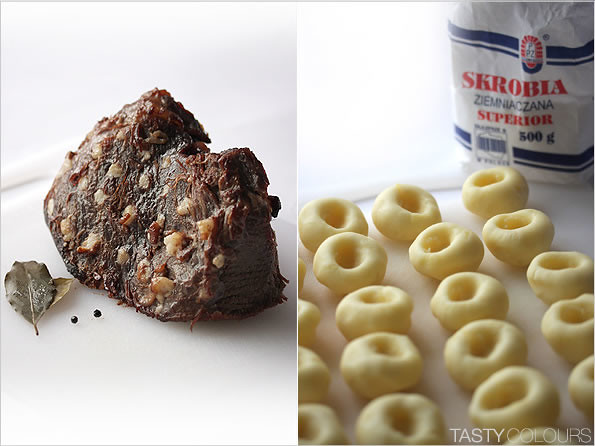
Sylvester dinner was usually celebrated in my family serving a hunter’s style beef tenderloin – “pieczeń wołowa na dziko”. A piece of beef was pickled for two to three days in wine and vinegar, then baked and served with « silesian dumplings » (“kluski śląskie”) - a sort of potato flour oval gnocchi, and lingonberry preserves.


CHRISTMAS EVE BORSCHT
Barszcz Wigilijny


Serves 8

Ingredients:
For the starter (“zakwas”)
2 kg (4.4 lbs) hard raw beets, peeled, washed and cut into slices
8 medium garlic cloves, peeled and cut in halves
1 teaspoon sugar
½ teaspoon salt
2.5 liter (2.6 quarts) boiled and chilled water
1 jar (3 liter (3.2 quart) capacity)
1 gaze or a piece of cotton fabric, to cover the jar

For the mushroom-vegetable broth
40 g (1.4 oz) dried ceps
2 medium beets, peeled, washed and cut in slices
1 root parsley or parsnip, peeled, washed and cut in halves
½ small celery root, peeled and washed, cut into slices
1 carrot, peeled and washed, cut into halves
1 onion, peeled and washed, cut into halves
1 bay leave
5 grains black pepper
2 grains all spice
Salt
Pepper
1 tablespoon lemon juice (optional, if the soup is not sour enough)
1 teaspoon marjoram


1 Prepare the Starter: Place beets in a clean, sterilized jar. Add garlic cloves. Mix water with salt and sugar and pour into the jar. The beets must be completely covered with water. Cover the jar with gauze and put aside at room temperature between 20° to 24° Celsius (68° to 75° Fahrenheit) for at least 5-6 days. Check from time to time. If you notice foam on the surface of the liquid, remove it delicately with a clean spoon and cover again. The base is ready when it has a strong sweet – acid taste. Strain the liquid. Discard beets and garlic. Pour the starter into a jar or a bottle and refrigerate. It may be saved up to two weeks.

2 Prepare the Mushroom Broth: Place the mushrooms in a saucepan and add 1liter (1quart) of water. Let them soak for at least 2 hours (preferably overnight). Cook them in the soaking water, under the cover, for 30 minutes or until they are soft. Strain the liquid and reserve it for the Borscht. Reserve the mushrooms and use them for another dish, for example Raviolis with Ceps.

3 Prepare the Vegetable Broth. In a deep saucepan, bring to a boil 1liter (1quart) of water. Add beets, root parsley, celery root, carrot, onion, bay leave, black pepper and all spice. Cook covered over medium heat until they become soft. Strain and discard vegetables and spices. Reserve the broth.

4 Prepare the Soup: Pour 2 liters (2 quarts) of the starter into a saucepan and add the entirety of the vegetable broth and half of the mushroom broth. Heat up, but do not bring to a boil, otherwise the soup will change in color. Taste: the soup should be quite sour, with a garlic and mushroom aftertaste. If necessary, add a bit more of the mushroom broth. Season with marjoram, salt and pepper and simmer for 10 minutes but do not allow the soup to boil.

A good starter should be transparent, but deep in color and a bit thick in texture. The best is to prepare it from organic beets. There exist recipes where some rye bread is added for faster fermentation. I prefer to prepare my base only from beets and garlic, as nowadays it is not so easy to find whole rye bread without industrial additions. Never add any vinegar to season this version of borscht.

Uszka (little dumplings with dried ceps)


Serves 8

For the filling:

Ingredients:
45 g dried ceps
750 ml water
1 onion or 2 shallots, peeled, washed and very finely chopped
4 table spoons butter
1 table spoon bread crumbs
1 egg white
Salt
Pepper

Soak mushrooms in water for a night.
On a second day, cook them until soft for around 20-30 minutes.
Strain the mushrooms.
Reserve the mushroom water and use, for example, for the borscht or other soup.
Chop the mushrooms very finely and put aside.
In a hot frying pan melt butter, add onions and cook them on a law flame until soft and golden.
Add mushrooms, fry for a minute or two, salt and pepper generously. Put aside in a medium bowl to cool down.
Then prepare the dough for the raviolis (see page XX below)
Once the dough is ready, finish the filling for the raviolis: add bread crumbs and mix.
Then beat egg white and add to the mixture. Mix delicately.

“Uszka” dough (around 60-70 small raviolis)

Ingredients:
200 g flour, sifted ((have some extra flour handy to adjust the recipe and to work the dough and roll it out)
1 egg
½ tea spoon butter
60-150 ml room temperature water (add little by little)
1 glass of 4 cm diameter (for example, champagne or vodka glass)

Sift flour on your working table.
Form a well in the centre of the flour.
Place the egg, butter in the well and mix all the ingredients with as much flour as possible.
Then start adding the water, 2 tablespoons at a time.
Knead the dough so the water is completely absorbed before adding the 2 following tablespoons of water.
Should you add too much water, the dough will become sticky; in that case, add little by little the extra flour until the dough is no longer sticky.
Knead the dough for about 15 minutes; it should become smooth, soft and elastic.
Divide the dough into 3 equal parts.
Place the first part on your working table.
Wrap two remaining parts in a plastic film and put aside.
Sprinkle some flour on your station and start rolling out the dough until it is between 1 and 2 millimeters thick.
Occasionally, flip the dough and sprinkle some flour over it so it does not stick to the table.

When dough is rolled out, cut disks of around 3-4 centimeters using a cookie cutter or, if not available, a champagne glass.
Put the scraps of leftover dough together and gently knead to form a small ball.
Wrap in plastic film and put aside to roll out later.
Place about ½ teaspoon of stuffing in the middle of each disk.
The stuffing must not reach the edge of the disk or it will prevent the proper sealing of the raviolis.
Fold disk in half and pinch edges together – you will obtain a little pieróg.
Using indexes and thumbs join the two tips of the pieróg to obtain a shape of “an ear”, most closely to Italian tortellini.
Should the dough be too dry, it will not seal properly.
In that situation, use a brush to moist the edges of the disk, and pinch them together.
Place “uszka” on a flat dish sprinkled with flour, and cover with a light cotton towel.
Repeat to prepare “uszka” from second and third part of dough and scraps.

Cooking
In a large saucepan (5 liter capacity), bring to a boil 3 liters of water; add some oil and a flat teaspoon of salt.
Drop a few “uszka” at a time, bring again to a boil and reduce flame.
When “uszka” rise to the surface, let simmer another 2 minutes.
Taste one to check that the dough is well cooked.
Do not strain them; use a slotted spoon to remove them from water and place over a paper towel to remove the excess of water.
Serve immediately as an accompaniment to Christmas bortsch.

In this recipe, you can use other dried mushroom, like for example dried boletus. Although they are served traditionally with the borsht, you can eat them as an accompaniment to bullion or mushroom soup. You can even fry cooked “uszka” on a frying pan and served them as a hot starter, served with some butter and parsley.
The precooked “uszka” freeze easily, so you can the excess for other occaision.

CARP JEWISH STYLE
(karp po żydowsku)


Serves 4

Ingredients:
50 g (1.8 oz) whole almonds, peeled and cut into quarters
40 g (1.4 oz) dried raisins (preferably sultana)
600 g (1 lb 5 oz) fish bones (preferably carp heads)
3 medium onions (300 g) (10.5 oz), peeled and cut into halves
1 carrot, peeled and washed
8 grains black pepper
600 g (1 lb 5 oz) carp cut into slices (if unavailable, use another soft water fish like sander or Northern Pike)
A pinch of salt
A pinch of ground black pepper
A pinch of sugar

1 In a small saucepan, bring to a boil 150 ml (0.6 cup) of water, add almonds and raisins and cook them for 5 minutes. Then put everything aside.

2 Remove any scale left from the fish skin. In a large saucepan, place the fish bones and cover with 1.5 liter (6.3 cups) of water. Add onions, carrot and pepper grains. Cover with a lid and cook over low flame for about 1 hour to 1.5 hour. In the meantime, sprinkle the fish steaks with salt, pepper and sugar.

3 When fish stock is ready, strain it using a very fine strainer (preferably, a chinois); collect half the quantity of the onions and reduce them into a purée using a blender, and add to the strained fish stock. Discard all other solids. Add almonds and raisins and their reserved cooking water to the fish stock. Bring the fish stock to a boil. Place the fish steaks into the stock and cook for 10 minutes, or until the color of fish meat changes to white.

4 Remove the steaks from the stock and place them on a deep serving dish or individual deep plates to cool down. Strain the fish stock once again to remove any additional solids; keep almonds and raisins aside. Pour the cooled-down fish stock over the fish steaks; they should be covered completely. Place almonds and raisins around the fish steaks in a decorative manner.

5 Refrigerate overnight so the fish stock turns into a jelly. Serve with quarters of fresh lemon and bread.

Thursday, November 18, 2010

Between Autumn and Winter – Time for Rich Soups

When I created my blog, I promised myself that irrespective of how busy I would be, I will always find time to publish at least one post per week. Today we are in the middle of November and several long weeks have passed since my last post. This is how dreams change into reality – one cannot do everything.
I hope that those five difficult weeks of hard work will turn into my favor in January (this is when the Government will publish results of the competition) and that I will be able to share some good news with you.
I had no time to cook regular, warm dishes, except for my daughter, who – on the other hand – has no taste for anything at the moment. Always no, no, no, not good!
On the contrary, I was eating « in between », meaning quickly, not complicated or simply I was forgetting that I was hungry. I could not believe that it was me, a person, who loves to cook and eat so much. After two weeks my stomach shrank to the size of a dried raisin. I was full after one sandwich and too tired or just too lazy to cook a proper dinner.

Do you like soups?

A few days ago I read an article according to which, in Poland, despite the fact that we own cars, mobile phones and shiny kitchens, the revolution did not affect our culinary habits. According to some statistics (I do not know who prepared them) Polish people, today, cook and eat nearly the same way as our parents did. The only radical change shows that they do not make huge supplies, as we did during the communist era.

Allegedly we eat a bit healthier, but still quite greasy. The standard Polish daily menu is: sandwiches for breakfast (didn't I tell you that in my post about sandwiches), a “nutritive” and rich soup or meat, potatoes and.... sometimes …. salads and vegetables for the main meal which is “obiad”. And again sandwiches for dinner. Only 10% to 15% of Polish society, mostly young, better educated people experiment in their kitchens with food from other countries.

According to the article, Polish people still love to eat soups (always made from meat or vegetable broth) and eat the largest quantities of soups per year in the World (around 72 l per capita). Contrary to the south of Europe, where “veloutés” or “moulinés” are more popular, our soups consist of larger pieces of meat and/or vegetables – partially because this comes from our traditions, partially because of the climate.

I agree that the tradition of eating soups was, and still is, strong. For example, in autumn and the winter, thick soups with “kasha” are popular, as Polish people are used to eating quite a lot of “kasha” grains (for example, barley, buckwheat, and others). In Polish, “krupnik” is the name of a soup with barley, and comes from the word “krupy”, meaning “kasza”, porridge. This type of soup is known from at least few hundred years, therefore it really is a traditional and ancient dish.
“krupnik” is often served to children. I will not exaggerate too much if I state that a lighter version of the soup, with no bone stock, is served to really young kids, under one year old. When I was a kid, I hated it.
In Polish language the word “krupnik” has another meaning as well. It is also a type of sweet honey and herb vodka, which you can find in every Polish liquor store, prepared after a traditional formula.

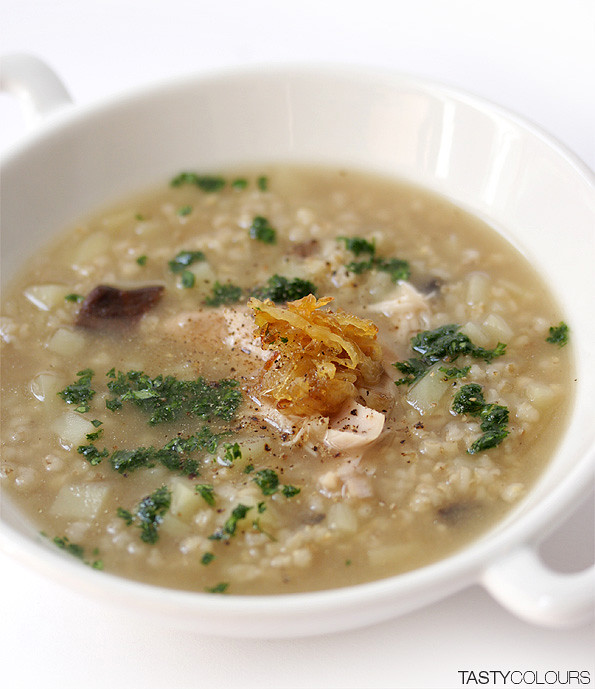
Today's recipe is made with rabbit meat. However, you can replace it with whichever meat you like, beef, chicken, or veal. You can make a vegetarian krupnik as well, without any meat. The soup is usually served with barley, but sometimes I use various grains, for example, bulgur or quinoa. Caramelized onion is my own idea; you will not find it in traditional krupnik recipes.


Barley Soup (Krupnik) with Caramelized Onion


Ingredients
Serves 4 to 6

For the soup
Rabbit – 21 oz (600 g) (preferably a body and two legs)
Pearl barley – 3.5 oz (100 g)
Carrots - 2 medium, peeled and washed
Root parsley or parsnip - 1 medium, peeled and washed
Celery root - 1/3 medium, peeled and washed
Leek - 1 small, washed and cut into halves
Onion - 1 peeled and cut into halves
Garlic clove - 1
Potatoes – 7oz (200 g), peeled, washed and cut into small cubes
Bay leaves - 2
Allspice - 3 grains
Black pepper - 4 grains
Dried ceps – 5 to 6
Sour cream – ½ a cup (120 ml)
Fresh parsley - 2 tablespoons, finely chopped
Salt
Pepper

For the caramelized onion:
Onion - 2 medium, peeled and cut into very thin slices
Olive oil - 3-4 tablespoons

Soak mushrooms in about 300 ml of water (1.25 cup) for at least 2 hours.

Prepare the broth: In a saucepan, bring to a boil about 1,6 l of water (1.7 quarts)
Add the meat, pepper grains, all spice and bay leaves.
Cook for about 30 minutes.
Then add carrots, root parsley, celery root, leek, onion, garlic, mushrooms and their soaking water.
Cook for another 30 minutes, until the vegetables and mushrooms become soft.

In the meantime, prepare caramelized onions:
In a hot frying pan, heat olive oil and put onions. Simmer for between 20 and 30 minutes, over a low flame until soft, golden and caramelized.
Mix often and do not let the onions burn.
Reserve.

Put barley in a thin strainer and wash it under running water, then strain and put aside.
Once the broth is ready, strain it.
Separate meat from the bones and slice it according to your liking.
Cut carrots and root parsley in small cubes; slice the mushrooms and put aside. Throw away all other leftovers.
Bring the broth to a boil again and add pearl barley.
Cook for about 5 minutes, under cover, on a medium flame, then add potatoes and cook under cover until the barley and potatoes are soft.
Finally add sliced meat, mushrooms, carrots and root parsley.
In the meantime, in a cup, mix a bit of broth with cream.
Remove the soup from the heat, add the cream mixture to the soup, mix everything well but do not cook. Season with salt, pepper and some freshly chopped parsley.

Serve immediately, hot, sprinkled with warm caramelized onions.
Related Posts Plugin for WordPress, Blogger...