Friday, December 24, 2010

Merry Christmas!


Should you ask me what is my most memorable episode from Polish Christmas when I was a kid – I would not mention a Christmas tree (we always had one, of course), or gifts (which we were offered), or the extraordinary cleaning of the apartment one month in advance, or the preparation of the Christmas dinner for three days in a row (which was actually the case), or not going to school and even not playing and singing Christmas carols, handling family meetings and so on – but rather « hunting » a carp, a soft water fish probably most appreciated in our region, and maybe in China.

In the eighties, when I was a kid, we had been suffering from food shortcomings - I mentioned this to you already. The preparation of tasty Christmas meals was - for a family living in a city like Krakow - a challenge. We had to spend long and boring hours in lines at food stores. A lot of basic food products, like sugar and meat, were in limited supplies. Even to purchase a carp fish was not easy. Additionally, the poor fish were taken home a few days before Christmas Eve and they were being kept alive in.... bathroom bathtubs. This may be the most common picture of any Polish home before Christmas: fish in the bathtub! .... Then the fish was murdered by the parents one or two days before the Christmas Eve. A blister of the fish was placed on a heater so it could explode with a noise to children’s pleasure. The fish's scales were washed, dried and placed in wallets - for good luck in the coming year. Indeed, that was a cruel habit – the animal was killed in a non humanitarian way, which nowadays is stigmatized in some Polish TV campaigns.

As far as I know, the carp was, in old times, a fish for poor people; then, it became an eminent part of Polish culinary traditions after the World War II and a proletariat king on Christmas tables. It replaced nobler soft water fish like sander, eel or pike. On the other hand, due to the development of Polish species of carp (for example, karp zatorski), the carp remained an eminent ingredient of our Christmas traditions. And you know what? I like to eat it once a year.  If you visit Poland right before Christmas, you will notice in nearly every food store a huge bathtub or a plastic pool with carps swimming inside it.

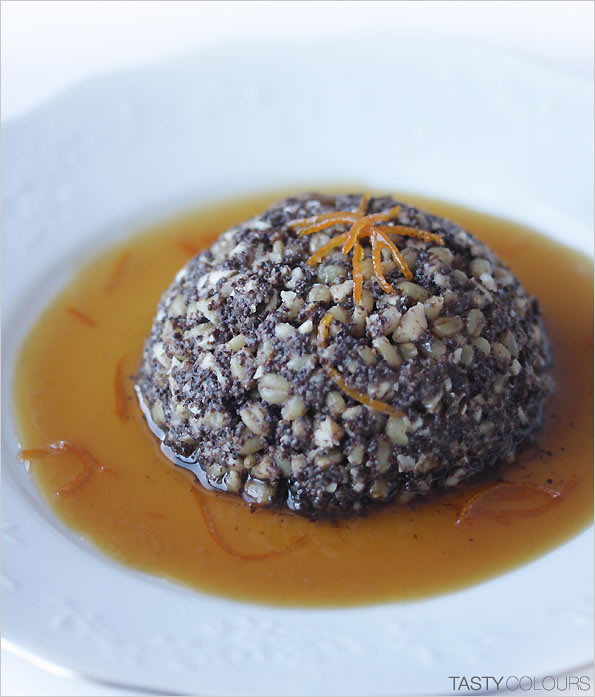
The Polish Christmas Eve (“Wigilia”) menu is very traditional. I know of some atheistic families whose Christmas menu is the same as in families practicing the Christian religion (which dictates for example, that absolutely no meat should be eaten during the Christmas Eve dinner). There are some dishes that we (or I) eat once per year, the preparation of which often takes a lot of time. Despite historical changes (like for example the expatriation of people whose families lived behind the Bug river), those dishes will probably be served for the Christmas Eve dessert in some regions of today’s Poland - kutia (a dessert having its origins in the Ukrainian territory).


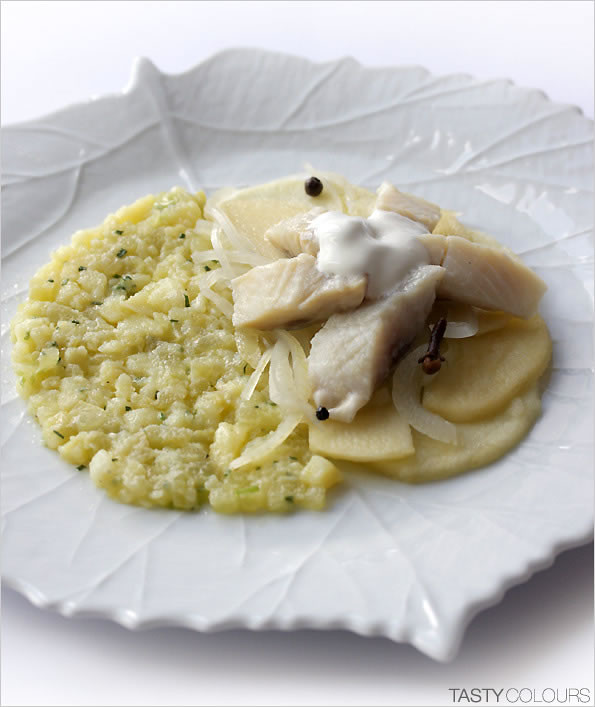
Christmas Eve in my family was preceded by a fast, meaning that we did not eat meat on that day. A light lunch consisted of tasty herrings marinated for a day or two in boiled, white vinegar, spices, onions, sour apples and then served sprinkled with thick cream, accompanied by a potato salad, with  sour cucumbers and chives.


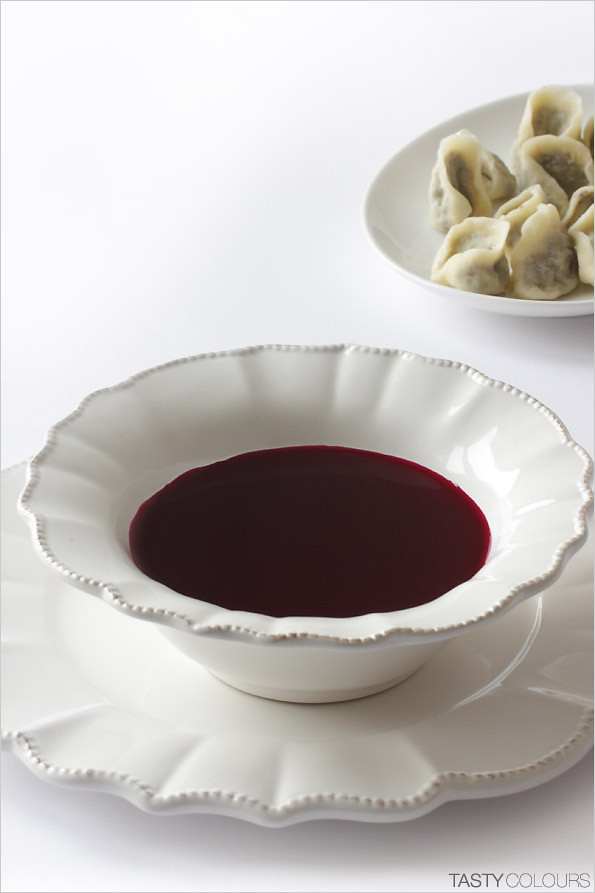
Christmas Eve dinner in many Polish homes and in my family started with a beetroot soup (borscht). In some families, the vegetarian version of a mushroom soup made from dried forest mushrooms is also served; however, the Christmas version of the borscht in my family home varies a lot from a regular one which is made from cooked beets. In general, everything as regards the traditional Polish Christmas Eve may be summarized in a few words: sauerkraut, dried forest mushrooms, carp, beets, dumplings, herrings and poppy seeds.

The Christmas borsht soup has been made from a base that had to be prepared a few days in advance (you will find the recipe in this post). The base consists of raw beets, peeled and cut into slices, pickled in boiled, chilled water with garlic, for four to five days. Then this « starter » is mixed with a light broth made from dried ceps and vegetable broth. The soup cannot be boiled; otherwise its color and taste will change. First records about the soup probably date from the beginning of the XVIth century. So, people – eat beets, eat beets! They are not so awful. Even nowadays, the soup in its luxury version is often served in elegant parties, weddings and occasional feasts, although usually with some meat stock.

The common, daily version, usually served with potatoes or hard-boiled eggs, can easily be made within a few hours by simply cooking the ingredients and adding vinegar or lemon juice. However, the traditional way is to prepare the soup several days in advance and to allow it to get a natural sour taste. Of course it is possible to buy a concentrate in shops or on local markets, but homemade base is always better, as you can control the taste and the level of fermentation.

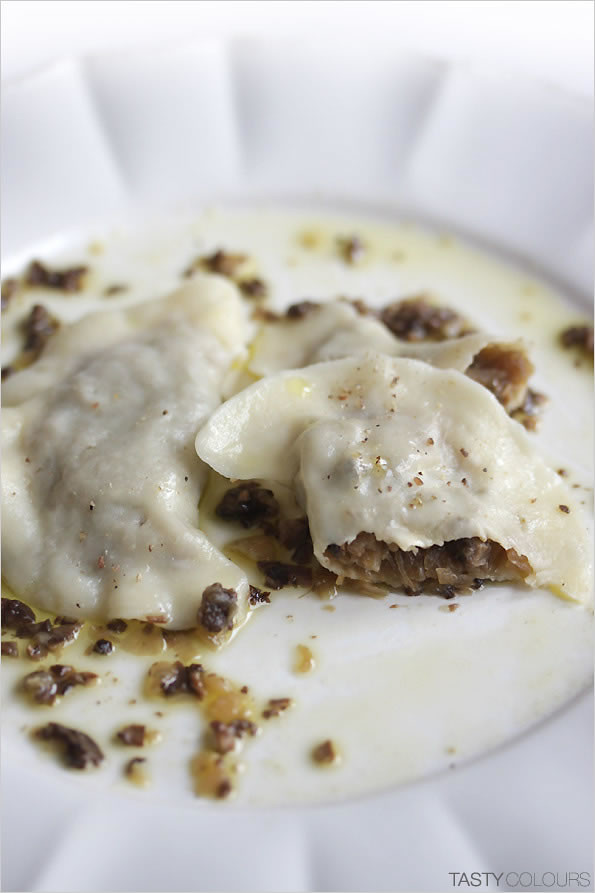
In my opinion, traditional Christmas borscht goes best with tiny dumplings stuffed with a preparation of soaked dried ceps and fried onions. These are called « uszka » in Polish. A direct translation means “little ears” and that is the shape you are aiming for. Some of the secrets to prepare really delicious uszka is to roll-out the dough as thin as possible, to shape them as small as possible, and then, finally, to use dried ceps of a good quality.
It is a pity that those delicious dumplings are practically unknown abroad. Although it is a lot of precious work to do them, I really like to make them (maybe because I do this only once per year). You can order uszka all year round in almost every restaurant serving Polish food. However, they may not be good everywhere. First of all, the uszka dough usually is much too thick, and secondly, cheaper restaurants use a mixture made of cheap button mushrooms and of a small quantity of dried bolets. Therefore, before ordering this dish you should ask first what kind of mushroom has been used for the filling.

After the soup, pierogi (dumplings) stuffed with braised sauerkraut and/or sauerkraut and dried mushrooms often appeared on our table. This is a type of pierogi that one can meet quite easily all year round in Poland, however I eat them usually around Christmas time. In some homes, people eat pierogi with poppy seeds.


Since the early nineties we had been invited to spend Christmas Eve at my mum’s closest friend, Ewa and her family.  This is where I acquired the habit of eating a vegetarian version of the popular “gołąbki” (stuffed cabbage rolls with kasha or rice and dried mushrooms in its vegetarian version).


Both at Ewa’s place and in our home, the carp fish was served in two different versions. The first one is a cold fish in jelly, often called Carp Jewish Style – a dish which probably finds its origins in the cuisine of Eastern European Jews. Pieces of fish are cooked slowly with almonds and raisins in a fish stock, then eaten cold with natural jelly and soft bread.
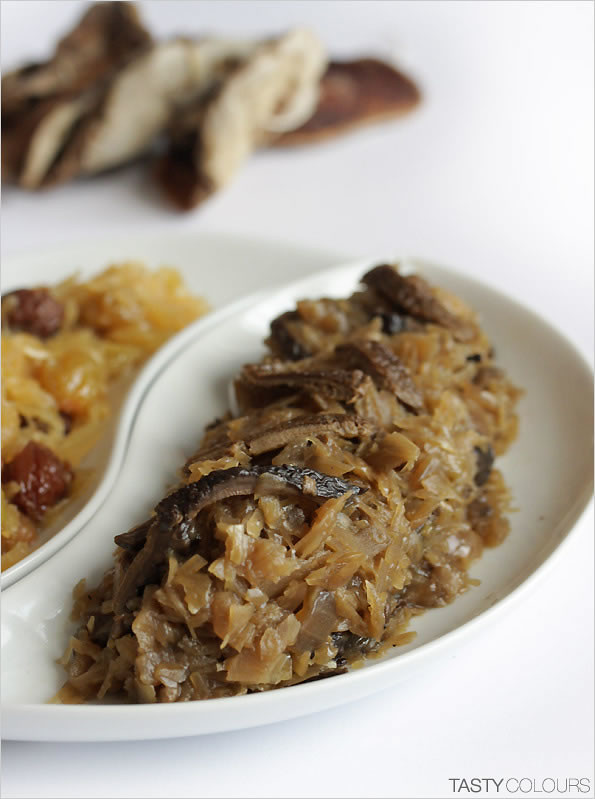
The second carp dish was served very simply, breaded and accompanied by hot sauerkraut with dried mushrooms and raisins, a vegetable salad or a potato salad – and usually nobody spoke a word when eating this fish, as it has a lot of bones.


Christmas Eve’s desserts were less important to me as I do not like sweets too much. Except for one thing: small, buttery pastry dough cookies made from whipped egg whites and from the addition of lemon juice on top, according to my grandma’s recipe. Besides that all those traditional cakes with poppy seeds, dried fruits or candied fruits, as well as kutia - a dessert which came to us through Polish people who were expatriated, after the War, from today’s Ukrainian territories, had no existence for me.


At the end of Christmas Eve, my mum used to serve compote - kompot - a drink made from cooked dried, smoked fruits: plums, apples, pears, raisins, apricots, the purpose of which is to speed-up digestion.

Christmas Days

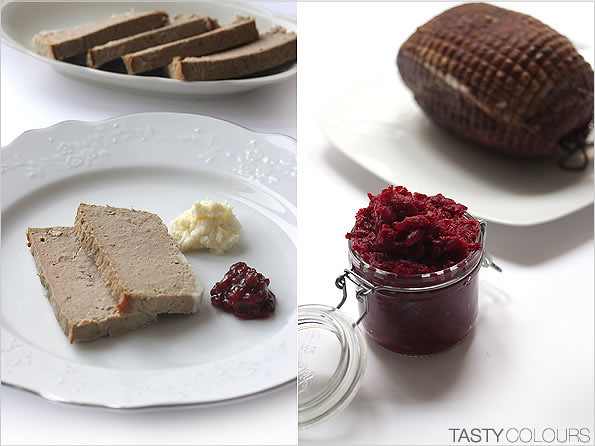
In Poland, Christmas lasts for nearly three days: Christmas Eve (Wigilia), starts at around 5 p.m. (when the first star appears in the sky), it then continues for two more days. A typical and traditional Polish Christmas Day breakfast, which was celebrated in my family, consisted of a good assortment of charcuterie - cooked hams, sausages, pates, served with accompaniments such as pickled ceps, horseradish with eggs, tartar sauce, a spicy and cold beet-horseradish salad called “ćwikła” and lingonberry preserves.


A traditional vegetable salad also comes with all that. It is made from cooked root vegetables like parsley, carrot and celery root as well as potatoes, sour cucumbers and apples.
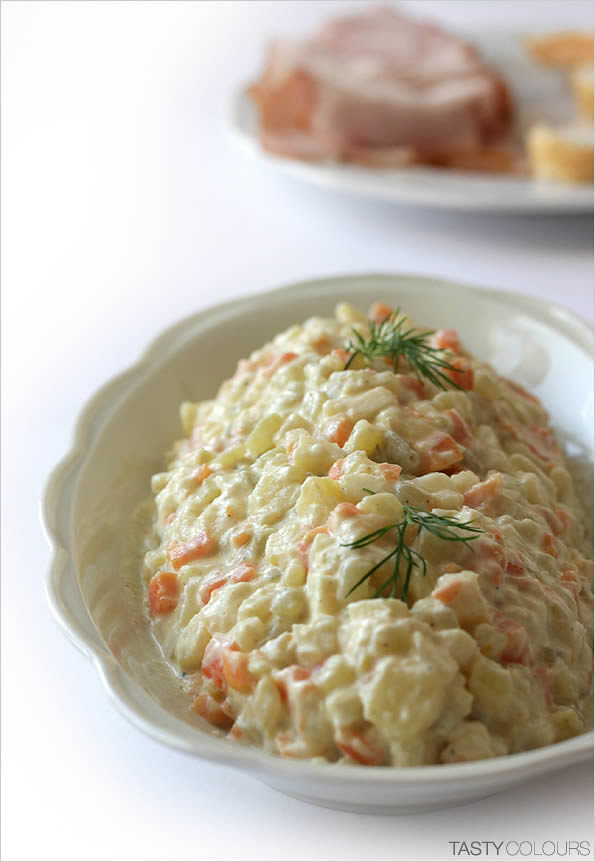


Then cakes always appeared on our Christmas table. Contrary to Christmas Eve, when meat is not allowed, on Christmas day the main course (obiad) consisted of meat like duck, veal, beef, goose or leftovers of fried carp from the previous day, served with cabbage or with some other accompaniments, followed, again, by cakes and cookies. Then, for dinner, cold charcuterie and accompaniments were served, as they were for breakfast.
In Poland, the second day of Christmas is celebrated as well, and people do not work, so the gluttony continued for one more day, interrupted by family visits and walks.

New Years Eve

The meaty leftovers from Christmas meals are used to prepare bigos – a hunter stew cooked very slowly (most preferably, for two or three days) using several types of meat, sauerkraut, dried mushrooms, dried plums, red wine and a lot of spices. In its extraordinary version a bigos is cooked in my family between Christmas and New Years Eve, and is eaten on New Year’s day – as a good solution for hangover, should anybody had one.
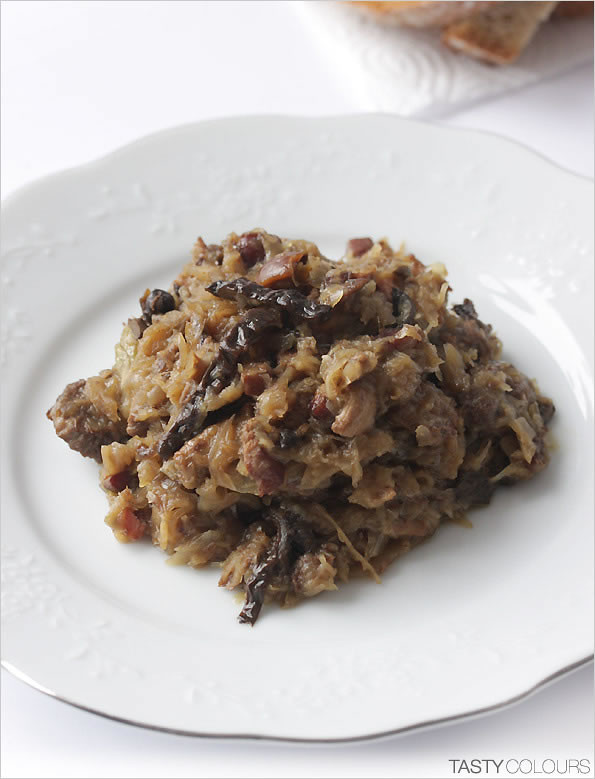


Bigos is a traditional stew typical of Polish and Lithuanian cuisines. Many consider it to be the Polish national dish.  Indeed, bigos has a long tradition in Poland. Some say that first traces about bigos can be found in the middle ages. It is said that bigos has been introduced to Poland by Jagiełło, a Lithuanian prince who became king of Poland in the XIVth century and founded the long-lasting union between the two states. However, Polish linguists trace the word bigos to be of a German origin rather.
In old times, bigos was stored in every household’s pantries in big stone pots, ready to be served to unexpected guests or as a provision for long trips. Should anyone ask me about the most traditional and the most pauperized Polish dish during the communism – the answer is bigos.  As nearly everything in Polish cooking after the Second World War, this old and rich dish was brutally simplified due to, inter alia, food shortcoming and political concerns. I can remember a version of bigos served in my school cantina as a few slices of meat of poor quality swimming in half-raw sour cabbage. This has nothing to do with real bigos, which needs many ingredients and a long cooking time.  Even today, in many cheap restaurants or “milk bars” you can order an ersatz of bigos, which usually translates into a preparation of cooked cabbage with a bit of sausages. 

There exists many variations of this dish and the one that I present in my book is the one I learnt from my mom.

There is no standard recipe for the dish. There are, however, certain rules to make it properly: it requires a long cooking time; different types of meats are to be used; the addition of dried plums, mushrooms and spices is required. Recipes vary between regions and families. Typical ingredients include sour cabbage, sometimes as well white cabbage, various cuts of meat and sausages, tomato paste and honey, sour apples, mustard and wine.

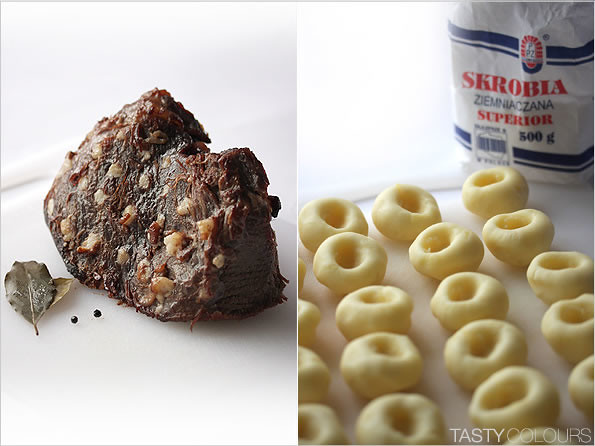
Sylvester dinner was usually celebrated in my family serving a hunter’s style beef tenderloin – “pieczeń wołowa na dziko”. A piece of beef was pickled for two to three days in wine and vinegar, then baked and served with « silesian dumplings » (“kluski śląskie”) - a sort of potato flour oval gnocchi, and lingonberry preserves.


CHRISTMAS EVE BORSCHT
Barszcz Wigilijny


Serves 8

Ingredients:
For the starter (“zakwas”)
2 kg (4.4 lbs) hard raw beets, peeled, washed and cut into slices
8 medium garlic cloves, peeled and cut in halves
1 teaspoon sugar
½ teaspoon salt
2.5 liter (2.6 quarts) boiled and chilled water
1 jar (3 liter (3.2 quart) capacity)
1 gaze or a piece of cotton fabric, to cover the jar

For the mushroom-vegetable broth
40 g (1.4 oz) dried ceps
2 medium beets, peeled, washed and cut in slices
1 root parsley or parsnip, peeled, washed and cut in halves
½ small celery root, peeled and washed, cut into slices
1 carrot, peeled and washed, cut into halves
1 onion, peeled and washed, cut into halves
1 bay leave
5 grains black pepper
2 grains all spice
Salt
Pepper
1 tablespoon lemon juice (optional, if the soup is not sour enough)
1 teaspoon marjoram


1 Prepare the Starter: Place beets in a clean, sterilized jar. Add garlic cloves. Mix water with salt and sugar and pour into the jar. The beets must be completely covered with water. Cover the jar with gauze and put aside at room temperature between 20° to 24° Celsius (68° to 75° Fahrenheit) for at least 5-6 days. Check from time to time. If you notice foam on the surface of the liquid, remove it delicately with a clean spoon and cover again. The base is ready when it has a strong sweet – acid taste. Strain the liquid. Discard beets and garlic. Pour the starter into a jar or a bottle and refrigerate. It may be saved up to two weeks.

2 Prepare the Mushroom Broth: Place the mushrooms in a saucepan and add 1liter (1quart) of water. Let them soak for at least 2 hours (preferably overnight). Cook them in the soaking water, under the cover, for 30 minutes or until they are soft. Strain the liquid and reserve it for the Borscht. Reserve the mushrooms and use them for another dish, for example Raviolis with Ceps.

3 Prepare the Vegetable Broth. In a deep saucepan, bring to a boil 1liter (1quart) of water. Add beets, root parsley, celery root, carrot, onion, bay leave, black pepper and all spice. Cook covered over medium heat until they become soft. Strain and discard vegetables and spices. Reserve the broth.

4 Prepare the Soup: Pour 2 liters (2 quarts) of the starter into a saucepan and add the entirety of the vegetable broth and half of the mushroom broth. Heat up, but do not bring to a boil, otherwise the soup will change in color. Taste: the soup should be quite sour, with a garlic and mushroom aftertaste. If necessary, add a bit more of the mushroom broth. Season with marjoram, salt and pepper and simmer for 10 minutes but do not allow the soup to boil.

A good starter should be transparent, but deep in color and a bit thick in texture. The best is to prepare it from organic beets. There exist recipes where some rye bread is added for faster fermentation. I prefer to prepare my base only from beets and garlic, as nowadays it is not so easy to find whole rye bread without industrial additions. Never add any vinegar to season this version of borscht.

Uszka (little dumplings with dried ceps)


Serves 8

For the filling:

Ingredients:
45 g dried ceps
750 ml water
1 onion or 2 shallots, peeled, washed and very finely chopped
4 table spoons butter
1 table spoon bread crumbs
1 egg white
Salt
Pepper

Soak mushrooms in water for a night.
On a second day, cook them until soft for around 20-30 minutes.
Strain the mushrooms.
Reserve the mushroom water and use, for example, for the borscht or other soup.
Chop the mushrooms very finely and put aside.
In a hot frying pan melt butter, add onions and cook them on a law flame until soft and golden.
Add mushrooms, fry for a minute or two, salt and pepper generously. Put aside in a medium bowl to cool down.
Then prepare the dough for the raviolis (see page XX below)
Once the dough is ready, finish the filling for the raviolis: add bread crumbs and mix.
Then beat egg white and add to the mixture. Mix delicately.

“Uszka” dough (around 60-70 small raviolis)

Ingredients:
200 g flour, sifted ((have some extra flour handy to adjust the recipe and to work the dough and roll it out)
1 egg
½ tea spoon butter
60-150 ml room temperature water (add little by little)
1 glass of 4 cm diameter (for example, champagne or vodka glass)

Sift flour on your working table.
Form a well in the centre of the flour.
Place the egg, butter in the well and mix all the ingredients with as much flour as possible.
Then start adding the water, 2 tablespoons at a time.
Knead the dough so the water is completely absorbed before adding the 2 following tablespoons of water.
Should you add too much water, the dough will become sticky; in that case, add little by little the extra flour until the dough is no longer sticky.
Knead the dough for about 15 minutes; it should become smooth, soft and elastic.
Divide the dough into 3 equal parts.
Place the first part on your working table.
Wrap two remaining parts in a plastic film and put aside.
Sprinkle some flour on your station and start rolling out the dough until it is between 1 and 2 millimeters thick.
Occasionally, flip the dough and sprinkle some flour over it so it does not stick to the table.

When dough is rolled out, cut disks of around 3-4 centimeters using a cookie cutter or, if not available, a champagne glass.
Put the scraps of leftover dough together and gently knead to form a small ball.
Wrap in plastic film and put aside to roll out later.
Place about ½ teaspoon of stuffing in the middle of each disk.
The stuffing must not reach the edge of the disk or it will prevent the proper sealing of the raviolis.
Fold disk in half and pinch edges together – you will obtain a little pieróg.
Using indexes and thumbs join the two tips of the pieróg to obtain a shape of “an ear”, most closely to Italian tortellini.
Should the dough be too dry, it will not seal properly.
In that situation, use a brush to moist the edges of the disk, and pinch them together.
Place “uszka” on a flat dish sprinkled with flour, and cover with a light cotton towel.
Repeat to prepare “uszka” from second and third part of dough and scraps.

Cooking
In a large saucepan (5 liter capacity), bring to a boil 3 liters of water; add some oil and a flat teaspoon of salt.
Drop a few “uszka” at a time, bring again to a boil and reduce flame.
When “uszka” rise to the surface, let simmer another 2 minutes.
Taste one to check that the dough is well cooked.
Do not strain them; use a slotted spoon to remove them from water and place over a paper towel to remove the excess of water.
Serve immediately as an accompaniment to Christmas bortsch.

In this recipe, you can use other dried mushroom, like for example dried boletus. Although they are served traditionally with the borsht, you can eat them as an accompaniment to bullion or mushroom soup. You can even fry cooked “uszka” on a frying pan and served them as a hot starter, served with some butter and parsley.
The precooked “uszka” freeze easily, so you can the excess for other occaision.

CARP JEWISH STYLE
(karp po żydowsku)
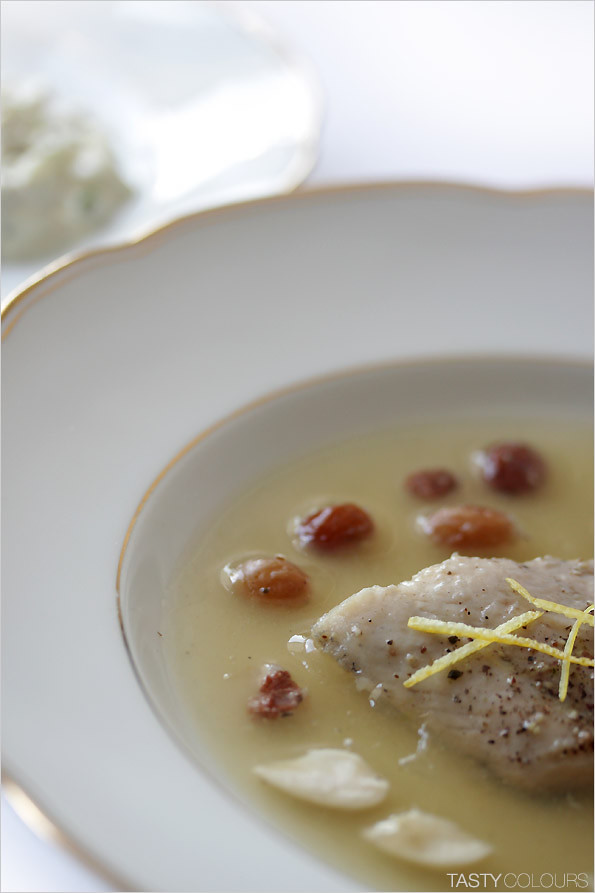


Serves 4

Ingredients:
50 g (1.8 oz) whole almonds, peeled and cut into quarters
40 g (1.4 oz) dried raisins (preferably sultana)
600 g (1 lb 5 oz) fish bones (preferably carp heads)
3 medium onions (300 g) (10.5 oz), peeled and cut into halves
1 carrot, peeled and washed
8 grains black pepper
600 g (1 lb 5 oz) carp cut into slices (if unavailable, use another soft water fish like sander or Northern Pike)
A pinch of salt
A pinch of ground black pepper
A pinch of sugar

1 In a small saucepan, bring to a boil 150 ml (0.6 cup) of water, add almonds and raisins and cook them for 5 minutes. Then put everything aside.

2 Remove any scale left from the fish skin. In a large saucepan, place the fish bones and cover with 1.5 liter (6.3 cups) of water. Add onions, carrot and pepper grains. Cover with a lid and cook over low flame for about 1 hour to 1.5 hour. In the meantime, sprinkle the fish steaks with salt, pepper and sugar.

3 When fish stock is ready, strain it using a very fine strainer (preferably, a chinois); collect half the quantity of the onions and reduce them into a purée using a blender, and add to the strained fish stock. Discard all other solids. Add almonds and raisins and their reserved cooking water to the fish stock. Bring the fish stock to a boil. Place the fish steaks into the stock and cook for 10 minutes, or until the color of fish meat changes to white.

4 Remove the steaks from the stock and place them on a deep serving dish or individual deep plates to cool down. Strain the fish stock once again to remove any additional solids; keep almonds and raisins aside. Pour the cooled-down fish stock over the fish steaks; they should be covered completely. Place almonds and raisins around the fish steaks in a decorative manner.

5 Refrigerate overnight so the fish stock turns into a jelly. Serve with quarters of fresh lemon and bread.

Thursday, November 18, 2010

Between Autumn and Winter – Time for Rich Soups

When I created my blog, I promised myself that irrespective of how busy I would be, I will always find time to publish at least one post per week. Today we are in the middle of November and several long weeks have passed since my last post. This is how dreams change into reality – one cannot do everything.
I hope that those five difficult weeks of hard work will turn into my favor in January (this is when the Government will publish results of the competition) and that I will be able to share some good news with you.
I had no time to cook regular, warm dishes, except for my daughter, who – on the other hand – has no taste for anything at the moment. Always no, no, no, not good!
On the contrary, I was eating « in between », meaning quickly, not complicated or simply I was forgetting that I was hungry. I could not believe that it was me, a person, who loves to cook and eat so much. After two weeks my stomach shrank to the size of a dried raisin. I was full after one sandwich and too tired or just too lazy to cook a proper dinner.

Do you like soups?

A few days ago I read an article according to which, in Poland, despite the fact that we own cars, mobile phones and shiny kitchens, the revolution did not affect our culinary habits. According to some statistics (I do not know who prepared them) Polish people, today, cook and eat nearly the same way as our parents did. The only radical change shows that they do not make huge supplies, as we did during the communist era.

Allegedly we eat a bit healthier, but still quite greasy. The standard Polish daily menu is: sandwiches for breakfast (didn't I tell you that in my post about sandwiches), a “nutritive” and rich soup or meat, potatoes and.... sometimes …. salads and vegetables for the main meal which is “obiad”. And again sandwiches for dinner. Only 10% to 15% of Polish society, mostly young, better educated people experiment in their kitchens with food from other countries.

According to the article, Polish people still love to eat soups (always made from meat or vegetable broth) and eat the largest quantities of soups per year in the World (around 72 l per capita). Contrary to the south of Europe, where “veloutés” or “moulinés” are more popular, our soups consist of larger pieces of meat and/or vegetables – partially because this comes from our traditions, partially because of the climate.

I agree that the tradition of eating soups was, and still is, strong. For example, in autumn and the winter, thick soups with “kasha” are popular, as Polish people are used to eating quite a lot of “kasha” grains (for example, barley, buckwheat, and others). In Polish, “krupnik” is the name of a soup with barley, and comes from the word “krupy”, meaning “kasza”, porridge. This type of soup is known from at least few hundred years, therefore it really is a traditional and ancient dish.
“krupnik” is often served to children. I will not exaggerate too much if I state that a lighter version of the soup, with no bone stock, is served to really young kids, under one year old. When I was a kid, I hated it.
In Polish language the word “krupnik” has another meaning as well. It is also a type of sweet honey and herb vodka, which you can find in every Polish liquor store, prepared after a traditional formula.

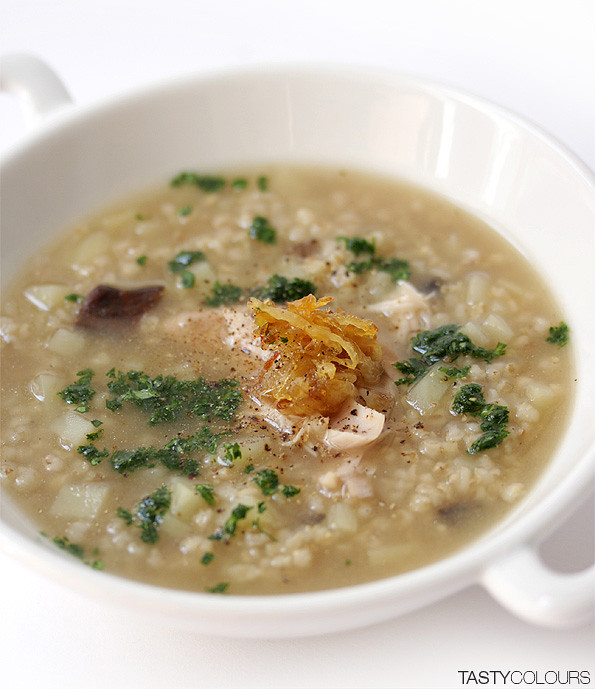
Today's recipe is made with rabbit meat. However, you can replace it with whichever meat you like, beef, chicken, or veal. You can make a vegetarian krupnik as well, without any meat. The soup is usually served with barley, but sometimes I use various grains, for example, bulgur or quinoa. Caramelized onion is my own idea; you will not find it in traditional krupnik recipes.


Barley Soup (Krupnik) with Caramelized Onion


Ingredients
Serves 4 to 6

For the soup
Rabbit – 21 oz (600 g) (preferably a body and two legs)
Pearl barley – 3.5 oz (100 g)
Carrots - 2 medium, peeled and washed
Root parsley or parsnip - 1 medium, peeled and washed
Celery root - 1/3 medium, peeled and washed
Leek - 1 small, washed and cut into halves
Onion - 1 peeled and cut into halves
Garlic clove - 1
Potatoes – 7oz (200 g), peeled, washed and cut into small cubes
Bay leaves - 2
Allspice - 3 grains
Black pepper - 4 grains
Dried ceps – 5 to 6
Sour cream – ½ a cup (120 ml)
Fresh parsley - 2 tablespoons, finely chopped
Salt
Pepper

For the caramelized onion:
Onion - 2 medium, peeled and cut into very thin slices
Olive oil - 3-4 tablespoons

Soak mushrooms in about 300 ml of water (1.25 cup) for at least 2 hours.

Prepare the broth: In a saucepan, bring to a boil about 1,6 l of water (1.7 quarts)
Add the meat, pepper grains, all spice and bay leaves.
Cook for about 30 minutes.
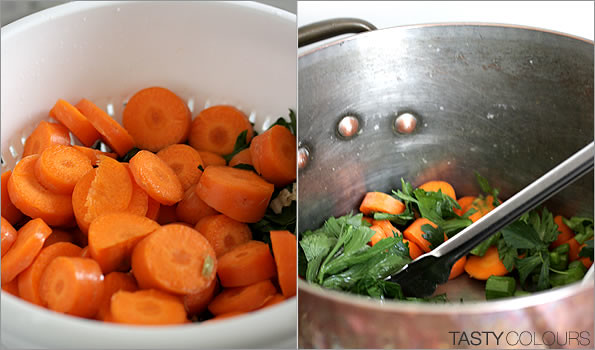
Then add carrots, root parsley, celery root, leek, onion, garlic, mushrooms and their soaking water.
Cook for another 30 minutes, until the vegetables and mushrooms become soft.

In the meantime, prepare caramelized onions:
In a hot frying pan, heat olive oil and put onions. Simmer for between 20 and 30 minutes, over a low flame until soft, golden and caramelized.
Mix often and do not let the onions burn.
Reserve.

Put barley in a thin strainer and wash it under running water, then strain and put aside.
Once the broth is ready, strain it.
Separate meat from the bones and slice it according to your liking.
Cut carrots and root parsley in small cubes; slice the mushrooms and put aside. Throw away all other leftovers.
Bring the broth to a boil again and add pearl barley.
Cook for about 5 minutes, under cover, on a medium flame, then add potatoes and cook under cover until the barley and potatoes are soft.
Finally add sliced meat, mushrooms, carrots and root parsley.
In the meantime, in a cup, mix a bit of broth with cream.
Remove the soup from the heat, add the cream mixture to the soup, mix everything well but do not cook. Season with salt, pepper and some freshly chopped parsley.

Serve immediately, hot, sprinkled with warm caramelized onions.

Friday, October 8, 2010

Mushroom Season Part 3

If you only knew how I have been eating lately, probably a lot of you, readers, would think: is this woman really writing a culinary blog? Or maybe she should rather write an anti-culinary one? No, I do not go to McDonalds (there is none in my neighborhood), but, for example, I had a hot dog with vegetables for lunch (I did not make it on my own, I bought it!), that I swallowed in 2 minutes….and a sandwich for breakfast….and no, I am not on a diet at the moment, but lately time has been flying faster than light, and there are so many new challenges in front on me, that I forgot how I  love to cook and eat. Today, I promised to myself, for example, that I will cook a savory chocolate risotto for dinner. However, I forgot to carefully check the ingredients for the dish, and since I found myself without any red chilies or cocoa powder at home, I will have to postpone this culinary fantasy…
This unusual behavior is due to the fact that I have been working on organizing the “Polish Days in Paris” project, which will take place next year on Place Saint-Sulpice (if everything goes well!).
All my energy is currently applied to preparing an application for a Governmental grant, which must be submitted by the end of October. Although the deadline seems fine, I am very concerned because everything seems to go so slow…
Anyone who already had to deal with this type of official paperwork should know what I am talking about, and how many telephone calls and meetings it requires…

Well, this explains why, today, I will bother you again with another mushroom recipe. Anyway the season will finish soon; the weather becomes worse, nights are really cold, close to ground frosts.

The recipe for the stuffing does not vary much from the classical recipe for Polish Style Dumplings with Potatoes and Cheese – “pierogi ruskie”, except for chopped pine mushrooms.

The dough I made was slightly different from usual: instead of using sparkling mineral water, I added some fresh milk, and clarified butter. The dough is quite easy to work, although I believe than anyone who is not used to roll pierogi dough out, may complain.  Do not worry; after three or four failures you should succeed… My first pierogi dough was a disaster. Now, I make it from scratch, even without measuring the amounts of flour and liquid – simply, I have in my mind that the dough should be worked well, should be elastic and shiny….and if it is too sticky, I add a bit more flour; or, if it is too dry – I add a bit more milk. Much depends on the humidity in your kitchen and on the quality of the flour. I will not tell you whether it is easy to roll out, as I used my pasta machine which rolled the dough out evenly and thinly. The dough is very delicate and elastic, but even though do not roll it too thin – it may break during boiling. I encourage you to make Polish style dumplings at least once in your life, and although it is quite a lot of work, they are really worth it.
I probably do not know anyone who would not like those potatoes and cheese dumplings! And with pine mushrooms, they are even more interesting. Prepare the pierogi dough, using the ingredients listed in this recipe, but follow the instructions given in the “Basic Pierogi” recipe.

Polish Style Dumplings (Pierogi) with Potatoes, Curd Cheese and Sautéed Pine Mushrooms


Serves 4-6

Ingredients:

For the Pierogi dough:
280 g all purpose flour (plus some more extra)
2 tablespoons clarified butter
100 ml milk (plus some more extra)
1 egg
Salt

For the filling:
500 g potatoes
200 g dry curd cheese 
1 large yellow onion, peeled and finely chopped
5 tablespoons clarified butter
150 g pine mushrooms (lactarius delicious)
Salt and pepper to taste
Some extra clarified butter and fresh chopped parsley for garnishing

1. In a large saucepan, boil water and cook potatoes, with skin on.
2. In the meantime, delicately clean mushrooms from leftovers of the forest. Scratch the stems to remove soil. Rinse the mushrooms delicately under cold water. Chop them finely.
3. Strain potatoes and let cool down a bit; peel them when still warm and mash them using a potato masher. Let potatoes cool down. Using the potato masher, mash the cheese. Working with hands, carefully mix potatoes and cheese. Put aside.
4. In a hot frying pan, heat clarified butter (how to prepare clarified butter, check this recipe, add onions and fry them over medium heat, mixing often, between 5 to 10 minutes. Do not let onions burn.  Add mushrooms and sauté them for about 5 minutes, until nicely gold or until they release their juices and absorb them back in.
5. Combine onions and mushrooms into the potato / cheese mixture. Season with salt and pepper and mix again thoroughly. The taste should be quite seasoned.
6. Prepare and cook pierogi as described in the basic recipe.
7. Serve immediately after cooking with some more clarified butter and fresh chopped parsley.

Pierogi also taste great on the second day, grilled on a frying pan with a bit of butter.

Bon appétit! 

Wednesday, September 29, 2010

Mushroom season part 2


There exist a lot of quick-to-prepare dishes, which are so delicious despite their total simplicity. Two, or three ingredients of good quality and we are in a culinary heaven.

What are your favorite, simple and quick dishes (or accompaniments?) made out of two or three ingredients, which you love, and you like to come back to? Share with us!

Fried Lactarius Delicious mushrooms (or saffron milk caps, red pine mushrooms, in Polish - "rydze") is that type of delicacies.

To prepare this very seasonal Polish hot starter, you need only two ingredients – some nice, fresh mushrooms and a lot of butter (without counting salt and pepper). And a large frying pan also, so the mushrooms can fry evenly. 

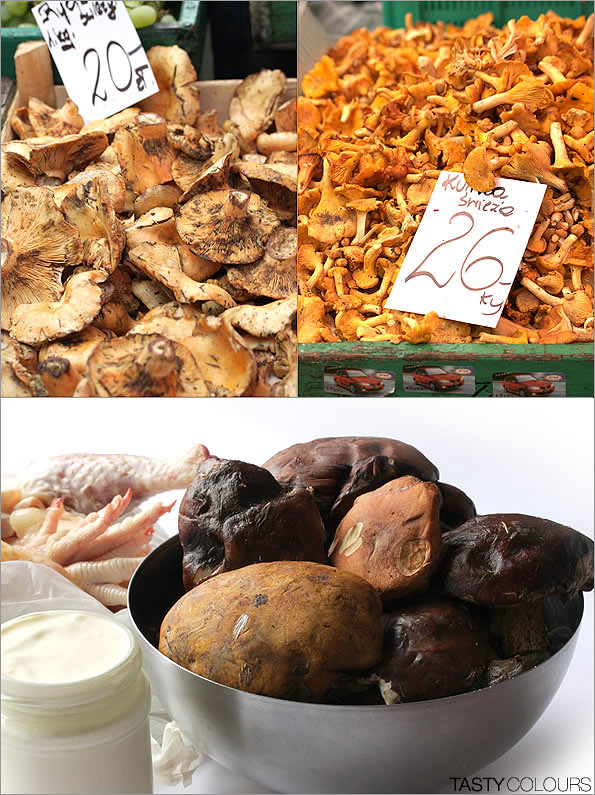
Those carrot colour - sometimes slightly red - mushrooms are not as easy to buy as ceps, chanterelles or boletus badius, but still, they are popular in Poland (it is quite easy to find them, particularly in the south of the country). They are still quite cheap on the Kleparz market in Krakow (around 5 euro per kg), as in the south of the country we have a lot of pine forests – the tree, under which those mushrooms like to grow the most.
One can find them across Europe and North America.  Last year, I saw them in La Grande Epicerie de Paris, but the price was prohibitive and nobody was buying them.

Pine mushrooms are best when fried, grilled or pickled (how to pickle forest mushrooms, check here). This is how they traditionally are served in my country. I also used fried lactarius for the stuffing of my pierogi. Two people who tasted them confirmed that they are good enough to be shown on the blog – so check out my next post!

In Poland, we are used to dry forest mushrooms and we use them out of the season for the preparation of many dishes.  However, pine mushrooms are not suitable for drying out, as opposed to boletus or ceps. Avoid adding them into soups because they are not suitable for boiling. Just grilling or frying them releases their taste. Their flat and wide caps are ideal for this type of preparation. The taste is a bit nutty, particular. Use clarified butter in this recipe, which has higher smoke point than regular butter, to prevent the ingredients from burning.

Pine Mushrooms Fried in Butter 
Ingredients:
Serves 2 as a starter
300 g fresh pine mushrooms
60 g butter
Salt
Pepper

1. Delicately clean mushrooms from leftovers of the forest. Scratch the stems to remove soil. Rinse the mushrooms delicately under cold water. Separate stipes (mushroom stalks) from caps.

2. In a saucepan, slowly melt butter over minimum heat (do not stir). Remove from heat and skim the foam off the surface. Spoon the butter into a bowl. Discard the milky sediment.

3. In a hot large frying pan, heat butter, add mushrooms (they should not be crowded, so they can grill evenly) and fry them on each side for about 4 to 7 minutes, until nicely grilled (depending on the thickness their caps) and until they release their juices and absorb them back in (when frying over high heat, they should not release a lot of juice). Salt and pepper and serve immediately with slices of country bread.

Bon appétit!

Friday, September 24, 2010

A Season for Forest Mushrooms


I mentioned in my first posts (for example, in the post about pickled ceps) that the flavor of forest mushrooms, both dried or fresh, is an essential ingredient of Polish cooking and this is one of my favorite ingredients in the kitchen. I already wrote about pickled ceps, Zrazy and potato pancakes with chanterelle sauce.

We are in the middle of the forest mushroom season here in Poland, so I could not hesitate to present some of our Polish style seasonal mushroom specialties. Poland is still relatively rich with forests and one can quite easily find in them edible and non edible mushrooms. This is also due to the quite humid climate. When I was a kid, we were spending each holiday in the mountains, and we dedicated a lot of time to “mushroom escapades”. Nowadays, when I visit Kraków, I buy them on local food markets, in particular on Kleparz – my favorite food market in town.
There are sellers who have a license for selling forest mushrooms. Remember that some of the poisoning ones may resemble some those edible ones. I know a bit about mushrooms, but besides the cèpes family and chanterelles, I do not buy any other types of forest mushrooms from individuals who do not have a sales permit.

A lot of people practice mushroom hunting in forests, and each year the media report some traumatic news about some adults and children (who would gives forest mushrooms to young children?!) being killed or heavily sick after eating, for example, a death cap (Amanita phalloides - in Polish "muchomor sromotnikowy"), taken by mistake for a parasol mushroom (Macrolepiota procera - in Polish "kania") (by the way, parasol mushrooms are delicious especially grilled).

So, if you ever visit Poland during the mushroom season, eat them and enjoy them, but buy them in places where they are thoroughly checked. For that part, restaurants are safe.

Let’s start this mushroom season with a Polish style soup, which is one of my favorites in that time of the year.
I used homemade, rich chicken broth for it, but feel free to use any other type of broth. This time, I blended part of the mushrooms as I wanted my soup to be a bit thicker than usual. I used Boletus badius (in Polish - "podgrzybek brunatny"), which is very popular in Poland (although some chefs do not appreciate them), and Leccinum (in Polish - "kozak", "koźlarz"; growing in Europe and in North America) - both from the boletus family. You can use cèpes, of course, but they are much more expensive.


Polish Style Forest Mushroom Soup 


Ingredients
Serves 4-6
500 g boletus badius
500 g leccinum mushrooms
1 onion, peeled and finely chopped
1.5 l homemade chicken broth
4 tablespoons clarified butter
100 ml heavy cream
Fresh chopped dill or parsley for sprinkling
Salt
Pepper

Delicately clean mushrooms from leftovers of the forest. Scratch the stems to remove soil. Rinse the mushrooms delicately under cold water. Separate bigger stipes (mushroom stalks) from caps. Cut caps into thin slices. Put the stalks aside.
In a hot frying pan, heat butter, add onions and fry over medium heat around 10 minutes, mixing often. Do not let the onions burn. Add mushroom caps in the frying pan and sauté them until they release their juices and absorb them back in. Salt and pepper and put aside.
In a large saucepan, heat the chicken broth, add mushroom stalks and cook for about 15 minutes, until the mushrooms are completely soft. Strain the broth, reserve it, but discard stalks (you can use the stalks for the soup if you like, but stalks of my big mushrooms were spongy and soft this time).

Add mushroom caps with onions into the broth. Cook for another 10 minutes, until the juices mix well. Pour one half of the soup into a blender and reduce it to purée and add it back to the remaining half of the soup (you should still see mushroom pieces in the soup). Pour a bit of the soup into a cup, add cream, mix well and add to the soup. Adjust the seasoning with salt and pepper, if necessary, and serve hot, sprinkled with fresh, chopped herbs (I used Polish dill).

The soup goes very well with noodles.

And finally to close this post: some time ago I was invited by Polish bloggers to list 10 things that I like, so let’s go for it! Thanks a lot guys for your invitation!

  • Swimming relaxes me and in the summer time I try to swim as much as possible, meaning a few times per week;
  • I like to watch documentaries and read reportages, in particular shot in other parts of the World;
  • Taking long walks releases my mind;
  • Showing the World to our daughter makes me happy;
  • I like to cook with my husband;
  • Laying down with a book at the end of the day is what I also like;
  • To be close to nature, to just watch it and think about nothing;
  • I love to drive a car and travel by train, in particular on long distances;
  • I like to listen to the music, although my music taste has changed over the years (I am getting older);
  • I like to work on things that I like.

Saturday, September 11, 2010

Home Made Veal Stock

In June, I presented the dish “Pierogi with Lamb”, for which I used my homemade veal stock reduced to demi - glace.
Stocks are the foundation of classic French Haute Cuisine. The French name for stock is fond - meaning “foundation”.  There exist two types of stocks: white stocks and brown stocks. The first ones are prepared from bones of birds, fish or veal, which are simmered in water with vegetables and herbs. They are lighter than brown stock – the second type.  To obtain a brown stock, one should fry or roast the bones first.  Brown stocks may be made from veal, beef, poultry, lamb, pork, venison or even shells or shellfish. 
This post is about brown veal stock. We make it at home several times per year. Some say that we are the last generation to learn how to cook with veal bones. It is not easy to buy them these days. Even in France, the legislation may change in the coming years, so we will not be able to buy them anymore. Still, we can buy them quite easily in butcher shops in Paris, and in Kraków.

As I already mentioned in my post about Pierogi with Lamb and Morels, veal stock is a kind of preparation that it is difficult to make at home (because, for example, in some countries you will not get any veal bones in any store – in this case one can use beef bones) and those industrial powdered stocks are hopeless. Moreover, to prepare homemade veal stock (or any other stock) is an absolute messy job. Furthermore, the authentic, homemade veal stock itself may not be very interesting in taste – its pure taste is not so pleasant. But what is fascinating about it is that once you combine it with other flavors, like for example, meat juices, wild mushrooms, butter, cream, garlic or alcohol - it becomes something absolutely outstanding.

There are tons of veal stock recipes. Some people like to dust the bones with flour before roasting them, others (like us) prefer not to roast the vegetables, or to deglaze the roasting pan with wine. Some prefer to add vegetables just one hour before the end of cooking. Others like to add bouqet garni. Just feel free to choose your favorite options. The recipe that I present here was given to me by my husband who taught me how to make good, classical veal stock and demi-glace. The recipe comes from one of the French restaurants, which he had been working et when he was younger.

Once your veal stock is ready, you can play with it further and reduce it to about one third and make a more concentrated stock called demi-glace , or reduce it even more (as little as a tenth of its original volume) – to obtain a glace – a sticky reduction ideal to flavor your sauces. I know: those sauces made with veal stock are not very light; but they are delicious; moreover, we do not eat them every day.

You will find here some advices to prepare a good veal stock, that I collected from my husband and from Michael Booth’s book (which helped me to write this post). Please note another book that I recently found: “Le Cordon Bleu’s Complete Cooking Techniques”.

I recommend cooking your own veal stock at least once in your life. If you cannot buy fresh veal bones, try to cook beef stock, following these instructions and the recipe:

(i)  Use good bones (the fresher, the better), cut into small pieces;
(ii) Use fresh vegetables (“a stock made with garbage will taste like garbage” – Alice Walters – Chez Panisse) the so called “mirepoix” (combination of carrots, onions, celery and sometimes garlic and shallots);
(iii)  The mirepoix should not dominate the flavor of the stock, so do not use too much of it (maximum around 20 per cent the weight of mirepoix to bones);
(iv) You can add a bouqet garni (a mixture of laurel leaves and thyme, sometimes parsley stems as well); we do not add any, as we want to have a clear, blend stock, which we will use later for various sauces of different flavors;
(v)  We do not salt and pepper the stock, because it constitutes a base for sauces, which will be reduced and seasoned later; if you will salt the stock during simmering the risk is that you will waste your job because the salty taste will intensify after reduction;
(vi) It is important to simmer the stock for at least a few hours – a stock which will not be cooked enough, will be watery and without flavor; and on the contrary, a stock which will be overcooked may become bitter;
(vii) Do not use a nonstick frying pan or saucepan to roast the bones – you need a good “sticky” roasting-pan, so you can deglaze all goods that stuck to its surface while roasting the bones.

Ingredients:
3 to 4 kg good quality and fresh veal bones, cut into pieces by your butcher, rinsed under cold water and dried (you can replace veal bones by beef bones, but beef stock is not as good as veal stock, because veal bones have more gelatin so the sauce will look better)
4 big onions, washed from soil, dried (but not peeled!), cut into halves
2 small cans of tomato paste
2 to 3 stalks of celery, washed and chopped in thick slices
3 carrots, washed and cut into thick slices
1 large, thick-bottomed roasting pan
1 large saucepan of about 10 liter capacity (the best is a narrow and high saucepan to minimize evaporating during cooking)
1large strainer
1”chinois” or muslin

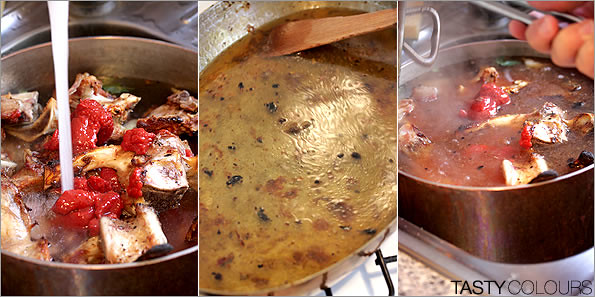
Heat the oven to 220° Celsius (430° Fahrenheit). Place the bones in the roasting pan and place the pan in the oven for about 1.15 to 1.5 hours. Be careful – the bones should brown evenly, and not burn. For that purpose, occasionally remove the roasting pan from the oven and flip the bones.


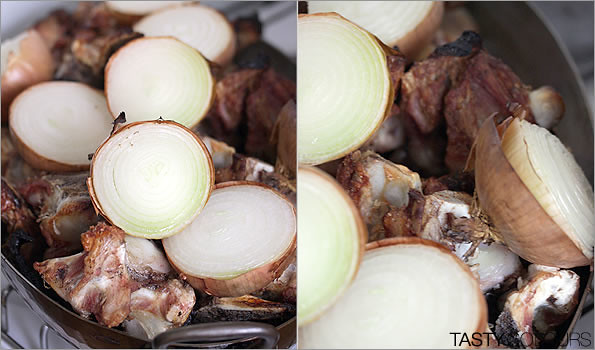
Once the bones are slightly gold (after about one hour), place onions on top of the bones. Roast everything another 15 to 20 minutes (you should really watch the onions and bones to prevent them from burning).


In the meantime, add slices of celery and carrot into the saucepan.


Then remove the roasting pan from the oven. Add onions and bones to the saucepan. Add tomato paste.
One important thing: the bones render some fat while roasting. Drain off as much of the fat as possible, using a sieve to catch the precious brown bits from the bottom of the pan. Do not throw away those brown bits! Pour some water into the roasting pan and deglaze it over heat by scraping all browning from the pan. Pour the liquid into the saucepan with bones and vegetables.


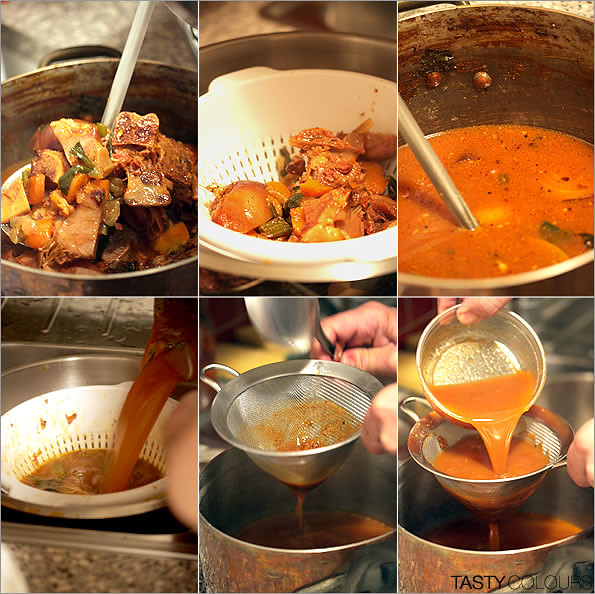
Fill the saucepan with cold water (about 5 cm above the level of the bones) and bring to a boil. Then reduce the heat to an absolute minimum, so it can simmer. It should simmer gently between 5 and 6 hours. Simmering does not stir up impurities in the way that a rolling boil would and keeps the stock clearer. The bones have to have enough time to give their full flavor. Occasionally, using a ladle, remove the impurities (mostly fat) which will rise to the top.


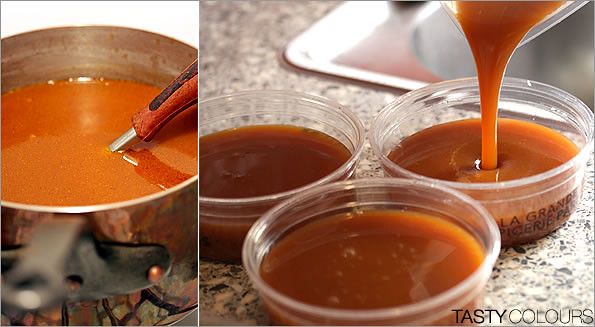
Using a ladle, strain the stock through a strainer set over a large bowl. Discard bones, vegetables and all other big solids. Then, using a “chinois” or a muslin, strain the stock once more, in order to get rid of smaller solids. Your stock is ready to use. It should have the brownish-cold color, similar to something between milk chocolate and caramel. At this stage, you can pour portions of the stock into plastic containers and freeze it, should you wish to use it later.


If you want to make demi-glace, apply the following instructions: pour the stock into a smaller saucepan and bring it to a boil. Once it is boiling, reduce the heat to a minimum. Simmer for about one hour - the cooking time will however depend on the thickness of the stock - sometimes you will need a bit less, sometimes more time. The best test to do is to pour a bit of stock into a cup and place it in the fridge. Once it thickens when cooled down, the stock is ready.  Occasionally, with a ladle, remove the foam which will form on the top.
Pour the veal stock into small plastic containers or ice cubes moulds. Once it is cooled down, freeze it and use it when needed.


Related Posts Plugin for WordPress, Blogger...