Thursday, November 18, 2010

Between Autumn and Winter – Time for Rich Soups

When I created my blog, I promised myself that irrespective of how busy I would be, I will always find time to publish at least one post per week. Today we are in the middle of November and several long weeks have passed since my last post. This is how dreams change into reality – one cannot do everything.
I hope that those five difficult weeks of hard work will turn into my favor in January (this is when the Government will publish results of the competition) and that I will be able to share some good news with you.
I had no time to cook regular, warm dishes, except for my daughter, who – on the other hand – has no taste for anything at the moment. Always no, no, no, not good!
On the contrary, I was eating « in between », meaning quickly, not complicated or simply I was forgetting that I was hungry. I could not believe that it was me, a person, who loves to cook and eat so much. After two weeks my stomach shrank to the size of a dried raisin. I was full after one sandwich and too tired or just too lazy to cook a proper dinner.

Do you like soups?

A few days ago I read an article according to which, in Poland, despite the fact that we own cars, mobile phones and shiny kitchens, the revolution did not affect our culinary habits. According to some statistics (I do not know who prepared them) Polish people, today, cook and eat nearly the same way as our parents did. The only radical change shows that they do not make huge supplies, as we did during the communist era.

Allegedly we eat a bit healthier, but still quite greasy. The standard Polish daily menu is: sandwiches for breakfast (didn't I tell you that in my post about sandwiches), a “nutritive” and rich soup or meat, potatoes and.... sometimes …. salads and vegetables for the main meal which is “obiad”. And again sandwiches for dinner. Only 10% to 15% of Polish society, mostly young, better educated people experiment in their kitchens with food from other countries.

According to the article, Polish people still love to eat soups (always made from meat or vegetable broth) and eat the largest quantities of soups per year in the World (around 72 l per capita). Contrary to the south of Europe, where “veloutés” or “moulinés” are more popular, our soups consist of larger pieces of meat and/or vegetables – partially because this comes from our traditions, partially because of the climate.

I agree that the tradition of eating soups was, and still is, strong. For example, in autumn and the winter, thick soups with “kasha” are popular, as Polish people are used to eating quite a lot of “kasha” grains (for example, barley, buckwheat, and others). In Polish, “krupnik” is the name of a soup with barley, and comes from the word “krupy”, meaning “kasza”, porridge. This type of soup is known from at least few hundred years, therefore it really is a traditional and ancient dish.
“krupnik” is often served to children. I will not exaggerate too much if I state that a lighter version of the soup, with no bone stock, is served to really young kids, under one year old. When I was a kid, I hated it.
In Polish language the word “krupnik” has another meaning as well. It is also a type of sweet honey and herb vodka, which you can find in every Polish liquor store, prepared after a traditional formula.

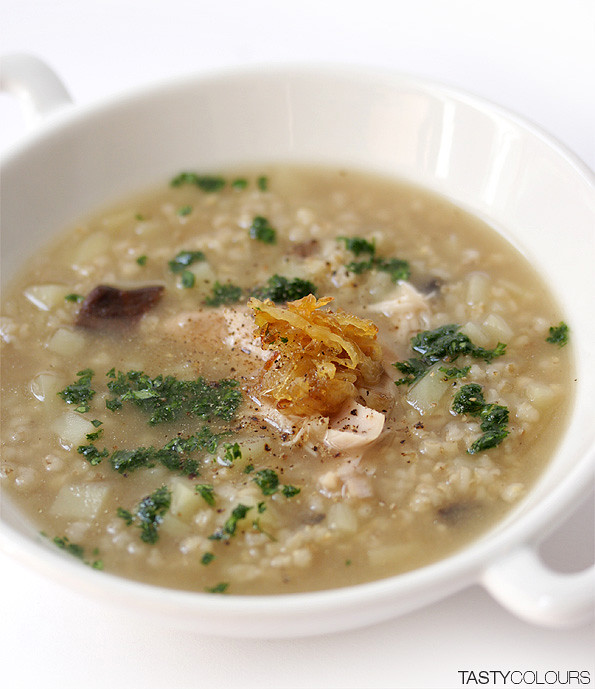
Today's recipe is made with rabbit meat. However, you can replace it with whichever meat you like, beef, chicken, or veal. You can make a vegetarian krupnik as well, without any meat. The soup is usually served with barley, but sometimes I use various grains, for example, bulgur or quinoa. Caramelized onion is my own idea; you will not find it in traditional krupnik recipes.


Barley Soup (Krupnik) with Caramelized Onion


Ingredients
Serves 4 to 6

For the soup
Rabbit – 21 oz (600 g) (preferably a body and two legs)
Pearl barley – 3.5 oz (100 g)
Carrots - 2 medium, peeled and washed
Root parsley or parsnip - 1 medium, peeled and washed
Celery root - 1/3 medium, peeled and washed
Leek - 1 small, washed and cut into halves
Onion - 1 peeled and cut into halves
Garlic clove - 1
Potatoes – 7oz (200 g), peeled, washed and cut into small cubes
Bay leaves - 2
Allspice - 3 grains
Black pepper - 4 grains
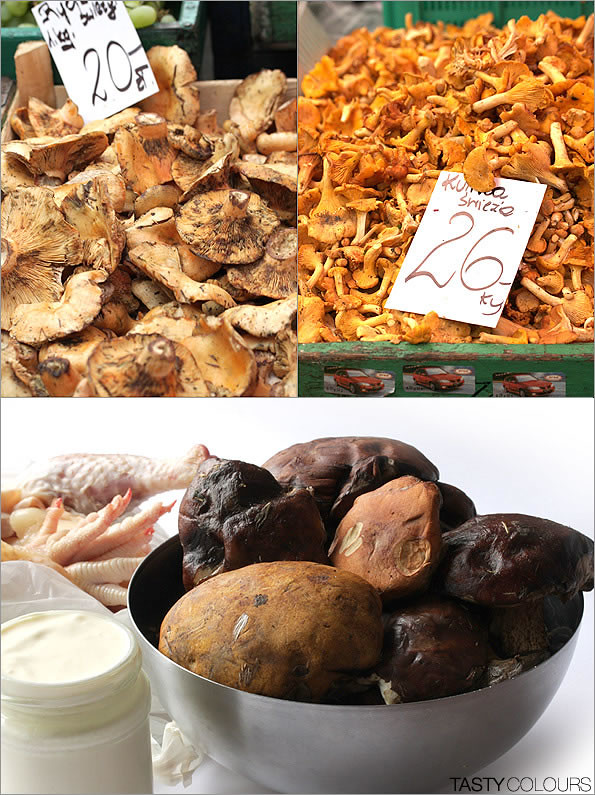
Dried ceps – 5 to 6
Sour cream – ½ a cup (120 ml)
Fresh parsley - 2 tablespoons, finely chopped
Salt
Pepper

For the caramelized onion:
Onion - 2 medium, peeled and cut into very thin slices
Olive oil - 3-4 tablespoons

Soak mushrooms in about 300 ml of water (1.25 cup) for at least 2 hours.

Prepare the broth: In a saucepan, bring to a boil about 1,6 l of water (1.7 quarts)
Add the meat, pepper grains, all spice and bay leaves.
Cook for about 30 minutes.
Then add carrots, root parsley, celery root, leek, onion, garlic, mushrooms and their soaking water.
Cook for another 30 minutes, until the vegetables and mushrooms become soft.

In the meantime, prepare caramelized onions:
In a hot frying pan, heat olive oil and put onions. Simmer for between 20 and 30 minutes, over a low flame until soft, golden and caramelized.
Mix often and do not let the onions burn.
Reserve.

Put barley in a thin strainer and wash it under running water, then strain and put aside.
Once the broth is ready, strain it.
Separate meat from the bones and slice it according to your liking.
Cut carrots and root parsley in small cubes; slice the mushrooms and put aside. Throw away all other leftovers.
Bring the broth to a boil again and add pearl barley.
Cook for about 5 minutes, under cover, on a medium flame, then add potatoes and cook under cover until the barley and potatoes are soft.
Finally add sliced meat, mushrooms, carrots and root parsley.
In the meantime, in a cup, mix a bit of broth with cream.
Remove the soup from the heat, add the cream mixture to the soup, mix everything well but do not cook. Season with salt, pepper and some freshly chopped parsley.

Serve immediately, hot, sprinkled with warm caramelized onions.

Friday, October 8, 2010

Mushroom Season Part 3

If you only knew how I have been eating lately, probably a lot of you, readers, would think: is this woman really writing a culinary blog? Or maybe she should rather write an anti-culinary one? No, I do not go to McDonalds (there is none in my neighborhood), but, for example, I had a hot dog with vegetables for lunch (I did not make it on my own, I bought it!), that I swallowed in 2 minutes….and a sandwich for breakfast….and no, I am not on a diet at the moment, but lately time has been flying faster than light, and there are so many new challenges in front on me, that I forgot how I  love to cook and eat. Today, I promised to myself, for example, that I will cook a savory chocolate risotto for dinner. However, I forgot to carefully check the ingredients for the dish, and since I found myself without any red chilies or cocoa powder at home, I will have to postpone this culinary fantasy…
This unusual behavior is due to the fact that I have been working on organizing the “Polish Days in Paris” project, which will take place next year on Place Saint-Sulpice (if everything goes well!).
All my energy is currently applied to preparing an application for a Governmental grant, which must be submitted by the end of October. Although the deadline seems fine, I am very concerned because everything seems to go so slow…
Anyone who already had to deal with this type of official paperwork should know what I am talking about, and how many telephone calls and meetings it requires…

Well, this explains why, today, I will bother you again with another mushroom recipe. Anyway the season will finish soon; the weather becomes worse, nights are really cold, close to ground frosts.

The recipe for the stuffing does not vary much from the classical recipe for Polish Style Dumplings with Potatoes and Cheese – “pierogi ruskie, except for chopped pine mushrooms.

The dough I made was slightly different from usual: instead of using sparkling mineral water, I added some fresh milk, and clarified butter. The dough is quite easy to work, although I believe than anyone who is not used to roll pierogi dough out, may complain.  Do not worry; after three or four failures you should succeed… My first pierogi dough was a disaster. Now, I make it from scratch, even without measuring the amounts of flour and liquid – simply, I have in my mind that the dough should be worked well, should be elastic and shiny….and if it is too sticky, I add a bit more flour; or, if it is too dry – I add a bit more milk. Much depends on the humidity in your kitchen and on the quality of the flour. I will not tell you whether it is easy to roll out, as I used my pasta machine which rolled the dough out evenly and thinly. The dough is very delicate and elastic, but even though do not roll it too thin – it may break during boiling. I encourage you to make Polish style dumplings at least once in your life, and although it is quite a lot of work, they are really worth it.
I probably do not know anyone who would not like those potatoes and cheese dumplings! And with pine mushrooms, they are even more interesting. Prepare the pierogi dough, using the ingredients listed in this recipe, but follow the instructions given in the “Basic Pierogi” recipe.

Polish Style Dumplings (Pierogi) with Potatoes, Curd Cheese and Sautéed Pine Mushrooms


Serves 4-6

Ingredients:

For the Pierogi dough:
280 g all purpose flour (plus some more extra)
2 tablespoons clarified butter
100 ml milk (plus some more extra)
1 egg
Salt

For the filling:
500 g potatoes
200 g dry curd cheese 
1 large yellow onion, peeled and finely chopped
5 tablespoons clarified butter
150 g pine mushrooms (lactarius delicious)
Salt and pepper to taste
Some extra clarified butter and fresh chopped parsley for garnishing

1. In a large saucepan, boil water and cook potatoes, with skin on.
2. In the meantime, delicately clean mushrooms from leftovers of the forest. Scratch the stems to remove soil. Rinse the mushrooms delicately under cold water. Chop them finely.
3. Strain potatoes and let cool down a bit; peel them when still warm and mash them using a potato masher. Let potatoes cool down. Using the potato masher, mash the cheese. Working with hands, carefully mix potatoes and cheese. Put aside.
4. In a hot frying pan, heat clarified butter (how to prepare clarified butter, check this recipe, add onions and fry them over medium heat, mixing often, between 5 to 10 minutes. Do not let onions burn.  Add mushrooms and sauté them for about 5 minutes, until nicely gold or until they release their juices and absorb them back in.
5. Combine onions and mushrooms into the potato / cheese mixture. Season with salt and pepper and mix again thoroughly. The taste should be quite seasoned.
6. Prepare and cook pierogi as described in the basic recipe.
7. Serve immediately after cooking with some more clarified butter and fresh chopped parsley.

Pierogi also taste great on the second day, grilled on a frying pan with a bit of butter.

Bon appétit! 

Wednesday, September 29, 2010

Mushroom season part 2


There exist a lot of quick-to-prepare dishes, which are so delicious despite their total simplicity. Two, or three ingredients of good quality and we are in a culinary heaven.

What are your favorite, simple and quick dishes (or accompaniments?) made out of two or three ingredients, which you love, and you like to come back to? Share with us!

Fried Lactarius Delicious mushrooms (or saffron milk caps, red pine mushrooms, in Polish - "rydze") is that type of delicacies.

To prepare this very seasonal Polish hot starter, you need only two ingredients – some nice, fresh mushrooms and a lot of butter (without counting salt and pepper). And a large frying pan also, so the mushrooms can fry evenly. 

Those carrot colour - sometimes slightly red - mushrooms are not as easy to buy as ceps, chanterelles or boletus badius, but still, they are popular in Poland (it is quite easy to find them, particularly in the south of the country). They are still quite cheap on the Kleparz market in Krakow (around 5 euro per kg), as in the south of the country we have a lot of pine forests – the tree, under which those mushrooms like to grow the most.
One can find them across Europe and North America.  Last year, I saw them in La Grande Epicerie de Paris, but the price was prohibitive and nobody was buying them.

Pine mushrooms are best when fried, grilled or pickled (how to pickle forest mushrooms, check here). This is how they traditionally are served in my country. I also used fried lactarius for the stuffing of my pierogi. Two people who tasted them confirmed that they are good enough to be shown on the blog – so check out my next post!

In Poland, we are used to dry forest mushrooms and we use them out of the season for the preparation of many dishes.  However, pine mushrooms are not suitable for drying out, as opposed to boletus or ceps. Avoid adding them into soups because they are not suitable for boiling. Just grilling or frying them releases their taste. Their flat and wide caps are ideal for this type of preparation. The taste is a bit nutty, particular. Use clarified butter in this recipe, which has higher smoke point than regular butter, to prevent the ingredients from burning.

Pine Mushrooms Fried in Butter 
Ingredients:
Serves 2 as a starter
300 g fresh pine mushrooms
60 g butter
Salt
Pepper

1. Delicately clean mushrooms from leftovers of the forest. Scratch the stems to remove soil. Rinse the mushrooms delicately under cold water. Separate stipes (mushroom stalks) from caps.

2. In a saucepan, slowly melt butter over minimum heat (do not stir). Remove from heat and skim the foam off the surface. Spoon the butter into a bowl. Discard the milky sediment.

3. In a hot large frying pan, heat butter, add mushrooms (they should not be crowded, so they can grill evenly) and fry them on each side for about 4 to 7 minutes, until nicely grilled (depending on the thickness their caps) and until they release their juices and absorb them back in (when frying over high heat, they should not release a lot of juice). Salt and pepper and serve immediately with slices of country bread.

Bon appétit!

Friday, September 24, 2010

A Season for Forest Mushrooms


I mentioned in my first posts (for example, in the post about pickled ceps) that the flavor of forest mushrooms, both dried or fresh, is an essential ingredient of Polish cooking and this is one of my favorite ingredients in the kitchen. I already wrote about pickled ceps, Zrazy and potato pancakes with chanterelle sauce.

We are in the middle of the forest mushroom season here in Poland, so I could not hesitate to present some of our Polish style seasonal mushroom specialties. Poland is still relatively rich with forests and one can quite easily find in them edible and non edible mushrooms. This is also due to the quite humid climate. When I was a kid, we were spending each holiday in the mountains, and we dedicated a lot of time to “mushroom escapades”. Nowadays, when I visit Kraków, I buy them on local food markets, in particular on Kleparz – my favorite food market in town.
There are sellers who have a license for selling forest mushrooms. Remember that some of the poisoning ones may resemble some those edible ones. I know a bit about mushrooms, but besides the cèpes family and chanterelles, I do not buy any other types of forest mushrooms from individuals who do not have a sales permit.

A lot of people practice mushroom hunting in forests, and each year the media report some traumatic news about some adults and children (who would gives forest mushrooms to young children?!) being killed or heavily sick after eating, for example, a death cap (Amanita phalloides - in Polish "muchomor sromotnikowy"), taken by mistake for a parasol mushroom (Macrolepiota procera - in Polish "kania") (by the way, parasol mushrooms are delicious especially grilled).

So, if you ever visit Poland during the mushroom season, eat them and enjoy them, but buy them in places where they are thoroughly checked. For that part, restaurants are safe.

Let’s start this mushroom season with a Polish style soup, which is one of my favorites in that time of the year.
I used homemade, rich chicken broth for it, but feel free to use any other type of broth. This time, I blended part of the mushrooms as I wanted my soup to be a bit thicker than usual. I used Boletus badius (in Polish - "podgrzybek brunatny"), which is very popular in Poland (although some chefs do not appreciate them), and Leccinum (in Polish - "kozak", "koźlarz"; growing in Europe and in North America) - both from the boletus family. You can use cèpes, of course, but they are much more expensive.


Polish Style Forest Mushroom Soup 


Ingredients
Serves 4-6
500 g boletus badius
500 g leccinum mushrooms
1 onion, peeled and finely chopped
1.5 l homemade chicken broth
4 tablespoons clarified butter
100 ml heavy cream
Fresh chopped dill or parsley for sprinkling
Salt
Pepper

Delicately clean mushrooms from leftovers of the forest. Scratch the stems to remove soil. Rinse the mushrooms delicately under cold water. Separate bigger stipes (mushroom stalks) from caps. Cut caps into thin slices. Put the stalks aside.
In a hot frying pan, heat butter, add onions and fry over medium heat around 10 minutes, mixing often. Do not let the onions burn. Add mushroom caps in the frying pan and sauté them until they release their juices and absorb them back in. Salt and pepper and put aside.
In a large saucepan, heat the chicken broth, add mushroom stalks and cook for about 15 minutes, until the mushrooms are completely soft. Strain the broth, reserve it, but discard stalks (you can use the stalks for the soup if you like, but stalks of my big mushrooms were spongy and soft this time).

Add mushroom caps with onions into the broth. Cook for another 10 minutes, until the juices mix well. Pour one half of the soup into a blender and reduce it to purée and add it back to the remaining half of the soup (you should still see mushroom pieces in the soup). Pour a bit of the soup into a cup, add cream, mix well and add to the soup. Adjust the seasoning with salt and pepper, if necessary, and serve hot, sprinkled with fresh, chopped herbs (I used Polish dill).

The soup goes very well with noodles.

And finally to close this post: some time ago I was invited by Polish bloggers to list 10 things that I like, so let’s go for it! Thanks a lot guys for your invitation!

  • Swimming relaxes me and in the summer time I try to swim as much as possible, meaning a few times per week;
  • I like to watch documentaries and read reportages, in particular shot in other parts of the World;
  • Taking long walks releases my mind;
  • Showing the World to our daughter makes me happy;
  • I like to cook with my husband;
  • Laying down with a book at the end of the day is what I also like;
  • To be close to nature, to just watch it and think about nothing;
  • I love to drive a car and travel by train, in particular on long distances;
  • I like to listen to the music, although my music taste has changed over the years (I am getting older);
  • I like to work on things that I like.

Saturday, September 11, 2010

Home Made Veal Stock

In June, I presented the dish “Pierogi with Lamb”, for which I used my homemade veal stock reduced to demi - glace.
Stocks are the foundation of classic French Haute Cuisine. The French name for stock is fond - meaning “foundation”.  There exist two types of stocks: white stocks and brown stocks. The first ones are prepared from bones of birds, fish or veal, which are simmered in water with vegetables and herbs. They are lighter than brown stock – the second type.  To obtain a brown stock, one should fry or roast the bones first.  Brown stocks may be made from veal, beef, poultry, lamb, pork, venison or even shells or shellfish. 
This post is about brown veal stock. We make it at home several times per year. Some say that we are the last generation to learn how to cook with veal bones. It is not easy to buy them these days. Even in France, the legislation may change in the coming years, so we will not be able to buy them anymore. Still, we can buy them quite easily in butcher shops in Paris, and in Kraków.

As I already mentioned in my post about Pierogi with Lamb and Morels, veal stock is a kind of preparation that it is difficult to make at home (because, for example, in some countries you will not get any veal bones in any store – in this case one can use beef bones) and those industrial powdered stocks are hopeless. Moreover, to prepare homemade veal stock (or any other stock) is an absolute messy job. Furthermore, the authentic, homemade veal stock itself may not be very interesting in taste – its pure taste is not so pleasant. But what is fascinating about it is that once you combine it with other flavors, like for example, meat juices, wild mushrooms, butter, cream, garlic or alcohol - it becomes something absolutely outstanding.

There are tons of veal stock recipes. Some people like to dust the bones with flour before roasting them, others (like us) prefer not to roast the vegetables, or to deglaze the roasting pan with wine. Some prefer to add vegetables just one hour before the end of cooking. Others like to add bouqet garni. Just feel free to choose your favorite options. The recipe that I present here was given to me by my husband who taught me how to make good, classical veal stock and demi-glace. The recipe comes from one of the French restaurants, which he had been working et when he was younger.

Once your veal stock is ready, you can play with it further and reduce it to about one third and make a more concentrated stock called demi-glace , or reduce it even more (as little as a tenth of its original volume) – to obtain a glace – a sticky reduction ideal to flavor your sauces. I know: those sauces made with veal stock are not very light; but they are delicious; moreover, we do not eat them every day.

You will find here some advices to prepare a good veal stock, that I collected from my husband and from Michael Booth’s book (which helped me to write this post). Please note another book that I recently found: “Le Cordon Bleu’s Complete Cooking Techniques”.

I recommend cooking your own veal stock at least once in your life. If you cannot buy fresh veal bones, try to cook beef stock, following these instructions and the recipe:

(i)  Use good bones (the fresher, the better), cut into small pieces;
(ii) Use fresh vegetables (“a stock made with garbage will taste like garbage” – Alice Walters – Chez Panisse) the so called “mirepoix” (combination of carrots, onions, celery and sometimes garlic and shallots);
(iii)  The mirepoix should not dominate the flavor of the stock, so do not use too much of it (maximum around 20 per cent the weight of mirepoix to bones);
(iv) You can add a bouqet garni (a mixture of laurel leaves and thyme, sometimes parsley stems as well); we do not add any, as we want to have a clear, blend stock, which we will use later for various sauces of different flavors;
(v)  We do not salt and pepper the stock, because it constitutes a base for sauces, which will be reduced and seasoned later; if you will salt the stock during simmering the risk is that you will waste your job because the salty taste will intensify after reduction;
(vi) It is important to simmer the stock for at least a few hours – a stock which will not be cooked enough, will be watery and without flavor; and on the contrary, a stock which will be overcooked may become bitter;
(vii) Do not use a nonstick frying pan or saucepan to roast the bones – you need a good “sticky” roasting-pan, so you can deglaze all goods that stuck to its surface while roasting the bones.

Ingredients:
3 to 4 kg good quality and fresh veal bones, cut into pieces by your butcher, rinsed under cold water and dried (you can replace veal bones by beef bones, but beef stock is not as good as veal stock, because veal bones have more gelatin so the sauce will look better)
4 big onions, washed from soil, dried (but not peeled!), cut into halves
2 small cans of tomato paste
2 to 3 stalks of celery, washed and chopped in thick slices
3 carrots, washed and cut into thick slices
1 large, thick-bottomed roasting pan
1 large saucepan of about 10 liter capacity (the best is a narrow and high saucepan to minimize evaporating during cooking)
1large strainer
1”chinois” or muslin

Heat the oven to 220° Celsius (430° Fahrenheit). Place the bones in the roasting pan and place the pan in the oven for about 1.15 to 1.5 hours. Be careful – the bones should brown evenly, and not burn. For that purpose, occasionally remove the roasting pan from the oven and flip the bones.


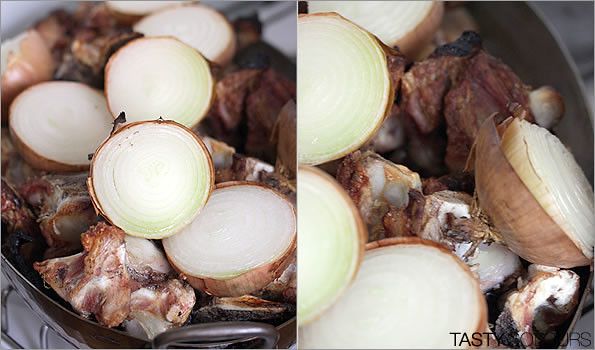
Once the bones are slightly gold (after about one hour), place onions on top of the bones. Roast everything another 15 to 20 minutes (you should really watch the onions and bones to prevent them from burning).


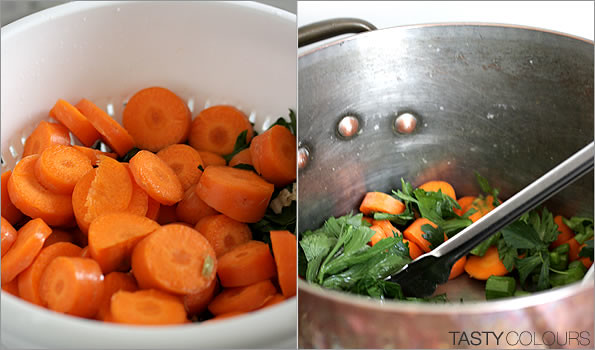
In the meantime, add slices of celery and carrot into the saucepan.


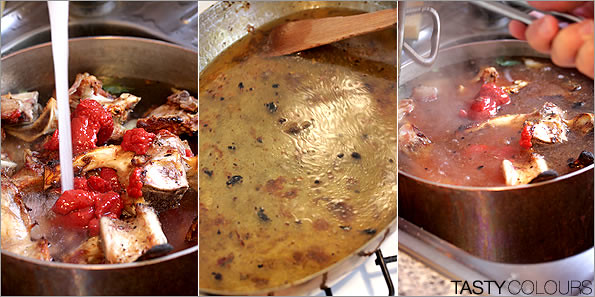
Then remove the roasting pan from the oven. Add onions and bones to the saucepan. Add tomato paste.
One important thing: the bones render some fat while roasting. Drain off as much of the fat as possible, using a sieve to catch the precious brown bits from the bottom of the pan. Do not throw away those brown bits! Pour some water into the roasting pan and deglaze it over heat by scraping all browning from the pan. Pour the liquid into the saucepan with bones and vegetables.


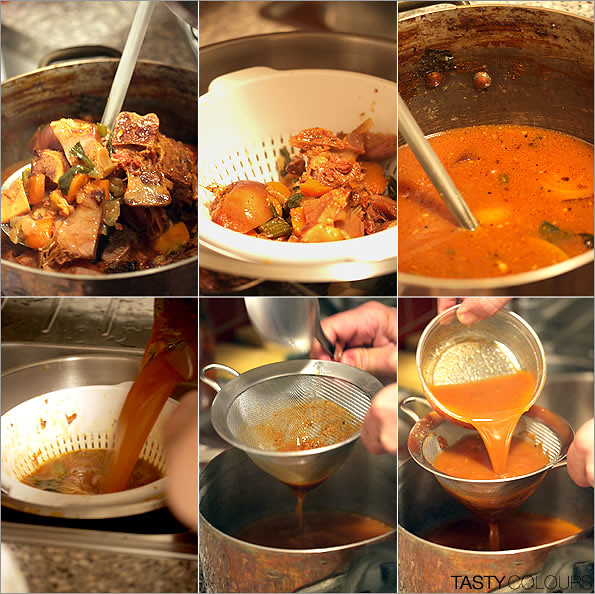
Fill the saucepan with cold water (about 5 cm above the level of the bones) and bring to a boil. Then reduce the heat to an absolute minimum, so it can simmer. It should simmer gently between 5 and 6 hours. Simmering does not stir up impurities in the way that a rolling boil would and keeps the stock clearer. The bones have to have enough time to give their full flavor. Occasionally, using a ladle, remove the impurities (mostly fat) which will rise to the top.


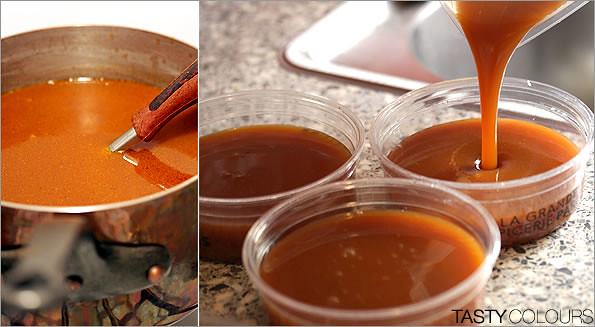
Using a ladle, strain the stock through a strainer set over a large bowl. Discard bones, vegetables and all other big solids. Then, using a “chinois” or a muslin, strain the stock once more, in order to get rid of smaller solids. Your stock is ready to use. It should have the brownish-cold color, similar to something between milk chocolate and caramel. At this stage, you can pour portions of the stock into plastic containers and freeze it, should you wish to use it later.


If you want to make demi-glace, apply the following instructions: pour the stock into a smaller saucepan and bring it to a boil. Once it is boiling, reduce the heat to a minimum. Simmer for about one hour - the cooking time will however depend on the thickness of the stock - sometimes you will need a bit less, sometimes more time. The best test to do is to pour a bit of stock into a cup and place it in the fridge. Once it thickens when cooled down, the stock is ready.  Occasionally, with a ladle, remove the foam which will form on the top.
Pour the veal stock into small plastic containers or ice cubes moulds. Once it is cooled down, freeze it and use it when needed.


Thursday, September 2, 2010

Food Festival in Gruczno

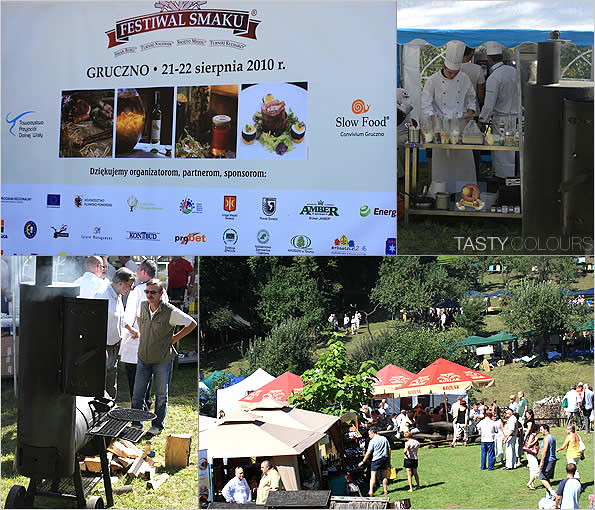
Forgive me for taking a long break in posting. The weekend before last, my husband and I went to the most renowned Food Festival in Poland, in the north of the country. And last weekend, we visited in Kraków the final session of the Małopolski Food Festival (“Festiwal Smaku”) – a food event for producers from the south of Poland. In the meantime, I have been bothered by an invalidating back pain and I had to reduce the sitting position to a minimum.

The Food Festival in Gruczno takes place every August.  This little town is located 500 km from Kraków, and about 100 km from the seaside. It probably is the largest and the most renowned festival of producers of artisanal and organic food products.

Food festivals have developed in Poland a few years ago only, thanks mostly to our membership to the European Union, which financially supports the development of regions. While the Małopolski Food Festival in Kraków is reserved for producers from the Małopolska region, the festival in Gruczno also welcomes producers from other regions, and for that reason it is more interesting. If you ever travel to northern Poland in August, try to visit this place. The best is to get there by car although driving in Poland is definitely not a pleasure (roads are rutted, people drive fast and aggressively). And while in Gruczno, you might as well visit the beautiful old town of Chełmno. Why not extend your visit to some of the biggest touristy attractions in the region: the city of Gdańsk, the Castle Museum in Malbork – one of the largest Middle Ages castles of the Teutonic Knights - around one hour of driving. Or Toruń – which is around 45 minutes of driving.


I had been hesitating to visit the festival for quite a while and we kind of decided to go there at the last minute. As we did not plan in advance where we could sleep, it was no surprise that the only “Chambre d’Hôtes” we found ad hoc was a stinky rat hole. I usually am not such a maniac as regards to sanitary conditions. But in this place, I was disgusted by the fact that sheets and pillow cases were not fresh. However, we arrived at 1 a.m. after 500 km of driving including 300 km in a huge traffic jam (it took us a total of 10 hours to get there). At that point, the physiological need to sleep was stronger than our will to find a more civilized and cleaner place. All in all, one can put a clean towel on a dirty pillow case and sleep well. The following morning, we got up very early and we arrived at the Festival as one of the first guests, a few hours before its official opening. Thanks to that I could have a few nice chats with several producers.

Around one hundred producers of organic or regional products from the whole country come to Gruczno. Some regions, like the North are better represented than the South or the East (they have their own food festivals). The producers encourage visitors to taste all their products – some of them quite famous, some of them forgotten or not so well known:

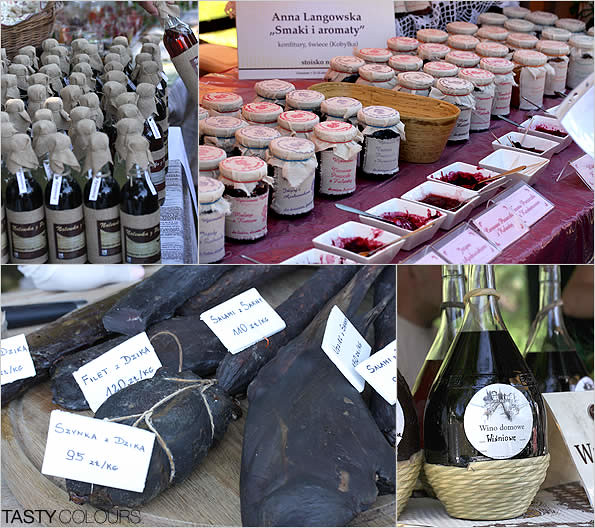
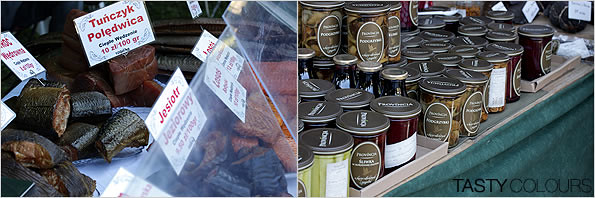
Hams (“szynki”), Sausages (“kiełbasy”), Kabanos (“kabanosy” – a thin and long sausage commonly made from pork, sometimes from other types of meat, including horse meat) and other charcuterie products made from pork (the most popular meat used for Polish charcuterie items). Besides pork, I tasted lamb and goat sausages - both interesting in taste (I have never seen them in any shops); Polish traditional charcuterie is cooked and smoked (not all foreigners like that particular smoked taste);


Półgęsek (“goose breast”) – an old dish made from boneless goose breast with the skin on, cured and slowly smoked in cold smoke. In some regions of Poland “półgęsek” was prepared from the whole goose carcass (without legs and wings). The dish was a luxury one, but in the 19th century became especially popular in the Northern region of Pomorze, where breeding of geese was popular. The texture is similar to raw ham; the characteristic taste of smoked, raw meat (similar duck breasts may be found in France). You will not find it in shops in Southern Poland. There is one place serving this Polish specialty abroad: the Polish restaurant in London, recently opened by the renowned Polish restaurateur, Adam Gessler. In Warsaw, you will find it in the restaurant “U Kucharzy.

Cheeses (“sery”) ; except for oscypek, bryndza and bundz (local and genuine cheeses from the south of Poland, which I already wrote about in my previous posts and fresh goat cheeses, one could find “korycińskie cheeses” (“sery korycińskie”). This cheese is a regional and traditional product from the east of Poland. Its name derives from a town called Korycin, located not far away from the famous Biebrza National Park. It is made from unpasteurized cow’s milk, with the addition of rennet. The cheese is harder than bundz, but its jangling texture is somehow similar. It is sold in large, round “loaves” of about 3 kg.  With maturity, it changes in taste, color and smell – for example, its texture, which initially is soft, becomes hard over time and its mild cream taste acquires a hint of salt over time.
Unlike bundz, koryciński cheeses are flavored with various herbs and spices. According to a local legend, the method of the cheese production was brought to the region by Swiss soldiers, engaged in the Polish Army during the Polish – Swedish War (“potop szwedzki”) in the 17th century. I further tasted cheeses from a few other producers who make hard cured cheeses of Italian or French styles. Amongst them, I met Rusłan Kozynko who produces cheeses that are close enough to a Parmiggiano, a Pecorino or a French Blue cheese (something between Roquefort and Bleu d”Auvergne).  All of them are worth mentioning and worth tasting as well, although I had a slight feeling that the blue cheese was overdone a bit. Their products, manufactured in Mazury (Northeast Poland) are available on the company’s website (vacuum packaging of the products allows for safe shipping).
I also visited the booths of two other renowned slow-food producers of hard cheeses. As far as I know, their products are available through their websites.


Powidl (“powidła”) – traditional plum preserves made from Polish plums, fried slowly over a bonfire in huge cauldrons; industrially made preserves are available in every food store; artisanal ones are not so easy to buy;

Fruit Preserves (“konfitury”) – very traditional ones as well as some with the addition of non typically Polish spices and flavors) (for example cardamom, amaretto); as well as naturally pressed fruit juices (“soki”) and fruit syrups (“syropy”);


Venison Charcuterie (“wędliny z dziczyzny”) – sausages and hams prepared from cured boar and roe deer meat. This type of charcuterie was more popular before the Second World War. The tradition to prepare it is reviving slowly now. Venison meat is easily available in food shops in Poland, but charcuterie made from it is very rare (the products are awfully expensive as for Polish conditions). I also found charcuterie (including raw sausages), made from ostrich meat – which my stomach had a difficult time to digest, and which are not extraordinary in taste (ostrich farms have been popular in Poland in recent years; but I am not an amateur of this bird’s meat as ostriches do eat anything including mobile phones and pens!).

Nalewka (Liqueur – correct me, if my translation is not proper); It is a general name for a traditional strong alcoholic beverage (usually around 40 %). It is prepared by maceration of herbs, fruits, spices, flowers, sugar, honey and so on. As opposed to regular liquors, “nalewka” usually is aged and must be stored for several weeks, months, or even years, before its final preparation. Very often its name is derived from its main ingredient (for example: apricots (“morelówka”), haw (“głogówka”), juniper (“jałowcówka”). The most renowned manufacturer of home-made “nalewskas”, Mr Hieronim Błażejak from Toruń, probably gained all possible prizes in various festivals. He invented 162 different flavours (what a pity that his webpage is in Polish only).


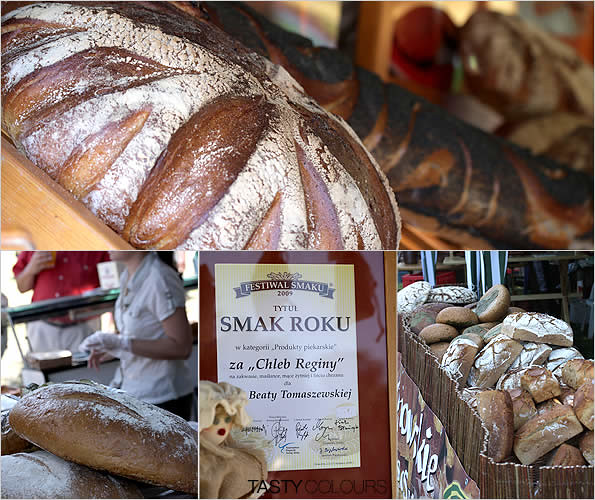
Breads (“pieczywo”; “chleby”): all possible types of organic wheat, spelt and rye breads; with the addition of spices, seeds and so on.


Pickles (“przetwory”) – omnipresent sour cucumbers and cabbage, but also pickled mushrooms (“grzybki marynowane”) – such as boletus, lactarius delicious, chanterelles; and other pickled vegetables;

Smoked fish (“wędzone ryby”) – Poland has a lot of lakes; the quality of soft water is unequal now, but there are still some clean lakes, rich with various types of fish. Warm smoking soft water fish have been popular in Poland for ages. Nowadays it is difficult to find good artisanal products like those I saw in Gruczno. This is true with many other products, of course. Distribution channels are weak, too, and in the south of Poland, Northern specialties are rare (in addition, small entrepreneurs cannot afford to have their products carried by big food store chains). Their smoked soft water fish like, for example, smoked eel, was excellent, full of flavor, not too salty and not too dry. On the contrary, smoked tuna and smoked tiger shrimps did not enslave my heart; the fish were awfully expensive (as far as I remember, around 20-25 euros per kilo);


Organic Oils, like, for example - Colza Oil or Linen Oil (the first one made by the Rutkowski family. For years, colza oil had a bad reputation in Poland, because in the eighties one could buy only refined modified oil, which was unhealthy. It is slowly changing nowadays. The oil is made from Polish non modified colza seeds and is rich in unsaturated fatty acids.  The linen oil, made by Krystyna just received a first place award in its category during the Festival.

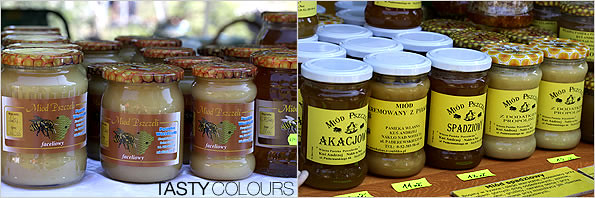
Organic Honeys (“miody”) from small apiaries from various types of local trees and flowers; traditional cakes, cookies and sweets; local fruits and vegetables;


Some exhibitors presented foreign organic wines, tea and cider from the Basque country or Greek products including halva (of which I am not a great fan).

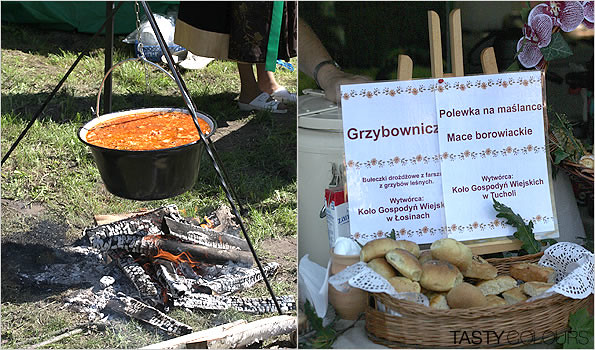
Aside from the products that were presented, one could also taste some regional dishes, such as: traditional dumplings, regional soups (for example, a type of sour cabbage soup from the Podhale region – “kwaśnica”; buttermilk soup; fried or marinated fish; baked potatoes with fillings; sausages, hunter’s stew – “bigos”, meats, including venison). Nevertheless, I can no longer look at the traditional, huge slices of bread spread with lard - pork’s fat (“smalec”) and topped with sour cucumber. This peasant, particular preparation despite the change of a political system, is still the king of food festivals!


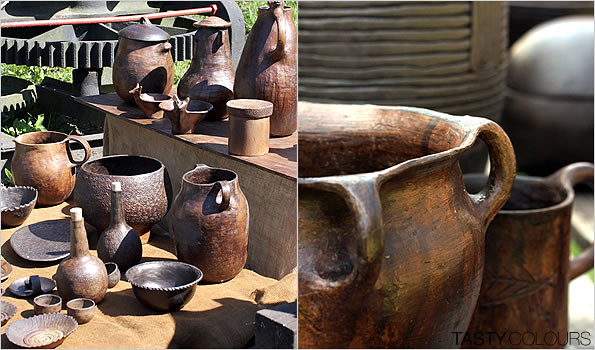
Finally, I was absolutely fascinated by Barbara Rożniak’s products. Her clay plates, pots, pans and jugs take you into the early Middle Ages. They are made using original methods from the Middle Ages, and for the purpose of rediscovering them, Barbara has visited numerous archeological sites.  She is regularly invited to many events in Poland and abroad.


Related Posts Plugin for WordPress, Blogger...