Thursday, September 2, 2010

Food Festival in Gruczno

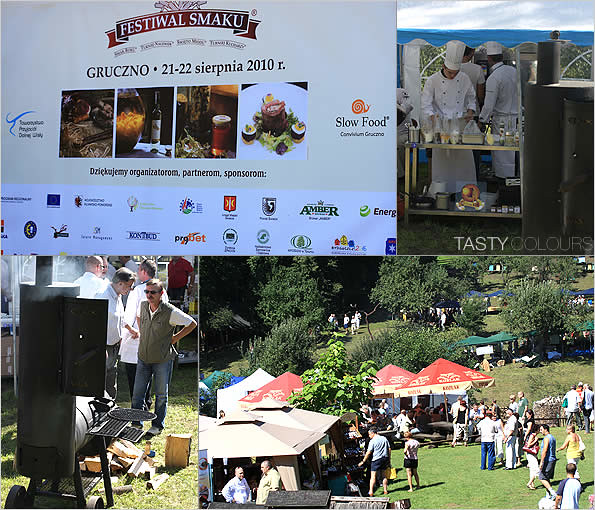
Forgive me for taking a long break in posting. The weekend before last, my husband and I went to the most renowned Food Festival in Poland, in the north of the country. And last weekend, we visited in Kraków the final session of the Małopolski Food Festival (“Festiwal Smaku”) – a food event for producers from the south of Poland. In the meantime, I have been bothered by an invalidating back pain and I had to reduce the sitting position to a minimum.

The Food Festival in Gruczno takes place every August.  This little town is located 500 km from Kraków, and about 100 km from the seaside. It probably is the largest and the most renowned festival of producers of artisanal and organic food products.

Food festivals have developed in Poland a few years ago only, thanks mostly to our membership to the European Union, which financially supports the development of regions. While the Małopolski Food Festival in Kraków is reserved for producers from the Małopolska region, the festival in Gruczno also welcomes producers from other regions, and for that reason it is more interesting. If you ever travel to northern Poland in August, try to visit this place. The best is to get there by car although driving in Poland is definitely not a pleasure (roads are rutted, people drive fast and aggressively). And while in Gruczno, you might as well visit the beautiful old town of Chełmno. Why not extend your visit to some of the biggest touristy attractions in the region: the city of Gdańsk, the Castle Museum in Malbork – one of the largest Middle Ages castles of the Teutonic Knights - around one hour of driving. Or Toruń – which is around 45 minutes of driving.


I had been hesitating to visit the festival for quite a while and we kind of decided to go there at the last minute. As we did not plan in advance where we could sleep, it was no surprise that the only “Chambre d’Hôtes” we found ad hoc was a stinky rat hole. I usually am not such a maniac as regards to sanitary conditions. But in this place, I was disgusted by the fact that sheets and pillow cases were not fresh. However, we arrived at 1 a.m. after 500 km of driving including 300 km in a huge traffic jam (it took us a total of 10 hours to get there). At that point, the physiological need to sleep was stronger than our will to find a more civilized and cleaner place. All in all, one can put a clean towel on a dirty pillow case and sleep well. The following morning, we got up very early and we arrived at the Festival as one of the first guests, a few hours before its official opening. Thanks to that I could have a few nice chats with several producers.

Around one hundred producers of organic or regional products from the whole country come to Gruczno. Some regions, like the North are better represented than the South or the East (they have their own food festivals). The producers encourage visitors to taste all their products – some of them quite famous, some of them forgotten or not so well known:

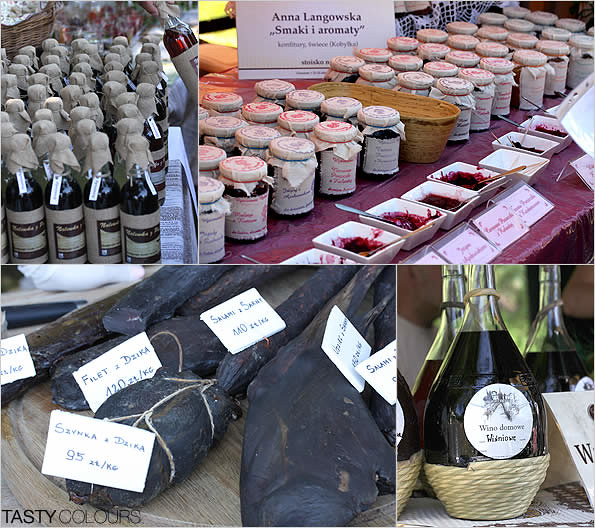
Hams (“szynki”), Sausages (“kiełbasy”), Kabanos (“kabanosy” – a thin and long sausage commonly made from pork, sometimes from other types of meat, including horse meat) and other charcuterie products made from pork (the most popular meat used for Polish charcuterie items). Besides pork, I tasted lamb and goat sausages - both interesting in taste (I have never seen them in any shops); Polish traditional charcuterie is cooked and smoked (not all foreigners like that particular smoked taste);


Półgęsek (“goose breast”) – an old dish made from boneless goose breast with the skin on, cured and slowly smoked in cold smoke. In some regions of Poland “półgęsek” was prepared from the whole goose carcass (without legs and wings). The dish was a luxury one, but in the 19th century became especially popular in the Northern region of Pomorze, where breeding of geese was popular. The texture is similar to raw ham; the characteristic taste of smoked, raw meat (similar duck breasts may be found in France). You will not find it in shops in Southern Poland. There is one place serving this Polish specialty abroad: the Polish restaurant in London, recently opened by the renowned Polish restaurateur, Adam Gessler. In Warsaw, you will find it in the restaurant “U Kucharzy”.

Cheeses (“sery”) ; except for oscypek, bryndza and bundz (local and genuine cheeses from the south of Poland, which I already wrote about in my previous posts and fresh goat cheeses, one could find “korycińskie cheeses” (“sery korycińskie”). This cheese is a regional and traditional product from the east of Poland. Its name derives from a town called Korycin, located not far away from the famous Biebrza National Park. It is made from unpasteurized cow’s milk, with the addition of rennet. The cheese is harder than bundz, but its jangling texture is somehow similar. It is sold in large, round “loaves” of about 3 kg.  With maturity, it changes in taste, color and smell – for example, its texture, which initially is soft, becomes hard over time and its mild cream taste acquires a hint of salt over time.
Unlike bundz, koryciński cheeses are flavored with various herbs and spices. According to a local legend, the method of the cheese production was brought to the region by Swiss soldiers, engaged in the Polish Army during the Polish – Swedish War (“potop szwedzki”) in the 17th century. I further tasted cheeses from a few other producers who make hard cured cheeses of Italian or French styles. Amongst them, I met Rusłan Kozynko who produces cheeses that are close enough to a Parmiggiano, a Pecorino or a French Blue cheese (something between Roquefort and Bleu d”Auvergne).  All of them are worth mentioning and worth tasting as well, although I had a slight feeling that the blue cheese was overdone a bit. Their products, manufactured in Mazury (Northeast Poland) are available on the company’s website (vacuum packaging of the products allows for safe shipping).
I also visited the booths of two other renowned slow-food producers of hard cheeses. As far as I know, their products are available through their websites.


Powidl (“powidła”) – traditional plum preserves made from Polish plums, fried slowly over a bonfire in huge cauldrons; industrially made preserves are available in every food store; artisanal ones are not so easy to buy;

Fruit Preserves (“konfitury”) – very traditional ones as well as some with the addition of non typically Polish spices and flavors) (for example cardamom, amaretto); as well as naturally pressed fruit juices (“soki”) and fruit syrups (“syropy”);


Venison Charcuterie (“wędliny z dziczyzny”) – sausages and hams prepared from cured boar and roe deer meat. This type of charcuterie was more popular before the Second World War. The tradition to prepare it is reviving slowly now. Venison meat is easily available in food shops in Poland, but charcuterie made from it is very rare (the products are awfully expensive as for Polish conditions). I also found charcuterie (including raw sausages), made from ostrich meat – which my stomach had a difficult time to digest, and which are not extraordinary in taste (ostrich farms have been popular in Poland in recent years; but I am not an amateur of this bird’s meat as ostriches do eat anything including mobile phones and pens!).

Nalewka (Liqueur – correct me, if my translation is not proper); It is a general name for a traditional strong alcoholic beverage (usually around 40 %). It is prepared by maceration of herbs, fruits, spices, flowers, sugar, honey and so on. As opposed to regular liquors, “nalewka” usually is aged and must be stored for several weeks, months, or even years, before its final preparation. Very often its name is derived from its main ingredient (for example: apricots (“morelówka”), haw (“głogówka”), juniper (“jałowcówka”). The most renowned manufacturer of home-made “nalewskas”, Mr Hieronim Błażejak from Toruń, probably gained all possible prizes in various festivals. He invented 162 different flavours (what a pity that his webpage is in Polish only).


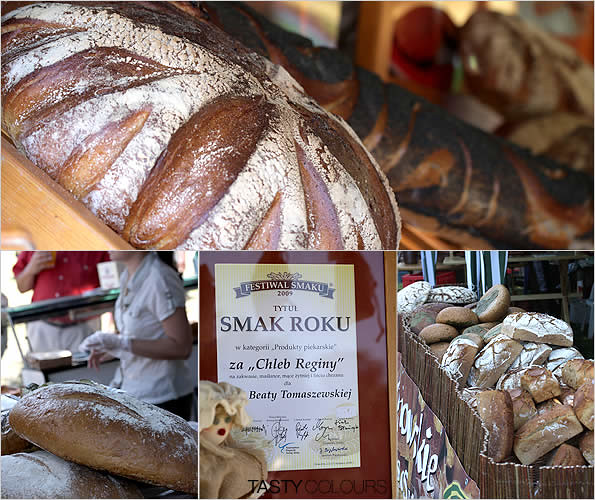
Breads (“pieczywo”; “chleby”): all possible types of organic wheat, spelt and rye breads; with the addition of spices, seeds and so on.

Pickles (“przetwory”) – omnipresent sour cucumbers and cabbage, but also pickled mushrooms (“grzybki marynowane”) – such as boletus, lactarius delicious, chanterelles; and other pickled vegetables;

Smoked fish (“wędzone ryby”) – Poland has a lot of lakes; the quality of soft water is unequal now, but there are still some clean lakes, rich with various types of fish. Warm smoking soft water fish have been popular in Poland for ages. Nowadays it is difficult to find good artisanal products like those I saw in Gruczno. This is true with many other products, of course. Distribution channels are weak, too, and in the south of Poland, Northern specialties are rare (in addition, small entrepreneurs cannot afford to have their products carried by big food store chains). Their smoked soft water fish like, for example, smoked eel, was excellent, full of flavor, not too salty and not too dry. On the contrary, smoked tuna and smoked tiger shrimps did not enslave my heart; the fish were awfully expensive (as far as I remember, around 20-25 euros per kilo);
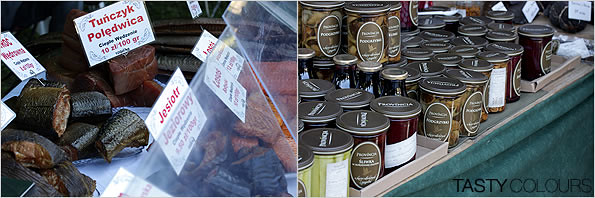

Organic Oils, like, for example - Colza Oil or Linen Oil (the first one made by the Rutkowski family. For years, colza oil had a bad reputation in Poland, because in the eighties one could buy only refined modified oil, which was unhealthy. It is slowly changing nowadays. The oil is made from Polish non modified colza seeds and is rich in unsaturated fatty acids.  The linen oil, made by Krystyna just received a first place award in its category during the Festival.

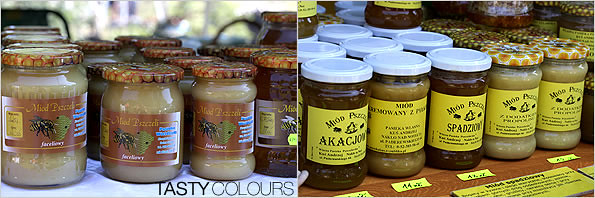
Organic Honeys (“miody”) from small apiaries from various types of local trees and flowers; traditional cakes, cookies and sweets; local fruits and vegetables;

Some exhibitors presented foreign organic wines, tea and cider from the Basque country or Greek products including halva (of which I am not a great fan).

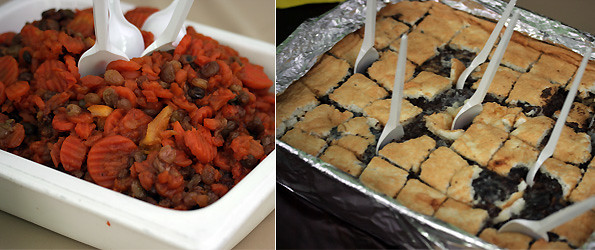
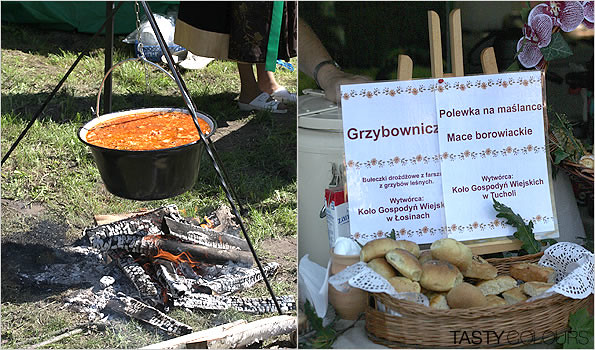
Aside from the products that were presented, one could also taste some regional dishes, such as: traditional dumplings, regional soups (for example, a type of sour cabbage soup from the Podhale region – “kwaśnica”; buttermilk soup; fried or marinated fish; baked potatoes with fillings; sausages, hunter’s stew – “bigos”, meats, including venison). Nevertheless, I can no longer look at the traditional, huge slices of bread spread with lard - pork’s fat (“smalec”) and topped with sour cucumber. This peasant, particular preparation despite the change of a political system, is still the king of food festivals!


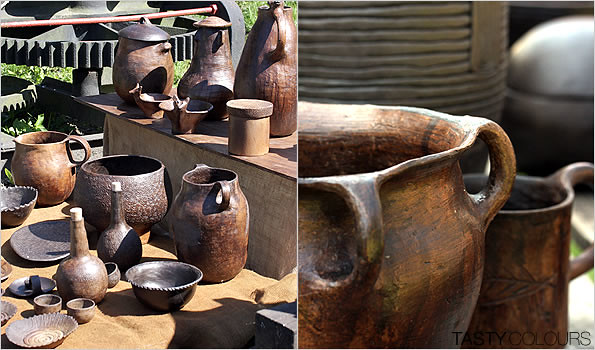
Finally, I was absolutely fascinated by Barbara Rożniak’s products. Her clay plates, pots, pans and jugs take you into the early Middle Ages. They are made using original methods from the Middle Ages, and for the purpose of rediscovering them, Barbara has visited numerous archeological sites.  She is regularly invited to many events in Poland and abroad.


Sunday, August 15, 2010

A Very Problematic Bean


One of my father’s summer culinary memories from his childhood is a very simple and rustic dish: young giant white beans cooked with slices of bacon and then served with fried onions and a lot of butter. Those beans are commonly called in Polish “fasola Jaś”.

It was not easy to find the English name for those beans. I raised the question on one Polish culinary forum to help me find a proper translation. Here are their suggestions:
- Butter Beans;
- Lima Beans;
- Broad Beans;
- Jack Beans;
- White Emergo Beans
- Giant Beans
- Jaś Karłowy Runner Bean
- Elephant Beans

It is not surprising that one can be lost in this nomenclatural mess, as Julia Child was lost while trying to find English equivalents for French names of fish when she had been working on her first book.
To make a long story short, following the Official Journal of the European Union, it seems that “Jaś Karłowy Runner Bean” (Phaseolus coccineus) is the official English name.  It is a regional product, cultivated in southern Poland, in the Nida and Wisła lowland. Probably it still does not ring a bell. Thanks to readers of the Polish culinary forum, I found out that this type of local giant beans may be replaced, for example, by White Emergo Beans.

Those beans are very popular in Poland. One can buy them dry all year round in nearly every shop. They are white, oval, a bit flat, usually 2 to 3 cm long.  They contain a lot of protein, minerals (phosphorus and calcium) and vitamins.

On the opposite, young and fresh butter beans are available only in summer time, in August, and they are not so common, as opposed to dry ones. They are covered by a thin, white skin. Fresh seeds are light green. Their taste is not as floury as the one of dried white beans and you do not have to soak them in water, which is the reason that usually prevents me from preparing dishes with dried beans.

I am ashamed that, until last May, I had no idea that those beans were available fresh in the summer. Or rather my father should be ashamed, when he reproached me once: “And why don’t you cook fresh runner beans”? He asked. “What? Green runner beans? What are you talking about?” – I yelled. It was obvious that I had to find those beans once they would be in season. And here you have them.

This recipe is based on my grandma’s preparation, which was transmitted to me by my father. I served them with fried baby ceps (boletus), which appeared two weeks ago on a local food market. I could not refrain from adding some fresh thyme and grilling an extra 2 slices of bacon.

White “Jaś Karłowy” Runner Beans with Fried Ceps


300 g white fresh Jaś Karłowy Runner Beans (which you can replace with any other fresh white beans)
300 g fresh ceps (boletus)
Fresh thyme
3 shallots, peeled and finely chopped
1 big garlic clove, peeled and finely chopped
5 tablespoons butter
2 tablespoons olive oil
4 slices bacon
Salt
Pepper


Prepare the beans: place the beans and 2 slices of bacon in a saucepan and cover with water (1 cm above the level of beans). Add some salt and cook (under the cover) until soft, but not overcooked (depending on the size of the beans, between 30 minutes and one hour). You really have to taste them. Strain them. Discard cooked bacon or use it for another purpose.

Prepare the mushrooms: Delicately clean mushrooms from leftovers of the forest. Scratch the stems to remove soil. Rinse the mushrooms delicately under cold water. Cut some mushrooms in halves, should some of them be too big. They all should be about the same size, so they will fry evenly. In a hot frying pan, melt butter, add onions and cook over medium flame for 5 minutes. Add garlic and fry for another 3 to 4 minutes. Do not let onions and garlic burn. Add mushrooms into the frying pan and sauté them over medium flame until they release their juices and absorb them back in. In the meantime, in a small frying pan, grill slices of bacon until gold and crispy. Add thyme, salt and pepper generously, stir and add beans. Serve immediately with grilled bacon on top accompanied with slices of some good grilled bread.

Tuesday, August 10, 2010

Blog of the week Publication


I would like to share with you some good news. The Polish internet magazine “Ugotuj.to” (“Cook.that”) handles a cycle called “Blog of the Week”, designated to the presentation of Polish food blogs. Yesterday, it published a brief interview with me, where I present my blog, I share my opinions and ideas about Polish and French culinary traditions, as well as food habits of Parisians.

I also revealed some news concerning my first book about Polish culinary traditions, which should be published in English, after some further revisions and final work are completed, in a close future.  I also informed that I have been working for some time on a project about “Polish Food Days in Paris”, which – if everything goes well – should take place in Paris, at the fall of 2011, when Poland will held the Presidency of the European Union. I will be informing you about those coming events. 

I also would like to thank all of you who left warm comments after the interview!


or

Tuesday, August 3, 2010

Yellow, Yellow, Yellow


Do you remember that in my last post I was complaining that I did not have enough courage for cooking because of tropical temperatures? And now you know what? I came back to cooking, and this is mainly what this post is about.

August started which means that the season for all types of soil tomatoes finally started. We can actually enjoy these summer tomatoes only for two or three months a year.  The season is too short, but I dare to say that our local tomatoes are not worse than those from southern Europe. When I am in Krakow in the summertime, I always buy extraordinary ones, on the food market I my neighbourhood, from a nice woman, who, twice per week, sells tomatoes straight from her farm in various sizes, shapes and colours. When I come back to France by car, I always buy a crate of them. Not because they are cheaper than in Paris, but simply because they are delicious. A quintessence of tomato in a tomato. Skins which peel easily without blanching them in boiling water. Pulpy, juicy but not watery. Sweet.

This is nothing special for those, who have access to great organic food markets in NYC, London or Paris. But for me, who watches the changes in my country, the discovery of various types of tomatoes on a small provincial food market is a tiny proof that something has been changing in my country. I remember from my childhood only one type of plain, round red tomatoes. One could only dream about Lima or Buffalo, or cherry tomatoes.  Or yellow ones.

The leitmotiv for last Saturday’s lunch, which I prepared for my father, was the colour yellow. Soup, tart, pesto… The monotony of yellowness was slightly disturbed by “Bruschettas with Young Beans and Grilled Bacon”, as well as by “fried Chanterelles, Spinach and Parmiggiano”. There are the dishes:

Yellow Tomato Gazpacho


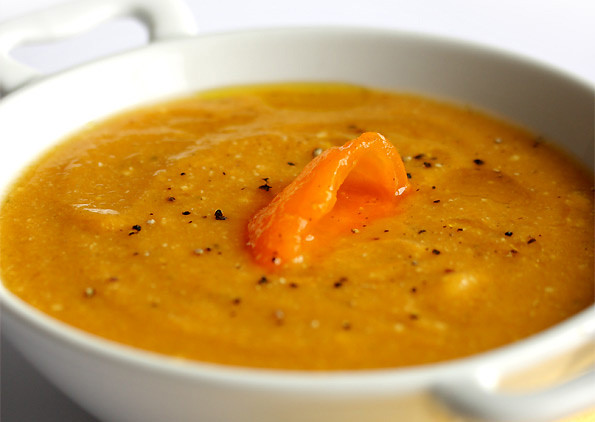
For my Gazpacho I used very ripe round yellow tomatoes and one grilled yellow bell pepper. The soup was quite sweet. I broke the sweetness by the addition of white wine vinegar, but I believe you can add more than indicated in the recipe. It was good, but not outstanding (or it is just a matter of taste).

Serves 4

Ingredients:
1 yellow bell pepper
1 slice of stale bread
150 ml chilled mineral water
700 g yellow tomatoes, blanched and peeled, seeds removed 
2 medium garlic cloves, peeled and chopped
1 handful of peeled almonds, sliced
6 nice basil leaves
½ half yellow onion, peeled and chopped 
1 small cucumber (max 100 g), washed, peeled and chopped  
Lemon zest of ¼ of small organic lemon
2 tablespoons lemon juice
3 tablespoons white wine vinegar
5 tablespoons olive oil
A pinch of powdered chili
Salt 
Pepper 

1. Preheat oven until 180° Celsius. Place your bell pepper on a baking sheet and bake it for about 30 to 40 minutes, or until its skin is well grilled and does not stick to the bell pepper anymore. Flip the bell pepper occasionally, so it will bake evenly. Remove the bell pepper from the oven, put into a plastic bag and let cool down. Then remove it from the bag, place it on a cutting board, and cut it along. Remove gently its stem, the seeds and peel the skin using a small and sharp kitchen knife.
2. In a small bowl, soak the bread in mineral water for a few minutes.
3. Put bell pepper, tomatoes, bread with its soaking water, garlic, onion, cucumber, basil lemon zest in your food processor or blender. Process the ingredients until smooth. Season with lemon juice, wine vinegar, olive oil, chili, salt and pepper.
4. Refrigerate for at least one hour before serving. You can add ice cubes right before serving.

Yellow Tomato Tart with Thyme


This tart may seem too simple at the first sight. For the filling, you only need ripe but firm tomatoes, fresh thyme, garlic and shallots. And that’s enough! You can add local goat or sheep’s cheese, but nothing more. I prefer the simplest savoury tarts with one or two ingredients – the onion tart Provencal style and this tomato are my favourite so far. The key is how you prepare this one ingredient. I like tarts, but except for Quiche Lorraine, I rather do not enjoy all those with heavy cream and eggs; usually, the sauce soaks into the dough; the dough becomes too heavy and too gluey, instead of crispy. I am also a maniac as regards the preparation of tomatoes. Except for some salads, I always peel them and I remove their seeds. I do not like all those pizzas and tarts, where seeds of freshly slices tomatoes drip into the dough, changing its texture into a chewing gum.  For this reason, I strongly recommend frying tomatoes for a while, before placing them in your tart mould. The excess of juices should evaporate if you want to enjoy the crispness of the bottom of the dough. 

I made this tart using home made pâte brisée, which I prepared a month ago and that I kept in my freezer. I used my husband’s recipe, coming from times when he was working as a pastry chef. Home made pâte brisée is not complicated; the only problematic action is to place the dough in the tart mould. It is just time consuming, but I assure that as long as you have a good recipe, the result has nothing to do with an industrial product.  

Ingredients

For the pâte brisée - makes 2 moulds: (18 cm and 24 cm) if rolled out quite finely. If you do not feel like to make your own dough, you can use ready industrial one, but I am not responsible for the final effect. 

200 g flour plus some more extra for your working table
1 teaspoon salt
125 butter, diced
1 large egg
1 tart mould (24 cm)
Baking beans

For the garnish:
700 g ripe but firm yellow Lima tomatoes, blanched, peeled, seeded; cut into quarters
5 tablespoons olive oil 
2 garlic cloves, peeled and finely chopped
2 shallots, peeled and finely chopped
1 tablespoon fresh thyme leaves
Salt
Pepper

1. Working with a small plastic pastry scraper (if unavailable with the tips of your fingers), combine quickly the flour, salt and butter, until you obtain a “sandy” texture. Add the egg and mix quickly and forms a ball.  If the dough is too dry, add a bit of cold water and mix (if you add too much water, then add a bit more flour). Do not overdo the dough or it will shrink during baking and it will be tougher than necessary.
2. Place the dough in the refrigerator for 2 hours (you can freeze the dough and use it later as well). 
3. Take the dough out of the fridge and roll it out on your working table. Make sure to always sprinkle enough flour between the table and the dough, and over the dough, to prevent it from getting stuck to the table or to the rolling pin. Use the rolling pin to place delicately the dough in the tart mould (I know that it is not easy, but even if the dough breaks a bit do not panic; just try to put the pieces together the best you can). Prick the dough with a fork, wrap the tart mould in plastic film and keep it in the fridge for about 15 minutes. Preheat the oven to 180° Celsius. Prepare a circle of baking paper, about 30 cm in diameter.
4. Take the dough out of the fridge. Remove the plastic film and place the baking paper on top of the dough; place baking beans over the paper (to prevent the dough from rising in the oven). Bake for about 15 minutes or until it gets slightly gold. Remove the dough from the oven. Let it cool down before removing the baking paper with the beans. Save the beans. Do not switch the oven off.
5. In the meantime, prepare the tomato garnish. Pour olive oil into into a hot saucepan. Add shallots, fry them for 5 minutes, then add garlic, fry for 2 or 3 minutes. Add tomatoes and fry them over high flame, mixing often, delicately (so they will not go to the pieces), for a maximum of 10 minutes.  And here’s one tricky thing. The frying time depends on your tomatoes. You should use ripe but firm tomatoes (Lima tomatoes are ideal). If they are too soft, they will give too much juices and will go into pieces while frying, and we do not want that to happen; on the other hand, they cannot be too cooked (the purpose of frying tomatoes is to get rid off the excess of water, which otherwise would go into the dough. You simply have to watch your tomatoes but if they gave a lot of juices, get rid of the liquid - do not add it to the tart –only add tomatoes! At the very end of frying, add salt, pepper and thyme leaves. Mix and place the totmatoes in the tart shell.
6. Place the tart in the oven and bake until the dough turns to a nice gold colour, and until tomatoes start to caramelize a bit (it should take about 20 to 25 minutes, but you really have to watch them). Remove the tart from the oven and serve hot. This tart tastes well both warm and at room temperature (this is how I served it to my father last Saturday). 


Fresh Corn Pesto (from Lottie & Doof).


As a main dish, I served Pappardelle with Fresh Corn Pesto. I rarely present on my blog dishes of other bloggers. It does not mean that I do not find ideas in culinary blogs. On the contrary, I find a lot of great ideas, and quite often I cook something from my favourite blogs. I do not present those dishes, as I think that the blog is a place to share your own culinary ideas. However, this Fresh Corn Pesto from Lottie + Doof is worth recommendation. Who would think of making a pesto from sweet corn? With grilled crispy bacon, it is absolutely delicious. Check out the recipe and try it. It is great.

Thursday, July 22, 2010

The Festival of Jewish Culture and the Jewish Quarter in Kraków

The extremely hot weather has been paralyzing us since a couple of weeks. I am not in the mood to cook and bake; the temperature in our apartment is not much lower than in a sauna. We even went to some shops to buy a cheaper air conditioner, to no avail. Everything was sold out!

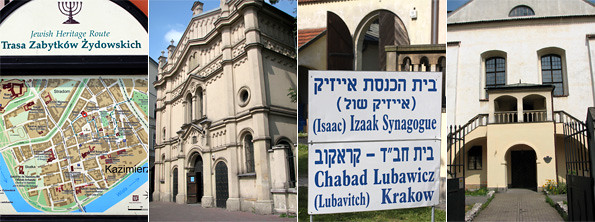
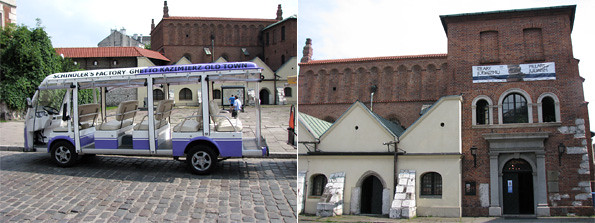
The twentieth International Festival of Jewish Culture took place here in Kraków at the beginning of the month. This is one of the largest and most important festivals of that kind in the World; I attend some of its events every year (it always takes place in the summer by the end of June or the beginning of July). The festival has been traditionally organized in the old Jewish quarter of Kraków - Kazimierz. This quarter was founded in the 14th century and, until the beginning of the 19th century was a separate city. Its north-eastern part was Jewish.


During the Second World War the whole Jewish community, amounting to around 45 thousand people, was transported by German Nazis to a ghetto created for that purpose on the other side of Wisła river (in an industrial quarter - Podgórze, before being murdered in German Nazis concentration camps, constructed by them on the territories of occupied Poland.


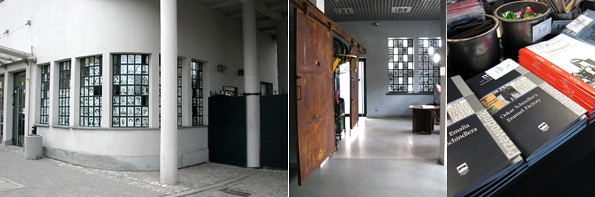
Very few of them who survived were saved, for example, by Oskar Schindler. Some eye witnesses (like, for example, Leopold Pfefferberg  – one of the “Schindler Jews” who survived Holocaust) disclosed this story to the world. The writer Thomas Keneally, published it as “Shindler’s Ark”, known in the U.S. under “the Schindler’s list”). Later the story of Schindler’s Jews was adapted in a movie by Steven Spielberg, which was shot here in Kraków at the beginning of the nineties (I remember how big an event it was – all of my friends wanted to be hired as background extras; and so did I, but I was not accepted). Those Jews who survived, like Poldek, moved to Israel or to other parts of the World after the Holocaust. Poldek landed in the U.S. and I met him personally, thanks to my father, at the beginning of the nineties (first, on a set of the Spielberg’s movie, and then in California as far as I remember). Still, his Polish, after over 40 years, was excellent. A few years ago this factory was converted into a museum.


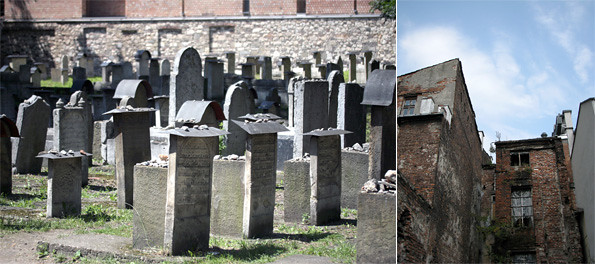
Many monuments of Jewish culture had been devastated during that time, but fortunately, quite a lot of them survived, like old synagogues (some of them had to be reconstructed) and two Jewish cemeteries. Unlike Warsaw, Gdańsk and Wrocław, Kraków avoided bombings. The city and its architecture survived that war nearly untouched. With the arrival of the communist era, the empty Jewish quarter was one of the most dangerous and abandoned neighbourhoods, where poor people, low in the social ladder, often with criminal records had settled in. This neighbourhood was depressing. Many ruined buildings, sad shanties and suspicious individuals were everything one could find there. Most buildings were not repaired after the war devastation and became empty shells.


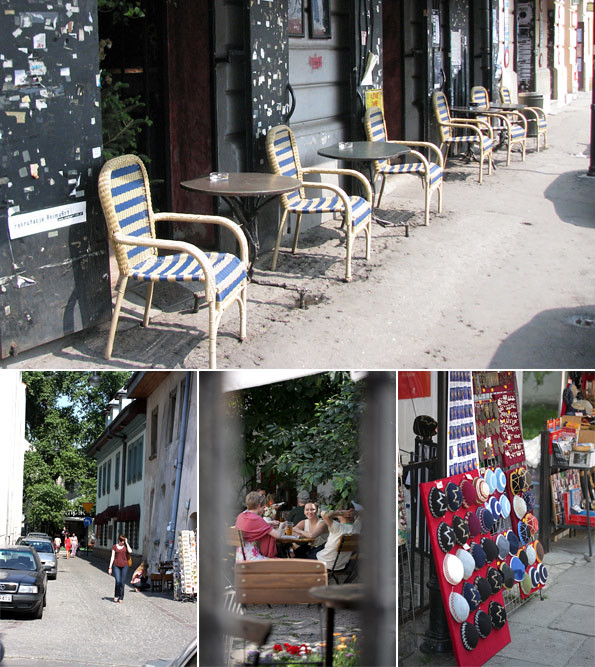
Only after 1989 it started, little by little, to come back to life, mostly thanks to the Festival of Jewish Culture, Steven Spielberg’s “Schindler’s list”, the opening of galleries, small museums, hotels and hostels, Jewish bookstores, pubs and restaurants serving Jewish food from this part of Europe, and so on. The social structure changed too, and now it is one of the most expensive neighbourhoods in Kraków. However, many problems pertaining to the ownership of some properties remain unresolved and it explains why one can see ruins between renovated buildings. Even though, empty Kazimierz changed into a touristy area. One huge void remains: its missing inhabitants…(the religious Jewish community of Kraków amounts to about 200 people).


Coming back to the Festival….one can find the following words on the Festival’s web page:
”Shaped by outstanding figures in various fields of Jewish culture and art, the Festival became over time a place where Jews and non-Jews from all over the world could meet. For over a week, Kazimierz resounds with synagogue song, klezmer music, and Hasidic, classical, and Jewish folk music. There are films, performances, presentations, and exhibitions to see and stories told by the Jews about their culture to listen to. In its present form, the Festival not only introduces the living Jewish tradition to a wide audience, but also offers a share of the joy in creating that tradition. Workshops in Hasidic dance and song, klezmology, Hebrew calligraphy, Jewish paper cutting and cooking, conducted by people from both Ashkenazy and Sephardic culture, attract numerous learners. Every year, the Festival puts on over 100 events featuring dozens of performers and thousands of participants from all over the world. During the most recent Festival, 13,000 people attended "Shalom on ulica Szeroka," the grand finale concert. The number of Festival guests grows from year to year, and television coverage brings the Festival to viewers across Poland and Europe and around the world… The Festival is a span of the symbolic bridge where Poles and Jews meet to strengthen the process of understanding and reconciliation…”
Well, should you ever want to visit Kraków, try to plan your trip around the end of June, to be able to join some events of the Festival, in particular some good concerts and exhibitions, as well as the final concert on Szeroka Street (however, be prepared to join a crowd of dancing people). This year, exceptionally I did not attend the concert, as I could not leave my daughter. However, I visited it so many times, and always had a great time, with my father and his friends.


There was one disappointing event though – a culinary workshop, done by Hanna Kossowska, an artist and a Mashgiach (a person supervising kashrut status of kosher food in the Jewish Community of Warsaw). She is supposed to be a great cook and she has a remarkable knowledge about kosher cooking.  She can introduce you to Jewish cooking with passion and engagement. What a pity that her speech was in Polish while most of the festival’s events are held in English. That is not the only thing that was badly organized. The classes were passive, in form of traditional lectures (some recipes were given at the end). A poor tasting of two dishes prepared by cooks from the kosher kitchen in Hotel Eden on Ciemna street, was far not enough. Furthermore, the “lecturer” was in a hurry and it was nearly impossible to ask her any question. She was not able to recommend any good Jewish cook book, not because she did not know about them, but because she was just in a rush to leave. All in all, I found out some interesting information about traditions and food preparations for Jewish traditional holidays, but I was disappointed by the presentation of the workshop itself. Moreover, when I visited the only food store in Kraków selling kosher products imported from Israel (I wanted to buy some kosher flour), it was closed because products did not arrive on time….


Nevertheless, it is always possible to try Ashkenazi dishes, which are served in several restaurants serving Jewish food. 
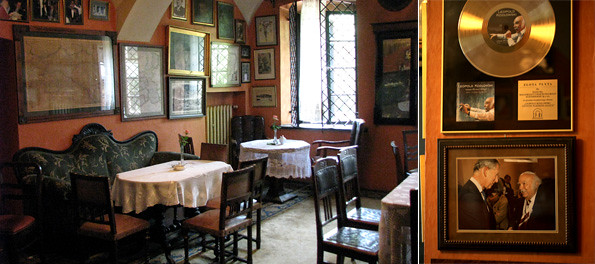
Two of them, which I know, serve good non-kosher Jewish food. The Klezmer hois at Szeroka Street is a calm guest house with a restaurant serving traditional dishes. On a regular basis, they organize concerts of klezmer music, too. One of their armchairs is often occupied by the oldest and probably the most popular klezmer composer Leopold Kozłowski, called the “last Galician klezmer”. This man – who is a history by himself, survived the Holocaust and stayed in Poland after II World War, and still gives some concerts. You can eat at Alef, now located on St. Agnieszka Street. Both restaurants serve traditional goose pipkes, gefilte fish, Jewish caviar, Jewish style Carp, Choulent, Broth with Kreplach, Kugel, and Pascha dessert.


As regards kosher food - as far as I know, there is only one kosher restaurant in Kraków located in hotel Eden, on Ciemna Street (the result is that hundreds of orthodox Jews visiting Kraków during the Festival, bring their own kosher food for the whole week). The second place for enthusiasts of kosher food is the Jewish Community Centre of Krakow on Miodowa Street (a Jewish cultural and educational centre that was created in 2008 and was opened by The Prince of Wales). Once per week they organize Shabbat dinners with kosher food (reservations are required in advance).


On Jozefa Street, you can visit Cheder Café, serving genuine Israeli style coffee (brewed and served in brass fijians with cardamom, cinnamon and other spices). They also sell Moroccan and Israeli style tea, with fresh mint leaves and brown sugar which can accompany their fresh sweet buns and cakes. Except for that - wines from Lebanon and Israel, Chile and Spain. Film screenings and concerts take place there, too.

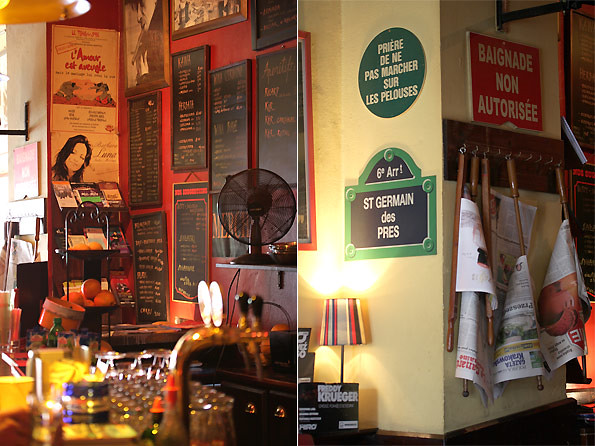
And if you wish a bit of Paris, go to Les Couleurs Café, on Estery Street. I always take my husband there, when he misses his posh 6th arrondissement. So, if you need a shot of Rive Gauche, and couldn't find it in Paris, then you might just find what you were looking for in this cafe in the old Jewish market square of Kazimierz - with walls covered from floor to ceiling with posters of French movies, and copies of Le Monde and Paris Match lying around for you to read.   French style breakfasts and coffee starts at 7 o'clock in the morning. The owners of the place also conduct their small B&B on the first floor.

Saturday, July 10, 2010

About One Calm Weekend and Two Salads with Our Local Cheeses

I spent a nice weekend in a fantastic place last week. If you think that I went to Rome or Barcelona and spent hundreds of Euros at fancy restaurants, you are completely wrong. Actually, I only went 75 km away from Kraków, to reload my batteries in a peaceful place. Some friends of my family's, Ela and Adam, decided a few years ago to escape from the city and to spend the rest of their lives conducting a small "chambre d’hôtes" in Koninki, a village close to Gorce National Park. 
The village itself, although surrounded by low mountains and forests, like thousands of other Polish villages, is full of architectural mess. Amongst simple and nice houses in local, rustic style, one can find some ugly constructions built without any sense of architectural order. Some of them are not even finished (people live on the ground floor and the other floors are not completed). But, well it is mostly a heritage of the previous era, like in every ex-communist country.


Ela and Adam's house is one example of how a house and its environment can create an harmony with nature. Their property is remote from the village and is surrounded not only by a forest, but by a small river as well.


The owners are warm people, who spoil their guests with homemade food and one can notice straight away their engagement for this piece of land. They like what they do and they found a sense to their existence living there. Ela and Adam not only renovated the old wooden house and created a small, but charming garden; they also collected hundreds of regional and artisanal gadgets and sculptures. On the other hand if you wish to take a bath in a Jacuzzi, it is not a problem at all – Ela and Adam installed one.


This reminds me of my holidays in the Podhale region. Usually, in the eighties, houses in villages did not have running water. Baths were taken in a metal tub or in the river. Often, iron beds did not have mattresses, but instead just a padding filled with hay. We did not have any civilized WC, too. Instead, one was going to fix his or her physiological needs in a wooden privy. Even toilet paper in the crisis of the eighties was a crucial problem and that’s why one could always find old newspapers cut into pieces and hanging on a nail in the privy. We did not have TV (even if we did, the quality of the network was awfully bad and there were only two state-owned channels at that time). Milking the cow from time to time, helping owners to collect hay in the fields, picking up mushrooms or forest fruits, sitting by the river and constructing stone dams, or just going on an escapade to the Tatra Mountains were amongst my daily attractions. If it was raining, we could play cards for the whole day (I knew tons of card games at that time).

Coming back to Ela and Adam. Ela is a specialist in homemade preserves, both savory and sweet. She makes tons of confitures, jams and juices from ecological fruits. She knows where to buy the best strawberries, gooseberries and other seasonal fruits in the neighborhood. In the season, she collects bilberries and mushrooms. And she cooks lunches for the guests.


Her husband, Adam, bakes bread and bread rolls from scratch (he mills grains to obtain his own flour).  He makes his own charcuterie, too (unfortunately, he made it only when I left – I hope I can watch the process the next time I will visit them). He has a habit to spoil children by picking up some wild strawberries in the morning and serving them on a blade of grass as an accompaniment to breakfast.


On Saturday, we also visited a tiny wooden shepherd’s house nearby in the mountains, to order some authentic local cheeses, made from the sheep milk produced by his 400 animals.

I already was mentioning to you two of local cheeses from the south of Poland - oscypek and bryndza.
The third one, called bundz (or bunc), is made in the south of Poland as well. It is rather difficult to buy it in the other regions of Poland (still, the production is small and distribution is badly organized).
Authentic bundz should be made only from sheep’s milk between May and October (some say the best comes only in May). The shape resembles a round meat loaf of bread. Fresh cheese has a sweet and delicate taste. I dare to say that cut into thin slices and served with some fresh herbs, ripe tomatoes and a good olive oil constitutes an alternative to Italian caprese, which here, in Poland usually is served from industrially made gummy and chewy mozzarella.  The first phase of the production of bundz resembles the production of oscypek - unpasteurized sheep's milk with the addition of rennet turns into a kind of curd – and takes about 24 hours.

The cheese is available in some shops in Kraków and on food markets, like Kleparz. It is sold by farmers coming from the Podhale region. The cheese found at those food markets is not 100 percent made from sheep’s milk, that’s for sure, and that is mostly why you can get it all year round. They use cow’s milk instead, sometimes less, sometimes more, but even amongst those one can find quite good ones. Two weeks ago, when I visited the food market where the cheese is sold, I bought 4 types of it: a freshly squeezed one, which was quite sweet in taste; an older salty one; a spicy one and a smoked one. 


Should you visit Kraków one day, try to find this cheese. In the season, it is served in some restaurants or on food markets (the best place to buy it is straight from farmers on Kleparz – a food market operating every day except on Sundays, in the center of the city).
I made several salads and starters using bundz, which I present today. You can try to replace this cheese by your favorite one.

Salad with Smoked Bundz Cheese, Fava Beans, Green Peas, Spinach and Chanterelles


Makes 1 big lunch salad

Ingredients:
4 thin slices of fresh bundz cheese (around 100 g) – depending on its size
A handful of fava beans
A handful of green peas
A handful of baby spinach
100 g chanterelles
1 tablespoon butter
3 to 4 tablespoons olive oil
½ onion or one small shallot, peeled and finely chopped
1 garlic clove, peeled and finely chopped
1 tablespoon chopped scallions or fresh thyme
Salt
Pepper

Preparation:
Firstly, cook both fava beans and peas al dente separately, in salted boiling water. Strain the vegetables and mix them in a bowl (peel the fava beans first).
Wash the baby spinach and drain them in a salad spinner or with a paper towel and add them into the bowl with fava beans and peas.
In the meantime, start preparing the chanterelles. Delicately clean the mushrooms from leftovers of the forest. Scratch the stems to remove soil. Rinse the mushrooms delicately under cold water. Cut some mushrooms in halves, should some of them be too big.  They all should be about the same size, so they will fry evenly. In a hot frying pan, melt butter, add 1 tablespoon of olive oil, add onions and cook on a medium flame for 10 minutes. After 5 minutes, add garlic. Mix occasionally and do not let the onion and garlic burn. Add the mushrooms into the frying pan and sauter them on a medium flame until they release their juices and absorb them back in.
Salt and pepper generously at the end. Pour hot mushrooms into the bowl with vegetables. Mix everything (the spinach should soften a bit). Add 2 tablespoons or more of olive oil, scallions or thyme and adjust to taste, if necessary.
Put some slices bundz on the bottom of the plate and place the warm salad on top of it.

Salad with Fresh Bundz Cheese, Strawberries, Pepper Mint in Balsamic – Strawberry Dressing


Serves 1

Ingredients:
4 thin slices of fresh bundz cheese (around 100 g) – depending on its size
100 g strawberries, washed and cut into slices
A few nice leaves of pepper mint
1 tablespoon balsamic sauce (see below)
1 tablespoon olive oil
2 tablespoons strawberry purée (see below)
1 tablespoon grilled and chopped walnuts (you can use hazelnuts, too)
Salt
Pepper

Thick balsamic sauce
120 ml balsamic vinegar
2 tablespoons flower honey
1 little spring (around 7 cm long) of fresh rosemary
Pepper

Pour balsamic vinegar and rosemary into a small saucepan and cook over a low flame until it is reduced by around one third (about 10 minutes). Remove rosemary, add honey and cook over a low flame until the sauce thickens a bit (do not thicken it too much, because it will get completely solid once cooled down). Add a bit of freshly ground pepper.

Strawberry purée:
100 g of nice strawberries, washed
Reduce strawberries into puree. Strain through a chinois to get rid of strawberries’ seeds.

Preparation of the salad:
Put slices of cheese and strawberries onto a plate. Mix 1 tablespoon of balsamic sauce, 1 tablespoon of olive oil and 2 tablespoons of strawberry puree. Add quite a lot of pepper and taste. Pour over the salad or on the bottom of the plate. Add mint. This time I served it without any green salad, but it goes really well with rucola or baby spinach.
If you do not like strawberries, you can prepare a similar dressing using raspberries or even bilberries. I made those dressings, too, and they go excellent with cheeses, nuts and green stuff.

Good luck!


Related Posts Plugin for WordPress, Blogger...