Sunday, March 21, 2010

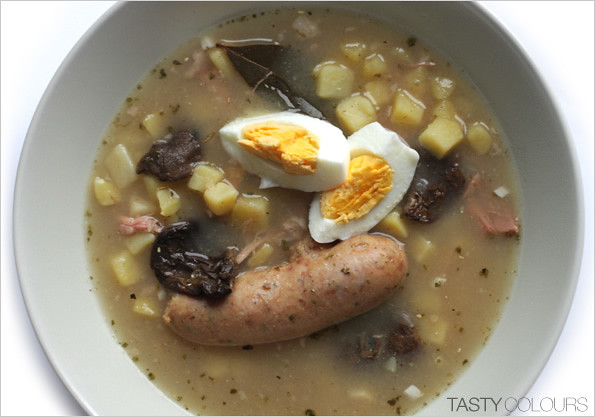
Sour rolled oats soup with whye and shiitake - Żur owsiany


Last week I experimented again with sour starters, homemade curd and sour cabbage. Working on all these in a 5 square meter kitchen requires some sort of courage. Every preparation takes time and place: another challenge is to find enough storage for all this food in such a tiny surface.
I found that the best place for a good fermentation of the sour starters is on top our laundry dryer. As to the jar of sour cabbage, it has found its place on the floor, under a small table, where it is protected from the day light. Two other bowls with sour milk were placed on the top of the washing machine, which is close to the window but not exposed to the sun. Thanks to two shelves that we installed last week, I managed to rearrange my cupboards finding products which I had forgotten about over time.
Since I have those two new shelves, I again have the feeling that our kitchen is endlessly big. This will not last for a long time!

Preparing rustic food and finding authentic tastes in the middle of a huge metropolis is actually fun. Being surrounded by trendy and sophisticated Parisian restaurants, great grocery stores, where one can find everything I have a bit of a countryside spirit in the kitchen.
Thanks to my friends: Rafal from Polish culinary forum Galeria Potraw, and Karolina, who started her culinary blog not so long ago, I decided to prepare my first sour rolled oats starter for another version of “żurek”, presented a few days agoMore details about rolled oats on Wikipedia.

The starter indeed is worthy recommending. Its taste is delicate in comparison to the rye starter, and it keeps its sourness. The starter was ready in 4 days, as the temperature in the kitchen was not very high (we do not have any heater in our kitchen). I was mixing it delicately every day and checking its smell. Everything went fine and so on the third day I added 2 chopped garlic cloves, and on the next day I could enjoy its nice smell. 
The good thing about the starter is that you can buy organic rolled oat in any good organic food store, either in Krakow, Paris or New York, and still enjoy your żurek without worrying about finding any rye flour for it.
Straight away I thought it could be nice to use a light vegetable broth. As I did not have any vegetable at home, and because I could not go out since our child was sick, I decided to use whey instead.


Rolled oats starter

(Makes between 800 ml - 1 liter)

Ingredients
8 tablespoons organic rolled oats, coarse-mashed in a mortar
1 liter warm (about 30°) mineral water, previously boiled
2 bay leaves
2 grains all spice
2 cloves garlic, finely chopped
1 jar (1 liter capacity), preferably sterilized
1 piece of fabric to cover the jar and 1 rubber band to hold it

Preparation
Place flour into a jar and pour the mineral water over it.
Add allspice and bay leaves.
Slowly, mix with a wooden spatula.
Cover the jar with the fabric, attach it with the rubber band and place the jar in a warm place.
Keep between 3-5 days, until the starter is ready.
The ideal temperature is between 18 and 22 degrees centigrade.
Mix delicately the liquid twice a day with a clean wooden spatula and then cover again.
If necessary, remove the foam that is forming on the surface of the liquid.
On the third day, add garlic and mix well.
Before pouring the liquid into the soup (see below) strain it and throw away the remaining oats.
For more general information concerning the preparation of sour starter, look here.

Last week I also continued experiments with homemade curd for my daughter. That’s why I had around 1 liter of spare fresh acid whey, which was a leftover after cheese curding.


In Poland, I only saw fresh, non pasteurized acid whey very rarely in some good stores carrying organic food. So far, I have not seen it in France and probably the only way you can get it is curding the cheese from sour milk yourself.
I decided to use it for the soup instead of broth. In the past, I already had replaced broth with acid whey in other types of soups and it worked well. 
I do not know much detail about acid whey plasma except for the fact that our grandmothers’ opinion was that homemade whey is supposed to be very healthy, thanks to its minerals and its vitamins. I was a bit afraid whether the French stomach of my husband, who is not used to fermented milk products, would react fine to the double acidity of the soup. All in all, he liked it a lot, especially because I had added a lot of fresh thyme, which he adores. No syndromes of bad digestion were found.


I have not found any recipe for żurek using whey instead of broth. Indeed, it was my own idea to do so; however I am quite sure that it had to be used in older preparations, in those times when nothing ever could be wasted. In any case feel free to use your favorite broth. I am sure your soup will come out excellent.
Since I did not have any marjoram, which is a traditional herb used for the seasoning of żurek, I decided to go for little branches of fresh thyme, which my husband bought on the marché that day.
The soup was thicker than usual.
This mixture worked well with shiitake mushrooms, which I found in my fridge. Unfortunately shiitake mushrooms do not have so much taste and when I try this version of the soup next time, I will definitely use a few sautéed fresh ceps.

Sour rolled oat soup (żur owsiany)

Serves 4

Ingredients
800 ml sour rolled oat starter (finely strained from oat leftovers)
800 ml sour whey, preferably homemade (optional, you can use any broth according to your liking)
4 fresh shiitake mushrooms (around 150 g), washed, dried and cut into ½ cm strips
3 medium size potatoes, peeled, washed and cut along into thin slices of 2 or 3 mm
2 garlic cloves, peeled, washed and finely chopped
5 to 6 branches fresh thyme
1 or 2 pinches powdered chili
1 tablespoon butter
Salt
Pepper

Preparation
In a pan, bring the acid whey to a boil.
Add potatoes and thyme and cook on a medium flame, under cover for around 10 minutes, until potatoes are nearly soft.
In the meantime, in a hot frying pan, melt butter, add garlic and shiitake.
Fry over a medium flame between 5 to10 minutes. If necessary, add some whey if they start to stick to the bottom of the pan.
Add shitakes with garlic and their juice into the bullion.
Add sour rolled oats starter, bring to a boil and cook between 5 to 10 minutes, until potatoes are soft.
Remove branches of thyme before serving.
Season with salt, pepper, and chili and eventually some more fresh thyme leaves.
Serve hot.

Friday, March 19, 2010

Almond Tuiles

We celebrated the second birthday of our daughter. My husband made a rich chocolate layer cake with chocolate biscuit and chocolate mousse for her. Or maybe rather he wanted to delight himself a bit, as he is crazy about chocolate. His usual breakfast is “pain au chocolat”, eventually fresh baguette with a piece of Cote d’Or milk chocolate.

From that day we had leftover egg whites in our fridge and the decision to make tuiles was spontaneous.

Tuiles are very thin and crispy cookies of curved shape copying roofing tiles. That’s why they are called “tuiles”. They have absolutely crispy texture, like fresh wafers. They are very basic, cheap but delicious cookies, provided that two conditions are met: they have to be crispy and thin.

You can find them in nearly every pastry shop or bakery in Paris and probably in France.
But even though, I did not know tuiles for quite a while after I arrived in France. I simply did not put attention to them as that I am not a great fan of cookies. Maybe a year or two ago my husband showed them to me in a bakery shop located at the corner of rue de Mezières and rue de Rennes in Paris. Their tuiles were not great as opposed to their exquisite “baguette tradition” and excellent “pain brioché” we buy there nearly every day.

There exists different sorts of tuiles, of various flavours, sometimes with the addition of freshly squeezed orange juice, for example, or a touch of Grand Marnier. I also found recipes for salty versions of tuiles with herbs, like rosemary or thyme which I am tempted to try next time.

Tuiles are very easy to prepare. The only problem is to place them, when still hot, on a rolling pin or simply a broom stick (we have not bought a tuiles mold yet), as we did, so they can reach the half-oval shape. I advise to apply melted butter on your baking sheet before baking. Tuiles baked on buttered baking sheet smells incredibly wonderful once removed from the oven.

These cookies are addictive and they disappear immediately in particular when you lay down on your comfortable bed under a warm blanket on a cold evening of March.

The basic tuiles below comes from my husband’s secret notebook. The broom stick which we hung our tuiles on comes from our closet (but we washed it before using it).


Ingredients (makes between 20-25 tuiles)
80 g powdered sugar, sifted
25 g flour, sifted
60 g sliced almonds 
2 egg whites
20 g butter
1 tuiles mold (may be replaced by a broom stick)
Some extra melted butter to apply on the baking sheet

Preparation
Preheat the oven to 180 degrees.
In a pan, melt butter on a low flame. Put the pan aside.
In a bowl, mix sugar with almonds and flour.
In a bowl, whip the egg whites to a very sift peak.
Gradually fold in the dry mixture to egg whites, slowly.
Then add melted butter.
Your “appareil” is ready.
Prepare the sheet pan: apply a thin layer of melted butter using a brush.

Spread 1½ teaspoon of tuile “appareil” into 6cm circles, about 2 cm apart, on the sheet pan.
Bake at moderate heat, for about 5-7 minutes or until the cookies get brown around the edges. You really have to watch them. 
In the meantime, prepare the broom stick – you should hang it between two firm points in your kitchen.
Then prepare yourself for the most difficult action.
Remove the sheet pan from the oven, lift tuiles carefully, one at a time (you will notice that they are still soft) and quickly, using a metal spatula, place immediately in the tuile mold or over a rolling pin or a broom stick to cool down.
Continue with the rest of the “appareil”.
Once they are cooled down, eat reading a good book or place them in an airtight container.
Should you leave them in the open air, they probably will be soft and sticky the next day (because of the humidity in the ambient air) instead of dry and crispy.
Cookies lose their crisp texture over time.
That’s why it is best to make them the day they are to be served.

Monday, March 15, 2010

Delicious Sour Rye Soup - Żurek

Polish food has two faces. Traditional, old recipes, with a lot of French influences, from before the communist era, are a remembrance of the days of aristocracy. Many of them are forgotten, although more and more people search for old “bourgeois” recipes. On the other hand you have simple, but tasty comfort food of hard-working farmers. One example of this type of food is żurek.

Żurek, in some regions known as “żur”, is a soup made with sour rye starter. The name of the soup probably has its origins in German language and means “sour”.
The starter – called “zakwas” is made out of water and flour, which acquire an acid taste during the natural process of fermentation. According to old cook books, this soup was one of the basic dishes in peasant’s cooking. Now, it is one of the most popular soups in my country, regardless of the profession and of the social status, thanks to historical changes.

In daily cooking, aside from the starter which is a sine qua non condition of żurek, meat, sausages or smoked bacon usually are used. The vegetarian version, which is often served as a traditional soup for Easter, uses mushroom or vegetable broth.

The key for a successful and delicious żurek is a homemade or a good artisan sour rye starter.
The latter you will rather not get abroad, that’s why I share here with you the traditional Polish recipe for the starter, which I already made many times.

Sour rye starter (zakwas)

Makes 1 liter

Ingredients
6-7 tablespoons whole grain rye flour
1 liter warm (about 30°) mineral water, previously boiled
1 bay leaf
2 grains all spice
2 cloves garlic, thinly chopped
1 jar (1 liter capacity), preferably sterilized
1 piece of fabric to cover the jar and 1 rubber band to hold it

Preparation
Put flour into the jar and pour the mineral water over it.
Add allspice and the bay leaf.
Slowly, mix with a wooden spatula.
Cover the jar with the fabric, attach it with the rubber band and place the jar in a warm place.
Keep for 4 days.
The ideal temperature is between 18 and 22 degrees centigrade.
Mix delicately the liquid twice a day with a clean wooden spatula and then cover again.
If necessary, remove the foam that is forming on the surface of the liquid.
On the third day, add garlic and mix well.
Before pouring the liquid into the broth (see below) strain it and throw away the flour.
This is optional. Some people prefer to add this flour to the broth, to make the soup thicker.

Good quality rye flour is essential for delicious sour rye starter. The best is coarse rye flour, available practically only in good food markets in Poland. It is so coarsely milled, than I have doubts if one can call it “flour”. Often it is sold by farmers, who make it on their own. Usually I buy the “żurek” flour in Poland.  I did not find this product in France.
In Poland, in stores selling organic food and sometimes, upscale supermarkets, you can buy rye flour called “żurek flour”. It is finely milled in comparison to the one I mentioned above, but you can use it to make a starter, as well. The name “żurek” traditionally refers to the soup made with a sour rye starter.
You may also use Rye Organic Flour which is easily found in organic food stores in France.
There are some other soups prepared with various sour starters, for example “white bortsch” which uses a wheat starter or “żur owsiany” which uses a rolled oats starter. Few Polish people are aware of those differences nowadays.
I found out that ready-to-use sour rye starters available in food markets are quite often made from a mixture of rye and wheat flour. 
Unfortunately, even in Poland, industrial starters have been replacing those traditional ones, which are much better. Industrial starters are available in every Polish food store. Artisanal ready-to-use sour rye starters are available on most food markets, organic shops and some good epiceries.
In Paris, one can find starters in stores carrying Polish food. However, I found out that this industrial starter usually is of poor quality.

More explanation regarding home preparation of the starter:
The proportion between flour and water is not so strict. Some people will prefer a very thick starter and they simply will use more flour than indicated in my recipe.  Some of them will use less flour. Everything depends on one’s preferences. My recipe is in between – the starter is not too thin neither too thick, but quite strong and tasty. Some add a piece of rye bread crust for the taste. As it is difficult to buy “real” rye bread made from artisanal sour dough starter, without softeners, I avoid adding bread, as I do not want to spoil my starter. 

I always use boiled mineral water for my starter as it is known that tap water is not good in Kraków. I prefer to use sterilized jars; however people usually do not pay attention to that. Then some of them complain than the starter is stinky and killed by bad microbes.

Very often the first homemade starter may need a longer fermentation, about one or two days more than indicated in the recipe and, its taste may be less intense. That is why some advice to throw most of first starter away, keeping only a small part of the fermented flour in the jar and then to add to it a new portion of fresh flour and water as indicated in the recipe.
The second starter will ferment quicker and should be ready within two days. Much of it depends on the quality of the flour, as I mentioned above. The temperature is important as well. It may not be too cold and nor too warm. That is why your jar must be stored in a place where the temperature is between18 and 22 degrees centigrade.

It is not necessary to add the allspice, bay leaves and garlic to your starter, as you can always add them straight into the broth. However, adding them to the starter will simply taste better.

Once the starter is ready (you can recognize this by its intense off-white color as well as by its acid smell and taste), it may be used right away or stored, covered, in the refrigerator for up to two weeks.

I recommend using only the liquid part of the starter for the soup. Some people, like my grandma, add the liquid and the flour to the soup. I do not like this because the soup is too thick and it resembles a puree. Further, it is more difficult to digest and the taste is “heavier”.

Żurek

Serves 4

Ingredients
1 liter sour rye starter
300 g veal ribs
4 caps dried ceps
2 white pork sausages, raw (300 g total) – may be replaced by Saucisse de Toulouse
2 carrots, peeled and washed
½ celery root, peeled and washed
1 shallot, unpeeled, washed and cut into halves
2 bay leaves
3 grains all spice
1 teaspoon marjoram
5 to 6 grains black pepper
5 medium potatoes, peeled and washed, cut into small cubes
2 hard boiled eggs, peeled and cut into quarters
100 ml crème fraîche (optional)

Preparation
Place the meat in a saucepan and add 1 liter of boiling water.
Add mushrooms, bay leaves, allspice and pepper.
Cook for 30 minutes, under the cover.
Then, add carrots, celery root and onion.
Cook until the vegetables are completely soft – between 30 and 40 minutes.
Remove vegetable from the saucepan, add potatoes and sausages, and cook for about 10 minutes, until potatoes are cooked.
Strain the starter and only keep the liquid.
Pour the starter into the broth.
Season with marjoram, salt and pepper.
Bring to a boil, cook for another 5 minutes and serve hot with hard boiled eggs.
Add the cream (optional).

Should you ever have a chance to try this soup in a Polish restaurant, please remember that a good Żurek should be quite acid. Unfortunately, in cheaper places soups are prepared from industrial starters or the proportion between the starter and the stock is not right, thus the soup loses its particular sour taste.
My favorite version of the soup is with white sausage (called biała kiełbasa). It is a sausage usually made of a mixture of pork and beef meat. It usually is sold raw and needs to be cooked or grilled before eating.

White sausage (which is difficult to get in France and sometimes found in shops carrying Polish food) may be replaced by a sausage from Toulouse. You can also use some Polish charcuterie, such as Polish smoked sausages, bacon, ham which are available in shops carrying Polish food in France. It is, however, not obligatory. You can eat your Żurek without any sausage or meat just as a vegetarian version of the soup with eggs and potatoes. Then, instead of preparing a meat broth simply use vegetable or mushroom bullion.
Some people also add whey (or milk plasma), that is, the liquid remaining after milk has been curdled and strained.
Old cookbooks indicate that very old fashioned versions of the soup were using curd cheese; however I never found this version of the soup in any restaurant. 

Wednesday, March 10, 2010

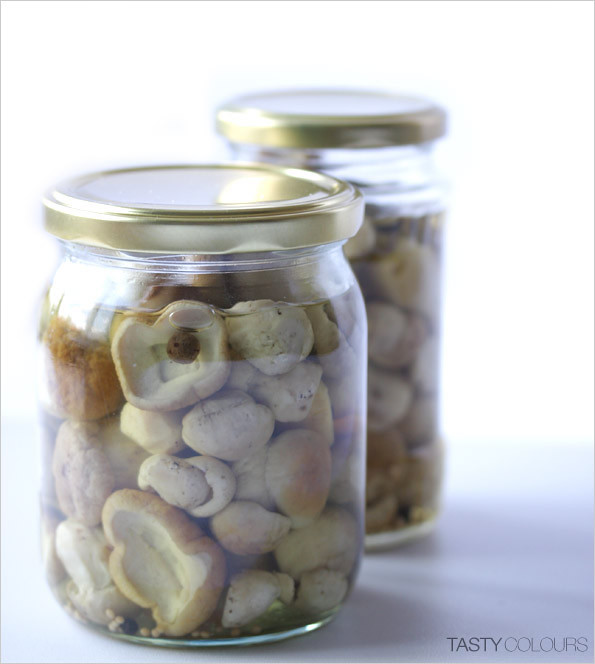
My favorite Pickled Ceps


Ingredients
1 kg small, young ceps
30 g salt
1 big yellow onion (about 200 g), peeled and cut into halves
4 bay leaves
1 teaspoon yellow mustard grains
12 grains allspice
14 grains black pepper
1 tablespoon sugar
250 ml white vinegar (10% acidity)
500 ml water
½ carrot, peeled, washed and finely sliced
3 250 ml jars

Preparation
Delicately clean the ceps from the leftovers of the forest.
Scratch the stems to remove soil.
Rinse the mushrooms delicately under cold water.
In a saucepan, bring to a boil 1 liter of water with 20 g salt.
Add the onion and ceps and cook between 20 and 25 minutes until they are quite soft, or Al Dente.
Strain the liquid, discard the onion and put the mushrooms aside.
In the meantime, in a small saucepan boil a small amount of water and blanche the carrots, strain them and put them aside.
Prepare marinade: in a middle size saucepan, put the spices (mustard, allspice, black pepper), bay leaves, sugar, 10 g salt, the water and the vinegar.
Bring to a boil and cook for 10 minutes.
Cool the marinade down and taste it. It should be sour with a sweet after taste.
Strain the marinade in order to separate the spices and bay leaves from the liquid (save the liquid).
Prepare sterilized jars.
Distribute the mushrooms, spices, bay leaves and carrots equally between the jars. The content should not be too tight.
Pour the liquid into the jars until it covers the mushrooms completely.
Close the jars and pasteurize them between 15 and 20 minutes.

You can use this recipe to pickle other eatable mushrooms, such as, for example, bay boletus, red pine mushrooms, suillus or chanterelles. Young red pine mushrooms are especially delicious when marinated. The best are small and young mushrooms. If you cannot get them, it is possible to marinade bigger mushrooms, but in such a case they must be cut into smaller pieces.
You can also adjust the acidity or sweetness of the marinade by changing the proportions of vinegar and sugar or replacing sugar by honey according to your own taste.
Remember that if you want to be happy with your marinated mushrooms (and other pickles) you should observe hygiene rules strictly. Mushrooms must be nice and in a good condition, well washed and dried. The jars and their lids must be ideally washed and sterilized.

As I already mentioned in my post concerning Lingonberry Preserves, Poland is a country where traditions of homemade preserves were strong for years.
Nearly every family – of either intellectuals or farmers – had a small cupboard full of marinated vegetables, mushrooms, jams, marmalades, juices, pickles, conserves, homemade alcohols etc. The tradition for homemade preserves is not as common anymore as it is possible to get all types of preserves in stores. Furthermore, people are busy with their professional lives and do not dedicate much time to this kind of culinary preparation.

However, it is obvious to say preserves are always better when homemade, provided that you have good recipes, and good ingredients, of course. You can always adjust their taste according to liking.

I like to pickle mushrooms on my own. Some brands which are available in stores are good as well, but in most cases they usually are too sour or too sweet for me, as they contain too much vinegar or too much sugar. And they are expensive!
In France, and possibly in other countries where Polish communities exist, you can find those pickled items in stores carrying Polish food.
Marinated mushrooms are my favorite side accompaniment to traditional Polish charcuterie and vegetable salad since childhood. When I was a kid, I could close myself in a bathroom, read a book and eat marinated mushrooms straight from the jar, risking stomach problems, as usually I had too much at once.
In the eighties, they were always made by my parents. The mushrooms were picked up in the summer time. Usually mushroom collection took place in local forest in an area surrounding small villages in the Podhale region, as we were going there every year. I have great memories, however, concerning the northern-eastern part of Poland, a real mushroom paradise, where we went for holidays in 1983, if I remember it well. The absolutely great area around the little town of Sejny. And Puszcza Augustowska, an old forest a bit remote from the ex-USSR border, was a paradise for picking mushrooms. The area was, and I believe, still is, not so overcrowded with people, with a lot of old forest rich in venison and mushrooms.

Now I pickle my mushrooms when I am in Poland, during summer holidays. In France they are awfully expensive. I always buy them on “Stary Kleparz”, a food market in the heart of the city, between Św.Filipa and Basztowa Streets. I will only say a few words today about this market, as it is worth mentioning it and visiting it. It is open every day, except Sundays, and it probably is the oldest food market in Kraków, having its origins from the 14th century. The history of this market is strictly connected with the history of Kraków.
Not such a long time ago, during the communist era, the market was a place to find goods in short supply. Women from the countryside were selling veal and other kinds of meat, for example. Exotic fruits, meaning banana, lemon, grapefruit and orange could be found there as well. My great aunt Janina, who passed away several years ago, used to run her small shop there, selling curd cheese and other milk products.
Also today the market is one of the most popular places in the city. Except for places selling meat, milk products, Polish and foreign fruits and vegetables, dried fruits, different types of beans, cereals, breads and so on, on a regular basis, you can find small retailers, very often farmers and producers, selling tons of fresh seasonal fruits, vegetable, mushrooms, homemade fresh and smoked cheeses and butter as well. The good thing about cheeses is that you are always invited to taste them before buying them, so you can choose what you really like.

Thursday, March 4, 2010

Socialist queen - buckwheat


Serves 4

Ingredients
250 g grilled buckwheat kasha (available in stores carrying Polish food)
500 ml vegetable, mushroom or meat broth (choose your favourite)
2 tablespoons vegetable oil or goose grease
½ teaspoon salt
1 egg white

Preparation
Crack the egg and separate yolk from white.
In a bowl, beat delicately egg white. Add kasha and mix thorough fully, so all grains are coated evenly with egg white.
Put aside for at least 30 minutes, until the egg white dries out completely.
Then rub the grains with your fingers, to ensure that all of them separate and do not stick to each other.
In a pan, bring to a boil 500 ml of broth. Add salt.
In the meantime, in a hot saucepan melt the grease, add kasha and fry over a medium flame for about 3 minutes, until you can smell nice vapors.
Add boiling broth to kasha; bring to a boil again, then cover and turn flame down to minimum and cook until the liquid is completely absorbed.
Preheat the oven to 160 degrees. Then place the saucepan in the oven and roast kasha for an additional 10 to 15 minutes with the cover still on.
Serve hot as an accompaniment to dishes such as warm meat, in particular zrazy.

More about buckwheat
It is not necessary to grill your kasha in the oven; it is ready to serve once the broth is completely absorbed; however, grilling it gives it more taste.
Adding the egg white ensures that the kasha will not become sticky and that its grains will separate.
In France, and in other countries, you can easily find buckwheat kasha in stores carrying Polish and Russian food, as well as in good shops carrying organic food.

Despite the fact that buckwheat probably originated from India, I can say that buckwheat kasha is the most “Polish” of kashas.
It is a common complement to meats with sauces, for example zrazy - under the condition, however, that it is not overcooked and that its grains do not get sticky.

You can use kasha to stuff “gołąbki” - which is a traditional Polish dish of stuffed and rolled cabbage. Pierogi with kasha and mushroom or curd cheese are also popular and you can find them in many Polish restaurants. Further, there exist recipes for buckwheat kasha pancakes. On the other hand, buckwheat flour is still not popular in Poland, as it is in France for example.

This kasha is very healthy. It contains a lot of dietary fibers, folic acid, magnesium, phosphorus, and zinc. It does not contain gluten. It warms the body up, for that it is a great complement in winter time.
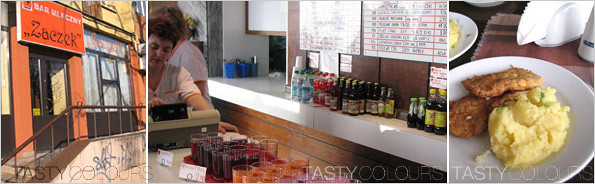
A typical Polish old fashioned summer dish is buckwheat kasha served with fried eggs and spinach, accompanied by a glass of fresh kefir. You can find this dish in famous Polish “milk bars”.


To make a long story short, a milk bar is a type of cheap and fast restaurant or rather eating-house, something like “greasy spoons”, where traditional dishes are served. The first milk bar was opened at the end of the nineteenth century and before the Second World War they were so popular enough that Governmental ordinances regulated their size and the prices of dishes. Thanks to that, the milk bars could be accessible to poorer part of society. After the Second World War they became especially popular, as they were always inexpensive, even twice or three times cheaper than regular restaurants. Certain of them are still in operation today, thanks, in a good part, to public subsidies. They usually are self-service restaurants, where old-fashioned cash-desks are still in use; however their interior decoration has rather changed and has been modernized. The fixed menu is displayed behind the cash desk, on big plastic boards.
During the communist era, the clientele of milk bars was a real phenomenon. In Kraków, for example, it was quite common to have students, physical workers and retired university professors share the same table.  
Many Poles remember an ironic scene from a cult Polish comedy “Miś”, a 1980 Polish film directed by Stanisław Bareja, full of a fearless and surreal sense of humor. Two individuals consume buckwheat served in metal bowls attached to a table with screws, barely “cleaned” with dirty rag. The meals are consumed in silence, using ugly metal spoons, chained together, so nobody can steal them.


To be honest, the reality of milk bars was much better than what this short film pictures. However, milk bars were specific places with specific smell of cooked dishes, that stuck to your hair and your clothes until bath was taken and clothes were changed.

Tuesday, March 2, 2010

Zrazy


Serves 4

Ingredients
800 g beef tenderloin
60 g dried ceps
1 big onion, peeled, washed and very finely chopped
¼  celery root (about 150 g), peeled, washed and sliced into julienne
½ large carrot (about 100 g), peeled, washed and sliced into julienne 
100 g raw, non salted pork’s back fat, cut into 8 strips of 4 cm long (optional)
8 thin slices bacon
6 grains black pepper
3 grains allspice
2 bay leaves
2 tablespoons butter
2 tablespoons goose grease
200 ml crème fraiche
Salt
Pepper
Cotton string

Preparation
Start by preparing the mushroom filling:
In 600 ml of water, soak mushrooms for at least 2 hours, preferably overnight.
Then cook the ceps in this same water, until soft, between 20 and 30 minutes.
Strain the mushrooms and let them cool down.
Reserve the mushroom broth.
Reserve 2-3 ceps caps for the sauce, chop the rest finely.

Cut the meat across fibers into 8 equal slices.
On a cutting board, place each slice of meat between two layers of plastic film and beat the meat delicately with a meat hammer. The meat should be around 5 mm thick.
Place the meat into the fridge.
In a hot frying pan, melt butter.
Add onions, fry over medium heat until gold.
Do not let onions burn.
Add chopped ceps.
Add salt and pepper to taste, cook for one or two more minutes.
Divide the filling into 8 equal portions.
Remove the meat from the fridge.
Place a slice of meat on the cutting board or on a plate.
Salt and pepper, then place in the middle of the meat one portion of mushroom stuffing, and a piece of pork back fat, should you decide to use it, and then roll the meat.
Wrap a slice of bacon around of each roll, and tie each roll tightly with a piece of cotton string.
Zrazy should not be huge – the perfect size is 8 cm long and 4 cm wide.

In a hot frying pan, melt the goose grease.
Place meat rolls and fry them equally on each side until bacon gets a golden colour.
In the meantime, prepare a large, not too deep, saucepan.
Place sliced carrot, celery and remaining mushrooms caps. Add bay leaves, grains of pepper and all spice and 400 ml of mushroom broth.
Bring to a boil and add the meat rolls in the saucepan.
Cover with a lid and cook over low heat for about 30 minutes, until the meat gets soft.
Flip the meat rolls occasionally so they cook evenly.
If necessary, add a bit of the remaining mushroom broth.

Once the meat rolls are cooked, remove them from the saucepan and place them on a warm plate. Cover and do not let them cool down.
Strain the sauce.
Reserve the mushroom caps, and throw away the vegetables.
Pour the sauce back into the saucepan; slowly add the cream, salt and pepper. Mix well. Should the sauce not look thick enough, add a bit of flour mixed with cold water, and then boil the sauce to cook the flour.
Add meat rolls into the sauce and cook everything for a couple of minutes, until the meat reaches the right temperature.
Zrazy taste best with buckwheat and beet puree, which I will present later.
However, they may be served with mashed or grilled potatoes as well.

This dish has very long tradition in Poland and there exist a lot of different recipes.
The dish itself probably came to Poland from Lithuania, a country which Poland was in political union with for ages. The name, however, has its origin in Polish language and means a “slice of beaten boneless meat”.
In general, beef for baking or even tenderloin cut in slices is used.
Some recipes use ground meat instead.

There are two types of Zrazy. One consists of slices of meat, beaten and cooked over law heat with onions and/or mushrooms. The other uses meat which is beaten at first, and then stuffed with various fillings. The latter, which I present here, is called “zawijane” which means, that the meat is rolled and tightened with thread.

Both types of Zrazy are firstly grilled on a frying pan until the meat becomes slightly gold, and then cooked in a broth. Usually crème fraiche is used to finish the sauce.

The most common filling for the Zrazy is a mixture of pork back fat, sour cucumber, bacon, mushrooms and sometimes vegetables like carrot and bell pepper.
My favorite version is prepared with dried ceps.

If you do not feel like eating pork back fat, you can omit it in your preparation. For the same reason, wrapping the meat in bacon is optional. I prefer the richer version of this dish. I do not eat Zrazy so often, so I sometimes can allow myself a little extra grease, which actually makes the dish much tastier! 
Related Posts Plugin for WordPress, Blogger...