Tuesday, November 12, 2013

Baked Goose with Jerusalem Artichokes for Polish Independence Day


Yesterday was Independence Day in Poland. Some of you could even watch or read the news in the press, showing riots and numerous acts of vandalism in Warsaw. The Independence Day in Kraków was much calmer, but the whole day was spoiled because of what happened in Warsaw.
Anyway, I ordered an organic oat goose a couple of weeks ago. It arrived on Saturday and we had it yesterday for lunch. You can read more about the goose season in Poland in this post and this one.

Yesterday, I baked the whole bird. The inspiration came from the recipe of Wojciech Modest Amaro who indicates to bake it for 5 hours. The meat was very tasty, although slightly hard ( I believe it could be baked a bit longer at a low temperature). I served it with a Polish style stuffing consisting of buckwheat, dried plums, smoked dried mushrooms and apples. You may prepare the stuffing on the previous day, the taste will even be better. My family could also try Jerusalem artichokes baked in honey. Polish goose goes very well with shredded beats, which is an extremely popular side dish in my country. I also experimented yesterday a red cabbage purée with shallots. The purée was tasty, but its texture was not ideal as it was not smooth).


Polish Baked Goose
Serves 6

For the goose and stuffing:
1 young goose (around 5 kg)
150 g dried prunes, thinly sliced
Around 200 g buckwheat
50 g dried mushrooms, soaked in about 400 ml of water
2 medium onions, peeled and finely chopped
Fresh thyme leaves
1 goose liver, chopped
2 sour apples, peeled and cut into small cubes
1 garlic clove, chopped
Goose grease
Salt and pepper

1. Prepare the stuffing. Soak the mushrooms in water for a couple of hours, alternatively cook them for around 30 minutes until soft. In a sauce pan, heat some goose grease, add buckheat and roast it for 2 minutes. Add mushrooms with the mushroom broth, bring to a boil, cook under the cover for around 6-7 minutes or until water evaporates, leave under the cover.
2. In a hot frying pan, melt goose grease and fry the onions until gold. Add apples, prunes and cook until apples are nearly soft. Add goose liver, thyme, and fry for around 2 minutes, stirring. Finally, add buckwheat with mushrooms, salt and pepper. Taste and put aside.
3. Tight goose legs and wings. Rub the goose with salt and chopped garlic and refrigerate overnight. Rub off the garlic in the morning (so it does not burn). Heat the oven to 90°C. Stuff the bird and sew the skin to close the cavity. Place in a large pan. Bake for 5 hours at 90°C. Then remove the bird from the oven, wrap it in aluminum foil, place it vertically and let it rest for 30 minutes. Warm the oven to 220°C and bake the bird for another 30 minutes. Cut the goose into pieces and serve with Jerusalem artichokes, the stuffing, beets and cabbage purée.

Baked Jerusalem Artichokes
300 g Jerusalem artichokes (peeled, washed and cut along into halves)
2 table spoons buckwheat honey
Goose grease

In a bowl, mix goose grease with honey, add Jerusalem artichokes and bake for 20 minutes at 220°C or until soft (depending on their size, the baking time will differ), mixing occasionally. You can also fry them in a frying pan. Delicately sprinkle with a bit of salt.

Traditional Polish Shredded Beetroots
4 medium beetroots
Butter
Cream
Salt
Pepper
A bit of lemon juice

You can bake the beetroots the day before baking your goose. Bake your beets in the oven (180°C) for one hour or until soft. Let them cool down completely and peel them. Thinly shred or blend them (I prefer the first option). In a saucepan, melt some butter, add beets and warm them up. Sprinkle with lemon juice, add cream, salt and pepper to taste. Heat well stirring constantly (it may easily burn).

Red cabbage purée
1/2 red cabbage, finely shredded
2 shallots, peeled and chopped
2-3 tablespoons red wine vinegar
2 tablespoons brown sugar
Salt
Heavy cream
Butter
Goose grease


In a large sauce pan, heat goose grease, add cabbage and simmer until nearly soft. In the meantime, in a small saucepan, add about 150 ml of water, the red vinegar and the sugar, bring to a boil, add shallots and reduce the heat down to the minimum. Cook until the liquid evaporates completely. Mix shallots with cabbage, blend them thoroughly until quite smooth (although its texture will not be smooth), add cream and a bit of butter, and salt to taste. Heat well.

Tuesday, October 22, 2013

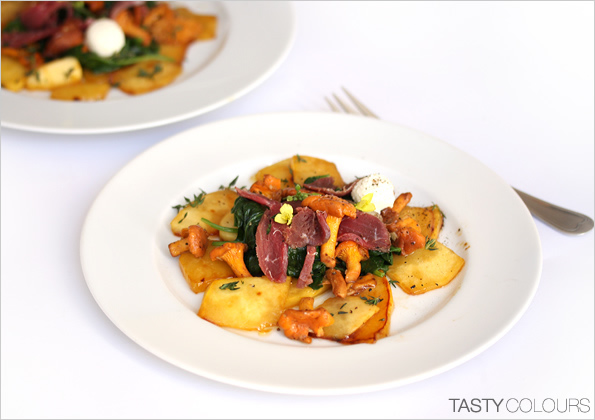
Goose Season. Warm Salad with Smoked Goose Breast, Chanterelles and Pumpkin.

Summer in Poland is gone. We are close to November which means that the peak of the goose season approaches. As you might remember it, last year I wrote a bit about the excellent Polish oat goose. I also mentioned the action promoting the Polish oat goose – "Gęsina na św. Marcina" – (goose tastes best on St. Martin’s fest”). This year, the event will last for more than two weeks: from 8th November to 1st December 2013. Selected restaurants, including top ones, have goose specialties on their menu. If you are in Poland at that time, I strongly recommend to visit one of the restaurants listed HERE.


Goose meat is also promoted by the authorities of the Kujawsko-Pomorskie Region. The region and a local touristic organization have created the "Goose Culinary Route" (Gęsinowy Szlak Kulinarny) which is financed, inter alia, by the Polish Ministry of Sports and Tourism. The region specializes in goose breading, and goose meat produced in this area is of a very good quality. You may then taste the classic baked goose, but also the famous "półgęsek" (an ancient specialty made from boneless goose breast with the skin on, cured and slowly smoked) or "okrasa" (a kind of spread which you can use as a topping for tartines). The official opening of the Goose Culinary Route is planned for the 7th of November 2013:

Below is a list of restaurants which are recommended by a special committee and, as a result, are listed on this culinary route:
  1. Restaurant "Weranda", Hotel Bohema, Bydgoszcz
  2. Restaurant "1921", Hotel Pod Orłem, Bydgoszcz
  3. Restaurant "Za piecem", Bydgoszcz
  4. "Regionalna Warzelnia Piwa", Bydgoszcz
  5. Hotelu Filmar Restaurant, Toruń
  6. Hotel 1231 Restaurant, Toruń
  7. Hotel Heban Restaurant, Toruń
  8. Jan Olbracht Browar Staromiejski, Toruń
  9. Sfera by Sebastian Krauzowicz Restaurant, Hotelu Copernicus, Toruń
  10. Ostromecka Restaurant, Ostromecko
  11. Gęsia Dolina Restaurant, Ślesin
  12. Karczma Rzym, Pawłówek
  13. Karczma Borowiacka, Bysław
  14. Vistula Hotel Restaurant, Świecie
  15. Karczma Chełmińska, Chełmno
  16. Hotel Młyn&SPA Restaurant, Włocławek
  17. Pałac Bursztynowy Restaurant, Włocławek

I still have one "półgęsek" in my fridge which I bought in Gruczno as it is practically impossible to buy it in any shop in Kraków (the distribution of local products in Poland is really bad and this is due to various reasons). Some restaurants here serve it occasionally. If I had my own house with a garden and a smokehouse, I would make this "półgęsek" on my own – the recipe itself is not complicated. I also brought from Gruczno an excellent buckwheat honey made by Mr. Wnuk from Lniano. His buckwheat honey won the first place at the Festival (it was also served during our Parisian event by chef Baron. It goes very well with sautéed pumpkin.

Warm Salad with Smoked Goose Breast, Chanterelles, Pumpkin and Spinach
(sałata na ciepło z półgęskiem, kurkami, dynią i szpinakiem)


Ingredients (serves 2-3)
200 g chanterelles
100 g smoked goose breast (półgęsek), thinly sliced (may be replaced with magret de canard)
1 small bunch fresh spinach leaves
200 g pumpkin, cut into thin slices
Buckwheat honey of good quality
1 table spoon, lemon juice
50 g fresh goat cheese
1 garlic clove, thinly chopped
Butter
Olive oil or cold pressed colza oil
Arugula flowers (optional)
Fresh thyme
Salt
Pepper

Prepare the mushrooms: Using a brush, delicately clean mushrooms from leftovers of the forest. Scratch the stems to remove soil. Rinse the mushrooms delicately under cold water. In a saucepan, slowly melt butter over minimum heat (do not stir). Remove from heat and skim the foam off the surface. Spoon the butter into a bowl. Discard the milky sediment. In a hot large frying pan, heat butter, add mushrooms (they should not be crowded, so they can grill evenly) and fry them on each side for a couple of minutes, until nicely grilled (depending on the thickness) and until they release their juices and absorb them back in (when frying over high heat, they should not release a lot of juice). Add garlic, fry for about one more minute. Salt and pepper.
Prepare the spinach: clean and wash your spinach, spin it. In a hot large frying pan, heat butter with a bit of olive oil, add spinach and fry it until soft. Salt at the end. At the same time, in another frying pan, melt some butter, add pumpkin slices, fry for a couple of minutes, then add honey with lemon. Reduce the heat and let the pumpkin simmer until nicely grilled and caramelized.

Prepare your salad: roll tiny cheese balls from your goat cheese. Heat the mushrooms. Put the caramelized pumpkin onto your plates. Put the spinach, chanterelles, cheese balls and the goose meat on top. Top generously with fresh thyme leaves, salt and pepper, as well as some olive oil or colza oil if you want.

Bon appétit !

Saturday, October 12, 2013

Polish Institute and Fête de la Gastronomie in Paris. 20-21 September 2013

A couple of months ago the Polish Institute in Paris asked me to co-organize an event promoting Polish cuisine. In September, "La Fête de la Gastronomie" is an important culinary event organized in France which is supported by the French Ministry of the Arts and Crafts, of the Trade and of Tourism (Ministère de l'Artisanat, du Commerce et du Tourisme). Basically, La Fête de la Gastronomie" is designated to the promotion of the French cuisine, but this year national cuisines of other countries were welcomed to present their culinary heritages. We did not have much time; the decision to participate in the event was taken in June, right before the holiday season, while the whole thing was planned for the month of September. We really had very little time!

As I mentioned it many times in this blog, Polish cuisine experiences great times (although you do not notice that so often in most restaurants). After years of fall during the communism, we witness the birth of a new Polish culinary art. Talented and non conformist chefs bravely use ancient traditions of the regions, the richness of nature, the extraordinary history and the unique, traditional techniques of food preparation as well as food products from the best local producers. That is why the Polish Institute invited Aleksander Baron, a talented chef of the young generation, to be in charge of setting up a menu, choosing the products, which arrived straight from some of the best producers in Poland and preparing the meals in Paris.


On Friday, 20th September, some selected guests were invited to the beautiful palace of the Polish Embassy in Paris. The honorable patronage over lunch was performed by Mrs. Urszula Orłowska, the wife of the Polish Ambassador in Paris.


This Friday lunch started with a famous chilled soup (chłodnik) made with Polish Red cattle broth and Polish noble crayfish. Then Białowieża Woodland bison - tenderloin was served with milk cap mushrooms and wild carrots as well as with Jerusalem artichokes baked in phacelia honey and wild Polish thyme. Between the courses the chef served "amuse-bouches", such as for example Vistula trout, pickled river lamprey and smoked goose breast. Dessert was simple but unique, as the chef had elected honeydew honey honeycomb, Polish sour cream and farmers' tvarog from Smykań, all of them brought over from Poland of course. Unfortunately, the artisanal butter which was part of the shipment did not survive the transportation by plane. Thus, the chef was not able to serve what he had anticipated: ice cream from butter from Smykań, Vistula sour cherry in single distilled young potato vodka (Młody Ziemniak 2012). The lunch was accompanied by an assortment of the best, local Polish liqueurs (nalewki) and vodkas, all chosen by the chef.


To make a step into in the culinary future, one has to know the past. That is why the second event, which took place on Saturday evening in one small Parisian restaurant (specializing in Hungarian food) called Beashka, was dedicated to Polish influences in the 19th century French cuisine. The dinner was animated by the renowned food and culture historian professor Jaroslaw Dumanowski, while chef Baron adapted ancient recipes to our more modern culinary language. Our guests could taste revised versions of meals based on ancient recipes from old French cook books like, for example, Vincent La Chapelle "Le cuisinier moderne" (The Hague, 1742) and Urbain Dubois "La cuisine classique" (Paris, 1856). Hardly anybody knows that a couple of hundred years ago, Polish cookery had been appreciated and described by old masters of French cuisine, who had been using Polish inspirations in their cooking.


The dinner started with Polish noble crayfish cooked with dill weed and lemon butter roux. The guests then were served two risky dishes: beets and carps. An excellent Polish borscht was prepared with pickled beetroots and smoked goose breast (półgęsek). Boneless carp from the Land of 1,000 lakes (Mazury) was served with an old fashioned grey sauce with gingerbread (from the pastry shop of Franciszek Pokojski in Toruń) and a parsley mousse. For desert, the chef served a selection of four ancient Polish species of apples (antonówka, grochówka, szczecinka, boskop) which were simply baked. Of course, everything was accompanied by Polish liqueurs (nalewki) and vodka, chosen by the chef.
Here's is the link to the booklet we prepared for the event.

The whole event was recorded by the National Digital Library of Poland and digitalized.

Let's hope that the Polish Institute will repeat the project in the future.


Tuesday, July 30, 2013

My Article about Parisian Pastry Chefs in Kuchnia Magazine. And Why I Was Silent.

It's been quite a while since my last post on the blog. Those of you who follow the Tasty Colours profile on Facebook are quite aware of what I was doing for the past couple of months. For those, who are not linked to Facebook: we were involved in a big move from France to Kraków. It took us a couple of months to organize ourselves in our new apartment.

We spent February and March in Paris. A day before leaving Kraków for Paris, my husband broke his leg,  then he had a surgery in Paris and the cast on his leg for 3 months.  Having a broken leg seems a bit stupid but actually is handicapping, so not only I was "working" as a driver for my husband, but also I was involved into many more things than usual. Despite the limitations caused by my husband's broken leg and the organization of the move from one country to another, I succeeded to make a couple of interviews with some top Parisian pastry chefs like Sadaharu Aoki, Gérard Mulot. I also visited the Maison Hermé and la Pâtisserie des Rêves and had a chance to have a chat with their press officers, to try the pastries and to take pictures.  The article was published in the July edition of the Polish culinary magazine Kuchnia. 


So, as you can see, despite this long silence on the blog, I was not completely disconnected from food matters. I am very happy about my article.  At the moment, I have no time for cooking and presenting a lot of the recipes, as I started to co-operate with some institutions in food related matters, but first of all I also work in my law firm.

It is the season here, in Krakow, for fava beans. Do you like fava beans? As I love pierogi and since I did not make any in months, I decided to prepare some last week and to stuff them with fresh mint, cooked fava beans and local sheep's cheese.


I served them with beurre noisette. When I was a kid, I spent a lot of our holidays in the mountains, where the mint was growing like crazy. Local people were collecting it and drying it out (in particular, around 15th of August – which is a religious celebration) but I do not remember that they were using it for cooking. From the perspective of years, I think that it was one of the result of the communist regime. The food that I remember from my holiday surely was not local and could be found anywhere. Even in the Podhale region, where small farms survived and where I had never seen a state owned agricultural enterprise (PGR) , the local cuisine was never served to us. Only a couple of years ago I found out that fresh mint was traditionally used in this region to make, for example, a garlic-mint soup with potatoes. Fresh mint may also be used to stuff pierogi, for example buckwheat and tvarog, or lamb.

Pierogi with Fava Beans, Bryndza Cheese, Fresh Mint and Potatoes


Ingredients:

300 g pierogi dough (follow the basic pierogi doughrecipe)
500 g fava beans (not peeled)
150 g bryndza (or other sheep's cheese)
1 onion, peeled and finely chopped
2 small potatoes (around 200 g both), peeled
1 handful fresh mint, finely chopped
few mint leaves, for garnishing
around 150 g butter
salt
pepper


1. Cook fava beans in salted water. Strain and let them cool down. Then remove their skins off.
2. Cook potatoes in salted water. Once they are cooked, strain and mash them.
3. In the meantime, fry onions over medium heat, until they are gold.
4. In a bowl, mix the cheese well, the mint, potatoes, fava beans and onions. Add generously salt and pepper, taste.
5. To make pierogi, follow the directions in the basic dough recipe
6. When the pierogi are cooked, prepare a beurre noisette, called in English "hazelnut butter" (for its hazelnut colour and nutty flavor). Add around 100 gram of butter, and let it cook over a gentle fire, allowing it to separate into butter fat and milk solids. The milk solids then sinks to the bottom of the pan and start to brown up with the heat, as the cooking process continues, until reaching a color of hazelnut, when the browned butter is finally removed from heat. Add fresh mint leaves, so they can fry gently (over low heat, so they will not become bitter). Serve immediately over your pierogi dish.

Bon appétit !

Friday, March 1, 2013

Ancient Veggies and Slowly Braised Pork Belly by Eric Ospital. Świerząbek – popie jajka i wolno duszony boczek Erica Ospital.


Sometime I find a recipe which I would like to cook right away, but for some reasons it must “wait”, like a good wine.  More than one year ago, when I was in Paris, my husband was awaiting surgery. We were sitting one Sunday morning in the kitchen and we were listening to the program about cooking “On va deguster” which is broadcasted every Sunday on France Inter, a French public radio station. Chefs, pastry chefs, famous bloggers and food producers are invited to the program. On va deguster reminds me that when I was a small girl, I was often sick. When I was sick, I used to stay home alone. I was reading books, but the radio had to be turned on all the time. You might not know about that, but in the middle of the eighties, in Poland, we had only two TV channels and there were no programs for kids during the day.  There was no video recorder in my family. The radio was the only option to be entertained. 

Coming back to this program which we listened to one year ago: it was about pork meat. The special guest of the program was, inter alia, Eric Ospital, a renowned producer of pork and hams from the south of France - close to the Pyrenees (he produces, inter alia, Jambon Ibaiona, Jambon Pays Basque). Today’s recipe is his recipe for a slowly braised pork belly. Why I decided to cook this? Because the idea of this pork belly is to have two textures – “fondant et croquant” – soft, nearly melting meat – “fondant” and covered by crispy external crust ("croquant").  He advises to braise the pork belly for 12 hours. In my case 8 hours were sufficient (I used a relatively small piece of pork belly).  The finishing in butter gives the crispy texture outside. 
I served it with baked, winter, ancient vegetables: “racine de cerfeuil” (tuberous-rooted chervil, bulbous chervil), yellow – violet rutabaga (swede), yellow turnips, Jerusalem artichokes, potatoes and carrots – baked with fresh bay leaves and fresh rosemary. 

Do you know “racine de cerfeuil”? In latin it is called Chaerophyllum bulbosum, in English “tuberous-rooted chervil”, “bulbous chervil”. It is root vegetable which was popular in the past (allegedly a specie from the carrot family), a native of Europe and Western Asia.  The tuberous-rooted chervil was a popular vegetable in the 19th century. 
This mysterious rooted chervil was also known in Poland and was called “świerząbek”. And you will not believe, but it is mentioned as “popie jajka” (“priest  testicles”) in the first Polish cookbook – the famous Compendium Ferculorum, written and published in the  17th century (described in details in my January post. 

The vegetable can be eaten raw (thinly sliced, sprinkled with olive oil, lemon juice, salt and pepper), it may be boiled, baked or fried. It is starchy, like topinambur and potatoes (especially once baked in the oven), but sweet like parsley root or parsnip. It grows in Poland in fields, as topinambour (Jerusalem artichoke), but I do not believe that it is available in any store in Poland. Now forgotten in Britain and in the United States, allegedly root chervil is still used in French cuisine, in soups or stews. One more thing: after two weeks in Paris, I have an impression that topinambour is as common as potatoes. I have checked: one can buy topinambour in every food market in Paris, in food stores like Monoprix, in stores with bio food (Bio c’bon), Naturalia,and even in food discount stores. The price is between 3 and 4 euro a kilo.

I found the rooted chervil two weeks ago, on the food market boulevard Raspail – the one, where I used to do my shopping every Tuesday and every Friday when we lived rue de Bérite. Almost everything looks the same.  The same “poissonniers” sell fresh seafood, the same man in glasses pushing you to buy vegetables and the same guy selling farmers’ cheeses. One thing was new – Americans selling specialties including burgers straight from “a food truck”. They called themselves “Cantina California”.  It seems that "street food" is trendy in Paris, which is not so obvious, because: a) a typical French person hates to eat with hands – and the burgers the American guys sell are huge and juicy and you HAVE to eat them with your hands b) a typical French person does not eat outside, standing up – he or she MUST sit down; c) a typical French person does not like to eat in a hurry.  The first “food truck” in Paris was “Le camion qui Fume” which appeared in some Parisian streets in November 2011 and it was a huge success. The “Cantina California”, the competitor, which has only been in business for a few months is also successful. Both published their burgers cookbooks which are available in Fnac stores. 


Slowly Braised Pork Belly (by Eric Ospital)


Ingredients:
(serves 2) 

500-600 g raw, nice pork belly (as it does not contain too much meat, you should count around 300 grams per person (which includes abound 120 grams of meat)
2 grains all spice
Few brines fresh thyme
2 bay leaves (most possibly, fresh ones)
2 small carrots, peeled and washed, cut into slices
2 medium onions, cut into halves
1 liter chicken stock
1 medium leek (white part), washed and cut into slices
50 g butter
Black pepper grains
Chives, finely chopped, for garnishing
Salt
Pepper

1.Brown onions on a dry frying pan or over the fire. Place pork belly in a saucepan. Add carrots, onions, thyme, laurel leaves, all spice, pepper grains and cover with the stock (if you do not have enough, add some white wine or water). Bring to a boil and then reduce the heat to a minimum and cook under the cover for 12 hours. You should check the cooking time because my pork belly was “fondant” after 8 hours. 
2. Cool down and refrigerate overnight.
3. On the next day: cut the pork belly into thick slices. Heat the pan, reduce the heat to a minimum, add butter and melt it. Place pieces of belly in the pan, it should caramelize on all sides between 20-30 minutes, until it is brown and crispy. Sprinkle with chives or parsley, serve with vegetables (the recipe below) and also with a green salad (for digestion) as advised by Eric Ospital.

Roasted Ancient Root Vegetables


Serves 2-3
Ingredients:

2 medium Jerusalem artichoke (topinambour) - around 100 g
150 g racine de cerfeuil (tuberous-rooted chervil) around 6 pieces
1 medium rutabaga (around 100 g)
1 medium yellow turnip (“boule d’or) 
1 medium potato  
1 carrot
Fresh rosemary 
Fresh thyme
Olive oil
3-4 bay leaves
Salt
Pepper

Peel and wash vegetables. Dry them out. Cut into strips (French fries type). Pour olive oil and mix. Salt generously, pepper. Place in a pan, add rosemary, thyme and bay leaves. Bake in the oven preheat to 180 degrees for around 30 minutes, occasionally mixing. Serve with braised pork belly.

Smacznego !


Sunday, February 24, 2013

Paris Cookbook Fair 2013. Paryski Festiwal Książek Kulinarnych 2013.


I am in Paris and yesterday I visited Paris Cookbook Fair which is the prestigious annual international cookbook and wine book trade meeting, to which I was invited. This year, it took place in the heart of Paris, right under the Pyramid of the Louvre Museum, in the spacious Carrousel du Louvre, famous for the Paris fashion shows. The weather was not appealing - a mixture of snow, rain and wind.


This is an event for professionals, editors, publishing companies rather than for amateurs. Of course everybody may enter if they pay.  The tickets, in my opinion, were far too expensive for the general public – 35 Euros for one day or 65 Euros for 3 days. Additionally, the event is not aimed at selling cookbooks or to promote them to the public. That explains why the event was not very crowded.


The official website presents the event as follows: “the event focuses on the sales of translations and foreign rights, with Asia the leading buyer today, and Europe the major seller”. I am not surprised at all. Asians indeed buy everything, including vineyards in France, chateaux in the Bordeaux region and whole inventories of the best French wines. Did you know that cookbooks and wine books are probably the healthiest segment of publishing today, with a two digit growth in Asia and Latin America? “Dozens of countries are now buying, and make significant contributions to the profitsof the sector”. Non European accents were strong in the crowd (35% guests to the event come from outside Europe).
The Paris Cookbook Fair lasted for 3 days (this year between 22-24 February). The supporting events included panel discussions, presentations, interviews with publishers and national TV stars (cooks, food stylists, writers and food photographers), live cooking shows with professionals and cooks from Le Cordon Bleu.


On Saturday, the Gourmand World Cookbook Awards (which took place yesterday in the 1,400 seats theater of the Carrousel du Louvre) for the best cook books, wine books and publishers have been awarded in quite a lot of categories. This year 171 countries were participating (after 162 in 2011). The full list of the finalists and winners is published in a large booklet which is available on line here, at the official website of the Paris Cookbook Fair.
At the Paris Cookbook Fair, hundreds (if not thousands) of cookbooks from all over the World in every possible language, edited by both renowned publishers but also by small ones, are presented but you can also meet the authors and publishers and you can have a chat with them. In general, they were very helpful, open and talkative. However it was very difficult to buy any books there. On most of the stands, in particular those with books from abroad, it was impossible to buy anything (either because they did not have card terminals, or they did not have enough copies for sale). But that was not the goal of the event.


So, despite I did not buy any book, I was happy because I could have some chats with interesting and open people, like for example the co-authors of the Swedish culinary anti-cancer cookbook, which sells in Sweden like hot cakes. The book includes gourmet anti-cancer recipes (written in co-operation with doctors).  Swedish were well organized - not only they were open to questions, but also they offered a wide range of Swedish specialties and beverages (including specific, bitter – sour lingonberry drink).


My eyes were also caught by a beautifully edited cookbooks about….Greenland cuisine. The luxurious and elegant stand of the Modernist Cuisine was impressive (like the brochure that they edited for the Paris Cookbook Fair), but I was more impressed to have a chat with guys who support (namely, by publishing cook books about Cambodian cuisine), and raise money to help homeless kids on the streets of Phnom Penh or with two guys from Argentina, wine importers, who came not only to promote their wines, about also to promote the cookbook about….Patagonian cuisine. Azerbaijanis not only proposed their cookbooks, but also prepared a food show and savory and sweet snacks.


Polish accents were visible, but not as strong as they should be. There was a stand of the Palace Wilanow Museum, presenting a series of cookbooks about Old Polish cuisine – Monumenta PoloniaeCulinaria. I met professor Jarosław Dumanowski and Elżbieta Grygiel from the Wilanów Palace Museum. We had a long chat about the Old Polish Cuisine and its possible promotion abroad. I’ve got a few heavy gifts (they were cookbooks, as you can guess). I met Grzegorz Trubilowicz from Cooklet - who is the co-founder of Cooklet - Inspiring Culinary Organizer. One should watch Cooklet – they already attacked the U.S. market and are finalists of some important competitions in media applications.


I was searching for the cookbook recently published by BOSZ, “The Fine Polish Cuisine”, the book about Polish cuisine published under the patronage of the wife of the President of Poland (the book was also the finalist of the Gourmet Awards). To no avail. I did not find the book, and I did not check it out, despite my thorough attempts. No other Polish culinary accents were present there, which is a big pity. 

Wednesday, February 6, 2013

Crunchy-Branchy or Angel Wings ? Chrust.


Here is Magda’s dad, special guest star of today’s blog post. I would like to suggest something very Polish and very tasty – sweet specialty prepared mainly for Carnival season which starts with Christmas and ends on Mardi Gras, Ash Wednesday. This year it falls quite early – February 13 (I am not superstitious but does that mean bad luck or what ?)

Our today’s hero is CHRUST (pron. “khroost”). In Polish it literally means “brushwood”, a bunch of twigs, small and tiny wooden brunches usually collected in the woods to serve as an easy starter of a bonfire. Similarity is obvious: these sweet twisted ribbon-shaped deep fried cookies resemble their natural wooden cousins. As it is in our rich Polish language, there is a plethora of names for these dessert items – “Chrust, chruściki, faworki, jaworki, kreple”. All as easy tongue-twisting as almost everything in my mother’s tongue. But it is much easier to cook. Particular name depends on the region of Poland they are prepared in. My choice comes from my mom who taught me to make CHRUST. My family for generations has been proud citizens of royal city of Krakow, the capital of Małopolska (Lesser Poland) region where CHRUST label dominate overwhelmingly.

How these cookies should be called in English ? Wikipedia and numerous culinary websites and recipes name CHRUST as “angel wings”. Sorry, but it sounds pretentious, a bit kitchy. We (me and Magda) wondered whether a new useful and corresponding name can be invented. Our conclusion (watch out ! Copyright) is Crunchy-Branchy. The cookies, when properly prepared, are quite al dente in a sense of crunchiness and crispiness. And since they are like small pieces of wood, twigs, broken branches, crunchy-branchy should be approved and accepted by all cookies lovers.
And, last but not least for this lengthy introduction to the recipe, I wish to say that dishes, specialties and culinary products strictly tied to a certain time of the year, special season, religious holidays etc. fill the drawer of my dearest recipes and flavors. Can you imagine Thanksgiving Day without a turkey (sorry American friends but you always demonstrate bizarre ability to overcook this bird unless it becomes tasteless…) ? Advent-lent period without gingerbread houses ? Mardi Gras without a fish or shellfish ? Christmas dinner without beloved traditional family dishes ? No way. So CHRUST dominates Poland during Carnival time.

Making CHRUST (CRUNCHY-BRANCHY) is not too complicated. The secret is making proper dough and keeping the rules of ingredients that form it.
We will need (for a big plate to be filled with mound of the cookies):

-   2 cups flour
5 egg yolks (some recipes suggest to add whole eggs but the whites make the cookies tougher)
4 spoons dense sour cream
teaspoon of white vinegar
spoon of white clear vodka (both liquids make the cookies more fluffy)
2 spoons of well-softened butter
salt (sprinkled to the taste, con amore)
oil/fat for deep frying (olive oil excluded – its flavor is too invasive), at least 1 lb or ½ litre but have more to add if necessary


Dough preparation wooden board would not hurt. Btw, it’s one of my favorite kitchen tools and utensils.
Making a dough: make a crater in the mound of dough, add all ingredients and start to mix it. Delicately but with no mercy. The dough may seem too dry but it’s only initial impression. If you make the dough patiently and thoroughly (hard labor, nothing comes for free !) it will reach the end as homogenous, smooth, slightly flexible. It it’s really too dry, add 1 – 2 spoonful of water but frankly speaking the dough need not to drink it. When you judge the dough to be well-worked out, beat it with a roll for several minutes – until it starts to reveal small air bubbles. I usually throw the dough against the wooden board (all sides) but this roars as a thunder and finally I hear neighbors knocking from the above or from the down under. Then I finish torturing the dough with a roll.

OK. Now the dough (cylinder-shaped) must take a rest in the refrigerator. Store it there for about an hour but covered with a linen cloth or kitchen towel.

Get the dough out of the cool place. Cut into three even pieces. Take one, the other two put back In  the fridge. Roll. Roll and roll. Don’t rock, just roll until the dough nears paper-thin. Cut it with a knife into 2,5 cm (1 inch) wide and 12 cm (5 inch) stripes. Make 4 cm (1,5 inch) cut in the middle of each strip. Take one end of each strip and draw it out through the slit in of the stripe. This way you shape it like a ribbon. You will truly see this once it is deep fried !

Now it’s time to warm up the fat/oil. I always use my old wok (bought in 1988 for one dollar(!)  at a garage sale in Boulder, Colorado) but any pan or pot for deep frying will do. The fat temperature is OK when small piece of the dough thrown upon immediately comes out to the surface “boiling”. Now you can softly put the dough ribbons into the hot oil. Not too many at a time, otherwise they will fry unevenly. For the same reason, turn them quickly when frying. Final color should be deep golden towards light brown. Gently (it’s CHRUST, pretty fragile “brushwood”) take the cookies out of the pan. Bring down the heat under the pan otherwise the fat will start burning. Dry the cookies on the paper towel, then move onto the large plate. When the first layer covers the plate, sprinkle it snow-white with the confectioner’s sugar.  It sounds a bit complicated, but believe me, it is not. Especially when you have a helper in the kitchen (no kids ! Boiling oil is a mortal danger and scars from oil burns can be lifelong) who moves the cookies from here to there.

What else ? You repeat the sequence of the activities unless all dough has been rolled out, cut into stripes, ribbon-shaped and fried. What’s crucial for successful frying operation is maintaining proper oil/fat temperature. And adding some fat (cookies absorb it when fried) every now and then. Don’t be frightened: you will get necessary experience after just one session.

The satisfaction of admiring the mountain of fantastic CHRUST cookies on the plate dusted with sugar snow rewards all efforts. And they are so delicious, so unique in texture, taste and flavor ! Writing this I already have my mouth watered all over even if swallowed final pieces of my CRUNCHY-BRANCHY only last Sunday. And don’t leave them for the following day. This is kind of food to be consumed the very same evening.

Cuisines of several nations include making “angel wings” cookies like Polish CHRUST. But believe me, none taste like ours.
The real sweet bonanza in Poland comes on “Tłusty Czwartek”, last “Fat” Thursday before Ash Wednesday. Everybody eats “pączki” (Polish style doughnuts) on this day. But that’s another story, for another post.

Vive le Carnaval à la Polonaise !

WERSJA POLSKA:

Dzisiaj wpis goscinny mojego Taty - specjalisty od chrustu. Ja chrustu nie umiem robić i pobrałam w ubiegłym tygodniu lekcję. Tata pisze:

Chrust, chruściki, faworki, jaworki, kreple. Różnie w różnych częściach Polski nazywane, jak to bywa z wpływem regionalności na kulinarne nazewnictwo. Etymologii tu nie będziemy objaśniać bo od tego mamy guglowanie/guglanie i inne wikipedie. Wyznam tylko, że najbardziej lubię nazwę „chrust” właśnie, nie tylko dlatego, że przejąłem to po krakowsku od Mamy. Chrust to przecież drobne, kruche i łamliwe gałązki. Cóż za piękna analogia z naturą tych podłużnych słodkich ciasteczek-chrupanek-kruchanek.
W ogóle uwielbiam potrawy i kuchenne wykwity związane z jakimś szczególnym okresem roku, ze świętami jednymi czy drugimi, z dorocznymi okazjami, mniej lub bardziej podniosłymi. Uwielbiam za ich wyjątkowość i nieprzystawalność do innego czasu. Boże Narodzenie bez wigilijnego postnego barszczu z uszkami ? Nie sposób. Ostatki przed Popielcem bez śledzika ? Jakże to. Cudowne amerykańskie Święto Dziękczynienia bez indyka (zawsze niedobry) ? No way. Adwent bez domków z piernika ? Unmoeglich. Raz z żoną zrobiliśmy sobie wigilijną kolację w lipcu. Nagotowałem się, a jakże, było wszystko jak trzeba. Pyszne. Tylko kulturowo obce jakieś, czułem przy tym posiłku element bluźnierstwa (Śledzika z tego wyłączam, śledzik jest uniwersalny i ponadczasowy).
No więc chrust (Kongresówko, wybacz, że nie będzie o faworkach). Może być karnawał bez niego ? Nie może. Dlatego zawsze jedną z weekendowych sobót końca stycznia, gdy przyjeżdżam z roboty w Warszawie do krakowskiego domu, poświęcam na wypełnienie sporego półmiska tym niezbieranym w lesie chrustem.
Roboty przy tym trochę, ale nie za dużo, choć ciasto wymaga nieco krzepy. Ważne by trzymac się i proporcji, jak zawsze przy wypiekach czy wysmażkach (to ostatnie pod copyrightem – wynalazłem przed chwilą). Trud będzie wynagrodzony.
Ja to robię tak. Zacznijmy od przepisu (żadna tam oryginalna filozofia, sami znajdziecie mnóstwo w necie):

2 szklanki mąki (uniwersalna czy tortowa, ganz egal)
5 żółtek (niektórzy dają całe jajka, ale białka powodują twardnienie ciasta)
4 łyżki śmietany (daję 22 %, ale 18 % też dobra)
Łyżeczka octu spirytusowego plus łyżka wódki (spirytus lepszy, ale nie zawsze jest w domu, co zresztą nie znaczy, że wódka też; niektórzy daja jeden z tych płynów, ja oba, smak chrustu jest wyrazistszy) – oba płyny spulchniają ciasto, ale z octem nie przesadźcie bo kwaśny chrust to chyba przegięcie
2 łyżki roztopionego masła (ma być letnie)
Trochę soli (niedużo, parę szczypt con amore)
Tłuszcz do głębokiego smażenia (zawsze mam do chrustu kostkę smalcu i kostkę Planty).

No i stolnica oczywiście. Robienie ciasta na gołym blacie stołu, jak w wielu domach, lekko je desakralizuje.
Ciasto: w kopczyku mąki robimy krater i wypełniamy elegancko wszystkimi ingrediencjami (no, tłuszczem do smażenia nie). I teraz trzeba się trochę pomęczyć. Mieszamy delikatnie, ale stanowczo, skladniki mają się rozprowadzić równomiernie. Ciasto wyrobiamy cierpliwie, na początku będzie się wam wydawać, że jest za suche: nic z tych rzeczy, trzeba wyrabiać i wyrabiać. Jeśli istotnie za suche, można się posiłkować 1 – 2 łyżkami wody, ale to wobec ciasta nie jest zbyt fair. Gdy już będzie jednorodne, leciutko rozciągliwe, trzeba je jeszcze skatować tak, by zaczęło wydzielać pęcherzyki powietrza. Na ogół ludzie tłuką ciasto wałkiem, ja wolę rzucać nim ze wszystkich stron o stolnicę (huk straszny) tak długo aż z dołu czy z góry nie usłyszę pukania sąsiada. Jeśli zapuka za wcześnie, przechodzę na ciosy wałkiem. Gdy ciasto uznamy za gotowe, musi powędrować do lodówki, by dojrzeć (do godziny). Tylko przykryjcie (nieśmiertelna lniana ściereczka), bo obeschnie.
Po lodówce formuję  ciasto na kształt dość grubego wałka/cylindra. Przed rozwałkowaniem dziele go na 3 części – w ten sposób całość rozwałkowanego ciasta jak raz zmieści się w trzech partiach na stolnicy.
Rozwałkowuję pierwszy kawałek – jak najcieniej, od tego zależy delikatność chrupkiego „wysmażu”, no i kroję (radełko lub nóż) na paski szerokości 2 – 3 cm (wolę ciastka-patyczki wąskie od szerokich) i długości 12 – 15 cm. W środku przecinam pasek na 1/3 długości. Robi się szczelina, przez którą z łatwością przewleczecie jeden koniec ciastowego paska, formując jakby wstążkę-kokardkę. Wyznam, że tę czynność bardzo lubię bo znamionuje ostatnią, czyli smażenie. No to smażymy. Ja to robię w chińskim woku, który drogą kupna nabyłe w 1988 r. na wyprzedaży garażowej w Colorado za dolara (!). Do dziś go bardzo kocham i jestem mu bezgranicznie wierny.  Jest stalowy, obrośnięty nagarem, jak przystało, żaden tam teflonowy wycirus.
Rozgrzewamy tłuszcz. Pół kostki jednego, pół kostki drugiego. Niektórzy smażą na oleju, ale ja mam jakąś awersję. Tłuszczyk kostkowy ładnie się topi. Temperatura jest smażalna gdy wrzucony do tłuszczu płatek ciasta szybko wypływa na powierzchnię, „gotując się”, czyli szybko wysmażając. Średnica woka plus taka ilość tłuszczu pozwala naraz smażyć ok. 7 chrustowych wstążek. W woku czy rondlu nie może być za ciasno, paski/wstążki muszą wysmażyć się (po obu stronach, w pewnym momencie należy je szybko odwrócić) swobodnie i równomiernie. Kolor wysmażonych – złoto przechodzące w lekki brąz (takie lubię najbardziej). Wyjmujemy delikatnie cedzakiem i osuszamy na papierowym ręczniku. Potem pomagier, o ile takiego mamy pod ręką, ma to przełożyć na półmisek. Delikatnie ! Wszakże to chrust, złamie się pod bardziej grubiańskim palcem. Istotna uwaga: cały czas kontrolujemy temperaturę tłuszczu; nie można go za bardzo schłodzić, ani nie zostawiać na full bo zacznie dymić i przypalać kolejne partie wrzucanych wstążek ciasta. No i tak nam schodzi do końca smażenia pierwszej partii. Pamiętajcie o zgaszeniu gazu lub zdjęciu rondla z płyty. Tłuszcz się przed następną partią wystudzi, ale go przecież podgrzejemy, dodając go nieco z kostki bo przecież każde smażone ciasto coś niecoś go wchłania.
Na półmisku rozprowadzamy usmażony chrust w równomierną i w miarę szczelną warstwę. Pojedynczą. Czas na posypanie cukrem-pudrem. Kiedyś to się sypało mączkę cukrową przez geste sitko. Teraz kupuje się ten puder w ustrojstwie, którym się kręci a puder jak śnieżny pył sam leci ! Jak mawiają Rosjanie, kak w kino ! Obfitość obsypania pudrem zależy od Waszego smaku i dozwolonego pułapu cukru w organiźmie.  Potem nakładamy kolejną warstwę usmażonych faworków (robię tu jedyny raz wyjątek – dla przyjaciół w Saskiej Kępy), i znów cukier puder.
Potem wszystko identico z drugim kawałkiem cylindrycznego ciasta, potem z trzecim. Nim powiem smacznego, jedna przestroga. Przy smażeniu pod żadnym pozorem nie wolno wpuszczać do kuchni dzieci, ani nadmiernej liczby gapiów. Gotowanie z wrzącym tłuszczem to naprawdę niebezpieczna robótka a oparzenia bywają tylko III stopnia i straszliwe.
Po tej sympatycznej uwadze mowię: bon apetit ! Podanymi proporcjami składników się specjalnie nie najecie (ale obsypany na biało kopczyk na półmisku zawsze będzie), lecz po pierwsze – można ilość składników proporcjonalnie zwiększyć, po drugie – chrust nie jest do obżerania się tylko do chrupano-kruchej zabawy na jeden wieczór. Za to jaki pyszny !


Related Posts Plugin for WordPress, Blogger...