Should you ask me what is my most memorable episode from Polish Christmas when I was a kid – I would not mention a Christmas tree (we always had one, of course), or gifts (which we were offered), or the extraordinary cleaning of the apartment one month in advance, or the preparation of the Christmas dinner for three days in a row (which was actually the case), or not going to school and even not playing and singing Christmas carols, handling family meetings and so on – but rather « hunting » a carp, a soft water fish probably most appreciated in our region, and maybe in China.
In the eighties, when I was a kid, we had been suffering from food shortcomings - I mentioned this to you already. The preparation of tasty Christmas meals was - for a family living in a city like Krakow - a challenge. We had to spend long and boring hours in lines at food stores. A lot of basic food products, like sugar and meat, were in limited supplies. Even to purchase a carp fish was not easy. Additionally, the poor fish were taken home a few days before Christmas Eve and they were being kept alive in.... bathroom bathtubs. This may be the most common picture of any Polish home before Christmas: fish in the bathtub! .... Then the fish was murdered by the parents one or two days before the Christmas Eve. A blister of the fish was placed on a heater so it could explode with a noise to children’s pleasure. The fish's scales were washed, dried and placed in wallets - for good luck in the coming year. Indeed, that was a cruel habit – the animal was killed in a non humanitarian way, which nowadays is stigmatized in some Polish TV campaigns.
As far as I know, the carp was, in old times, a fish for poor people; then, it became an eminent part of Polish culinary traditions after the World War II and a proletariat king on Christmas tables. It replaced nobler soft water fish like sander, eel or pike. On the other hand, due to the development of Polish species of carp (for example, karp zatorski), the carp remained an eminent ingredient of our Christmas traditions. And you know what? I like to eat it once a year. If you visit Poland right before Christmas, you will notice in nearly every food store a huge bathtub or a plastic pool with carps swimming inside it.
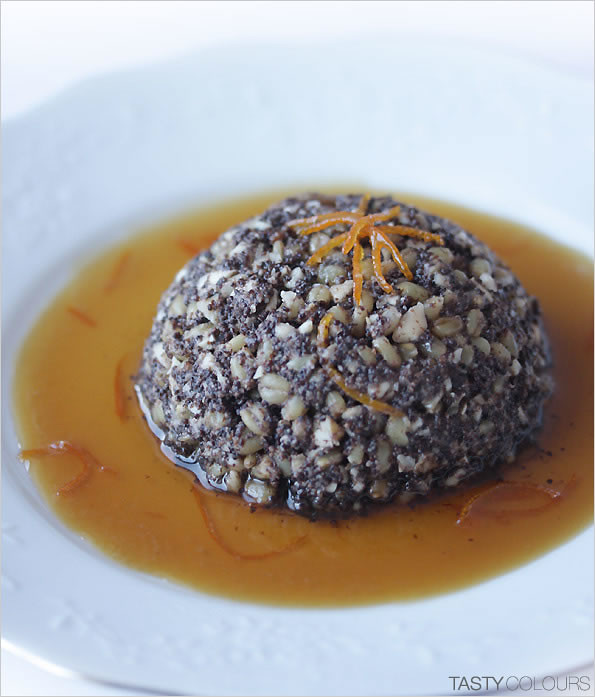
The Polish Christmas Eve (“Wigilia”) menu is very traditional. I know of some atheistic families whose Christmas menu is the same as in families practicing the Christian religion (which dictates for example, that absolutely no meat should be eaten during the Christmas Eve dinner). There are some dishes that we (or I) eat once per year, the preparation of which often takes a lot of time. Despite historical changes (like for example the expatriation of people whose families lived behind the Bug river), those dishes will probably be served for the Christmas Eve dessert in some regions of today’s Poland - kutia (a dessert having its origins in the Ukrainian territory).
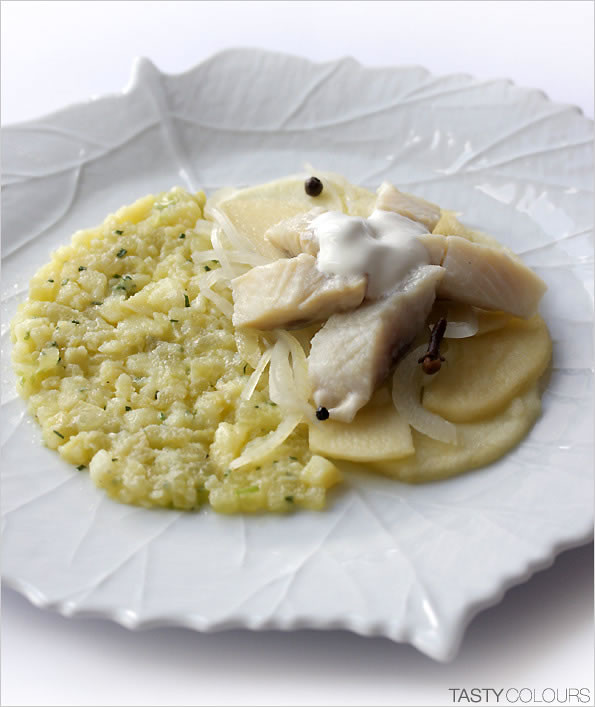
Christmas Eve in my family was preceded by a fast, meaning that we did not eat meat on that day. A light lunch consisted of tasty herrings marinated for a day or two in boiled, white vinegar, spices, onions, sour apples and then served sprinkled with thick cream, accompanied by a potato salad, with sour cucumbers and chives.
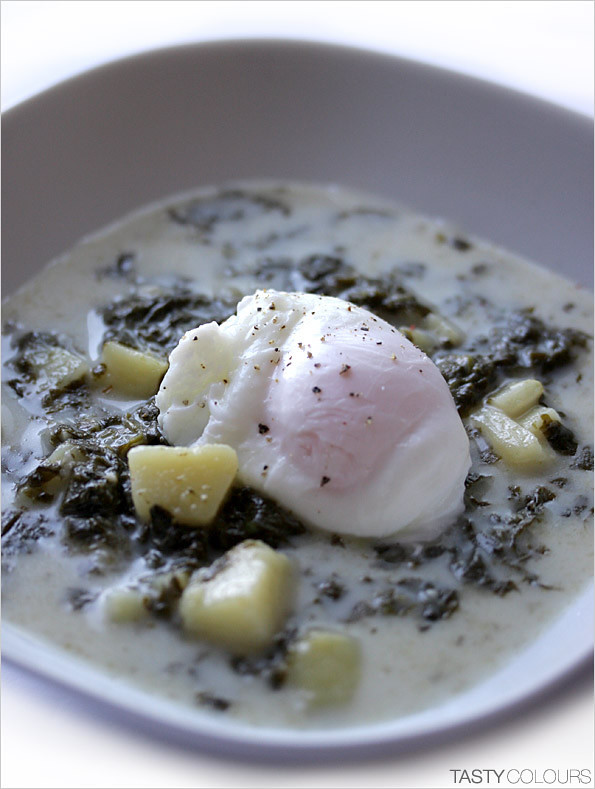
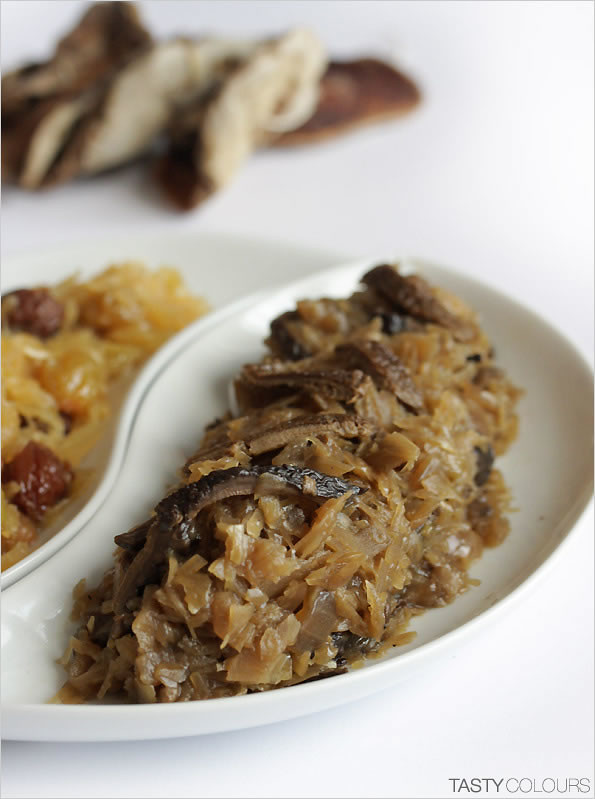
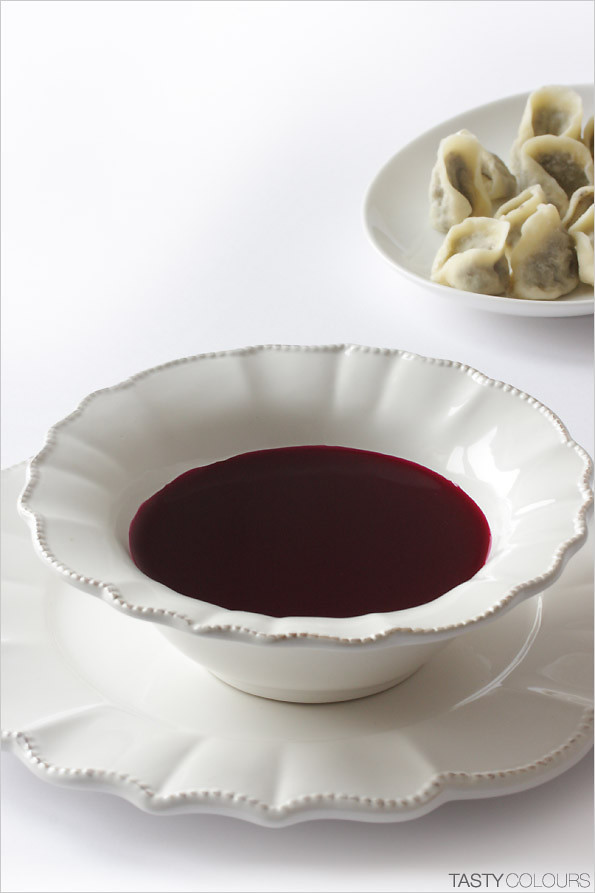
Christmas Eve dinner in many Polish homes and in my family started with a beetroot soup (borscht). In some families, the vegetarian version of a mushroom soup made from dried forest mushrooms is also served; however, the Christmas version of the borscht in my family home varies a lot from a regular one which is made from cooked beets. In general, everything as regards the traditional Polish Christmas Eve may be summarized in a few words: sauerkraut, dried forest mushrooms, carp, beets, dumplings, herrings and poppy seeds.
The Christmas borsht soup has been made from a base that had to be prepared a few days in advance (you will find the recipe in this post). The base consists of raw beets, peeled and cut into slices, pickled in boiled, chilled water with garlic, for four to five days. Then this « starter » is mixed with a light broth made from dried ceps and vegetable broth. The soup cannot be boiled; otherwise its color and taste will change. First records about the soup probably date from the beginning of the XVIth century. So, people – eat beets, eat beets! They are not so awful. Even nowadays, the soup in its luxury version is often served in elegant parties, weddings and occasional feasts, although usually with some meat stock.
The common, daily version, usually served with potatoes or hard-boiled eggs, can easily be made within a few hours by simply cooking the ingredients and adding vinegar or lemon juice. However, the traditional way is to prepare the soup several days in advance and to allow it to get a natural sour taste. Of course it is possible to buy a concentrate in shops or on local markets, but homemade base is always better, as you can control the taste and the level of fermentation.
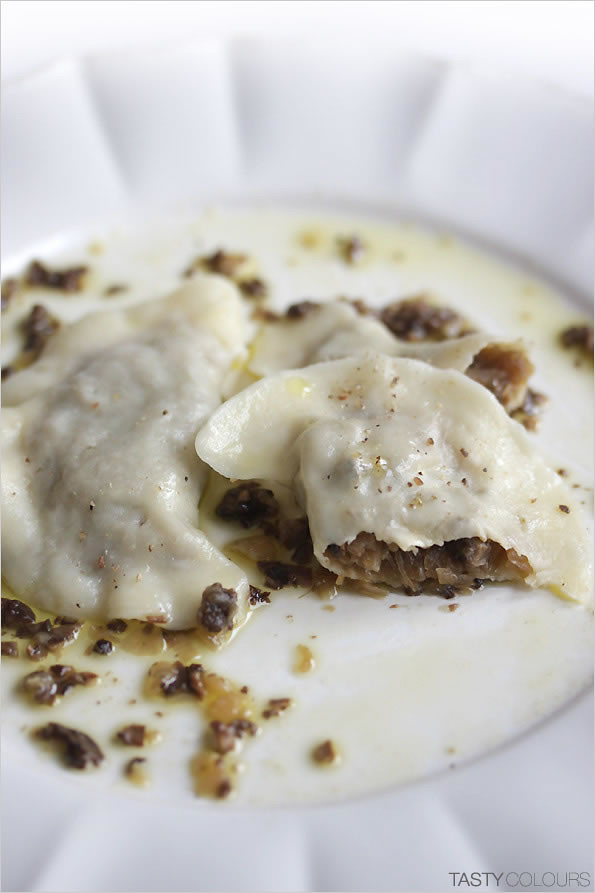
In my opinion, traditional Christmas borscht goes best with tiny dumplings stuffed with a preparation of soaked dried ceps and fried onions. These are called « uszka » in Polish. A direct translation means “little ears” and that is the shape you are aiming for. Some of the secrets to prepare really delicious uszka is to roll-out the dough as thin as possible, to shape them as small as possible, and then, finally, to use dried ceps of a good quality.
It is a pity that those delicious dumplings are practically unknown abroad. Although it is a lot of precious work to do them, I really like to make them (maybe because I do this only once per year). You can order uszka all year round in almost every restaurant serving Polish food. However, they may not be good everywhere. First of all, the uszka dough usually is much too thick, and secondly, cheaper restaurants use a mixture made of cheap button mushrooms and of a small quantity of dried bolets. Therefore, before ordering this dish you should ask first what kind of mushroom has been used for the filling.
After the soup, pierogi (dumplings) stuffed with braised sauerkraut and/or sauerkraut and dried mushrooms often appeared on our table. This is a type of pierogi that one can meet quite easily all year round in Poland, however I eat them usually around Christmas time. In some homes, people eat pierogi with poppy seeds.
Since the early nineties we had been invited to spend Christmas Eve at my mum’s closest friend, Ewa and her family. This is where I acquired the habit of eating a vegetarian version of the popular “gołąbki” (stuffed cabbage rolls with kasha or rice and dried mushrooms in its vegetarian version).
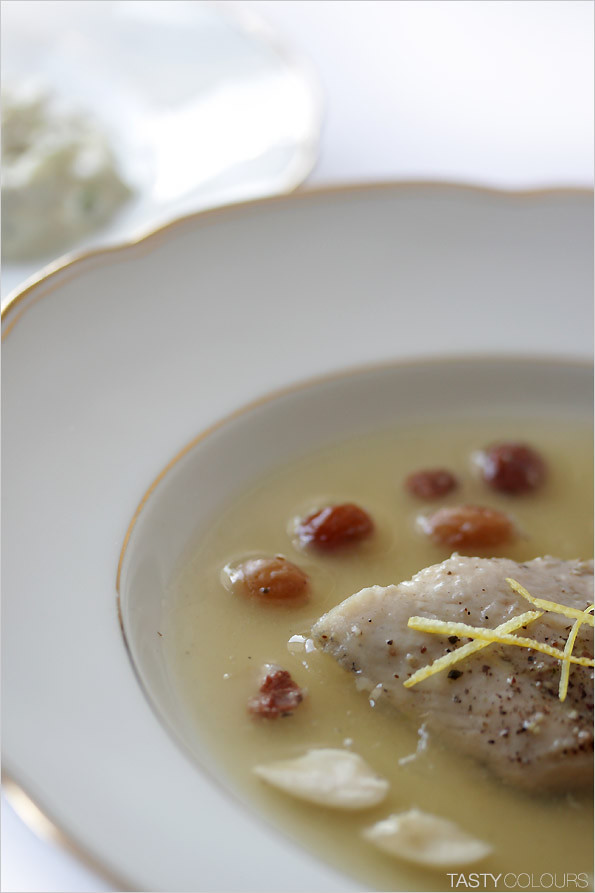
Both at Ewa’s place and in our home, the carp fish was served in two different versions. The first one is a cold fish in jelly, often called Carp Jewish Style – a dish which probably finds its origins in the cuisine of Eastern European Jews. Pieces of fish are cooked slowly with almonds and raisins in a fish stock, then eaten cold with natural jelly and soft bread.
The second carp dish was served very simply, breaded and accompanied by hot sauerkraut with dried mushrooms and raisins, a vegetable salad or a potato salad – and usually nobody spoke a word when eating this fish, as it has a lot of bones.
Christmas Eve’s desserts were less important to me as I do not like sweets too much. Except for one thing: small, buttery pastry dough cookies made from whipped egg whites and from the addition of lemon juice on top, according to my grandma’s recipe. Besides that all those traditional cakes with poppy seeds, dried fruits or candied fruits, as well as kutia - a dessert which came to us through Polish people who were expatriated, after the War, from today’s Ukrainian territories, had no existence for me.
At the end of Christmas Eve, my mum used to serve compote - kompot - a drink made from cooked dried, smoked fruits: plums, apples, pears, raisins, apricots, the purpose of which is to speed-up digestion.
Christmas Days
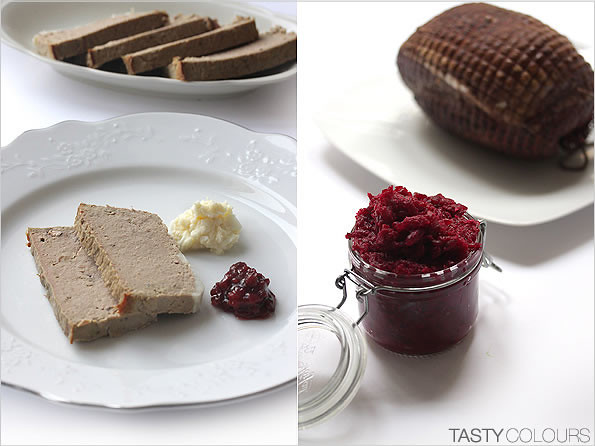
In Poland, Christmas lasts for nearly three days: Christmas Eve (Wigilia), starts at around 5 p.m. (when the first star appears in the sky), it then continues for two more days. A typical and traditional Polish Christmas Day breakfast, which was celebrated in my family, consisted of a good assortment of charcuterie - cooked hams, sausages, pates, served with accompaniments such as pickled ceps, horseradish with eggs, tartar sauce, a spicy and cold beet-horseradish salad called “ćwikła” and lingonberry preserves.
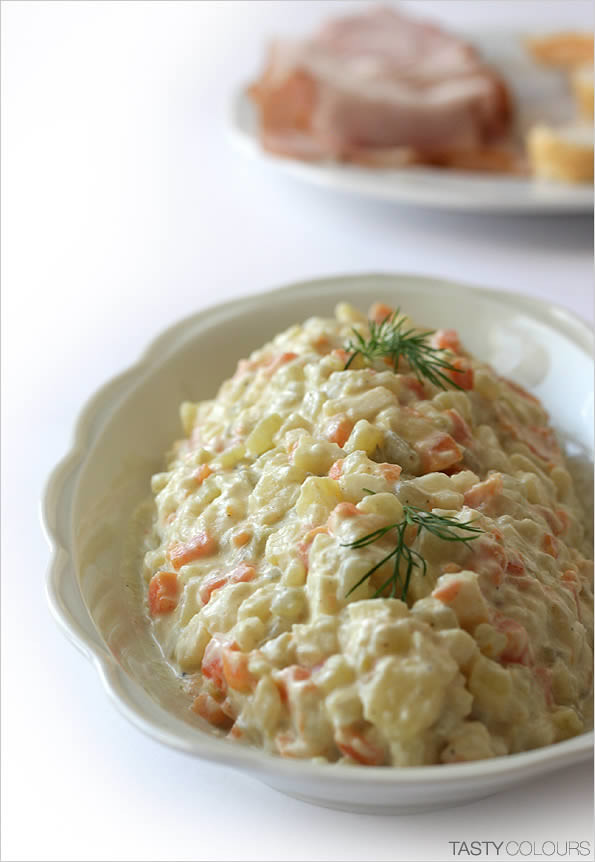
A traditional vegetable salad also comes with all that. It is made from cooked root vegetables like parsley, carrot and celery root as well as potatoes, sour cucumbers and apples.
Then cakes always appeared on our Christmas table. Contrary to Christmas Eve, when meat is not allowed, on Christmas day the main course (obiad) consisted of meat like duck, veal, beef, goose or leftovers of fried carp from the previous day, served with cabbage or with some other accompaniments, followed, again, by cakes and cookies. Then, for dinner, cold charcuterie and accompaniments were served, as they were for breakfast.
In Poland, the second day of Christmas is celebrated as well, and people do not work, so the gluttony continued for one more day, interrupted by family visits and walks.
New Years Eve
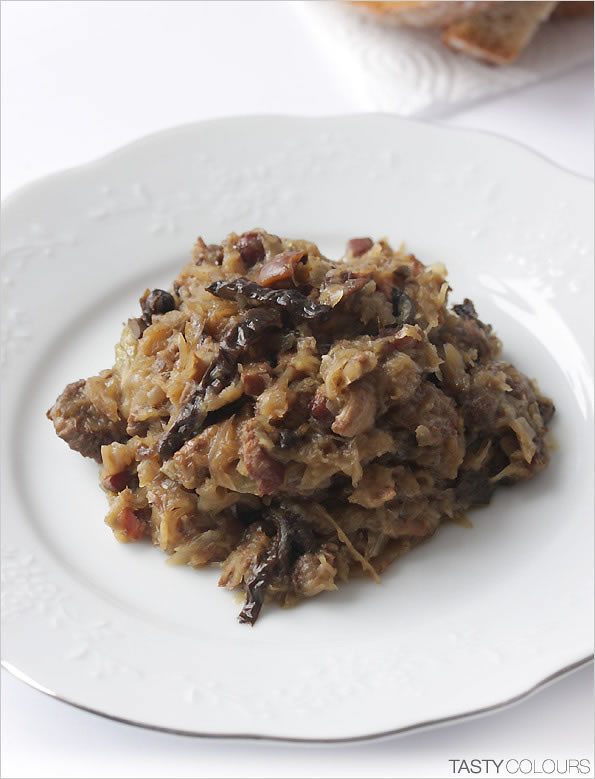
The meaty leftovers from Christmas meals are used to prepare bigos – a hunter stew cooked very slowly (most preferably, for two or three days) using several types of meat, sauerkraut, dried mushrooms, dried plums, red wine and a lot of spices. In its extraordinary version a bigos is cooked in my family between Christmas and New Years Eve, and is eaten on New Year’s day – as a good solution for hangover, should anybody had one.
Bigos is a traditional stew typical of Polish and Lithuanian cuisines. Many consider it to be the Polish national dish. Indeed, bigos has a long tradition in Poland. Some say that first traces about bigos can be found in the middle ages. It is said that bigos has been introduced to Poland by Jagiełło, a Lithuanian prince who became king of Poland in the XIVth century and founded the long-lasting union between the two states. However, Polish linguists trace the word bigos to be of a German origin rather.
In old times, bigos was stored in every household’s pantries in big stone pots, ready to be served to unexpected guests or as a provision for long trips. Should anyone ask me about the most traditional and the most pauperized Polish dish during the communism – the answer is bigos. As nearly everything in Polish cooking after the Second World War, this old and rich dish was brutally simplified due to, inter alia, food shortcoming and political concerns. I can remember a version of bigos served in my school cantina as a few slices of meat of poor quality swimming in half-raw sour cabbage. This has nothing to do with real bigos, which needs many ingredients and a long cooking time. Even today, in many cheap restaurants or “milk bars” you can order an ersatz of bigos, which usually translates into a preparation of cooked cabbage with a bit of sausages.
There exists many variations of this dish and the one that I present in my book is the one I learnt from my mom.
There is no standard recipe for the dish. There are, however, certain rules to make it properly: it requires a long cooking time; different types of meats are to be used; the addition of dried plums, mushrooms and spices is required. Recipes vary between regions and families. Typical ingredients include sour cabbage, sometimes as well white cabbage, various cuts of meat and sausages, tomato paste and honey, sour apples, mustard and wine.
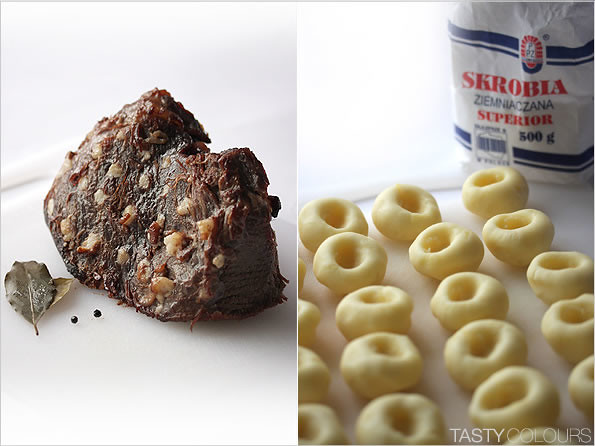
Sylvester dinner was usually celebrated in my family serving a hunter’s style beef tenderloin – “pieczeń wołowa na dziko”. A piece of beef was pickled for two to three days in wine and vinegar, then baked and served with « silesian dumplings » (“kluski śląskie”) - a sort of potato flour oval gnocchi, and lingonberry preserves.
CHRISTMAS EVE BORSCHT
Barszcz Wigilijny
Serves 8
Ingredients:
For the starter (“zakwas”)
2 kg (4.4 lbs) hard raw beets, peeled, washed and cut into slices
8 medium garlic cloves, peeled and cut in halves
1 teaspoon sugar
½ teaspoon salt
2.5 liter (2.6 quarts) boiled and chilled water
1 jar (3 liter (3.2 quart) capacity)
1 gaze or a piece of cotton fabric, to cover the jar
For the mushroom-vegetable broth
40 g (1.4 oz) dried ceps
2 medium beets, peeled, washed and cut in slices
1 root parsley or parsnip, peeled, washed and cut in halves
½ small celery root, peeled and washed, cut into slices
1 carrot, peeled and washed, cut into halves
1 onion, peeled and washed, cut into halves
1 bay leave
5 grains black pepper
2 grains all spice
Salt
Pepper
1 tablespoon lemon juice (optional, if the soup is not sour enough)
1 teaspoon marjoram
1 Prepare the Starter: Place beets in a clean, sterilized jar. Add garlic cloves. Mix water with salt and sugar and pour into the jar. The beets must be completely covered with water. Cover the jar with gauze and put aside at room temperature between 20° to 24° Celsius (68° to 75° Fahrenheit) for at least 5-6 days. Check from time to time. If you notice foam on the surface of the liquid, remove it delicately with a clean spoon and cover again. The base is ready when it has a strong sweet – acid taste. Strain the liquid. Discard beets and garlic. Pour the starter into a jar or a bottle and refrigerate. It may be saved up to two weeks.
2 Prepare the Mushroom Broth: Place the mushrooms in a saucepan and add 1liter (1quart) of water. Let them soak for at least 2 hours (preferably overnight). Cook them in the soaking water, under the cover, for 30 minutes or until they are soft. Strain the liquid and reserve it for the Borscht. Reserve the mushrooms and use them for another dish, for example Raviolis with Ceps.
3 Prepare the Vegetable Broth. In a deep saucepan, bring to a boil 1liter (1quart) of water. Add beets, root parsley, celery root, carrot, onion, bay leave, black pepper and all spice. Cook covered over medium heat until they become soft. Strain and discard vegetables and spices. Reserve the broth.
4 Prepare the Soup: Pour 2 liters (2 quarts) of the starter into a saucepan and add the entirety of the vegetable broth and half of the mushroom broth. Heat up, but do not bring to a boil, otherwise the soup will change in color. Taste: the soup should be quite sour, with a garlic and mushroom aftertaste. If necessary, add a bit more of the mushroom broth. Season with marjoram, salt and pepper and simmer for 10 minutes but do not allow the soup to boil.
A good starter should be transparent, but deep in color and a bit thick in texture. The best is to prepare it from organic beets. There exist recipes where some rye bread is added for faster fermentation. I prefer to prepare my base only from beets and garlic, as nowadays it is not so easy to find whole rye bread without industrial additions. Never add any vinegar to season this version of borscht.
Uszka (little dumplings with dried ceps)
Serves 8
For the filling:
Ingredients:
45 g dried ceps
750 ml water
1 onion or 2 shallots, peeled, washed and very finely chopped
4 table spoons butter
1 table spoon bread crumbs
1 egg white
Salt
Pepper
Soak mushrooms in water for a night.
On a second day, cook them until soft for around 20-30 minutes.
Strain the mushrooms.
Reserve the mushroom water and use, for example, for the borscht or other soup.
Chop the mushrooms very finely and put aside.
In a hot frying pan melt butter, add onions and cook them on a law flame until soft and golden.
Add mushrooms, fry for a minute or two, salt and pepper generously. Put aside in a medium bowl to cool down.
Then prepare the dough for the raviolis (see page XX below)
Once the dough is ready, finish the filling for the raviolis: add bread crumbs and mix.
Then beat egg white and add to the mixture. Mix delicately.
“Uszka” dough (around 60-70 small raviolis)
Ingredients:
200 g flour, sifted ((have some extra flour handy to adjust the recipe and to work the dough and roll it out)
1 egg
½ tea spoon butter
60-150 ml room temperature water (add little by little)
1 glass of 4 cm diameter (for example, champagne or vodka glass)
Sift flour on your working table.
Form a well in the centre of the flour.
Place the egg, butter in the well and mix all the ingredients with as much flour as possible.
Then start adding the water, 2 tablespoons at a time.
Knead the dough so the water is completely absorbed before adding the 2 following tablespoons of water.
Should you add too much water, the dough will become sticky; in that case, add little by little the extra flour until the dough is no longer sticky.
Knead the dough for about 15 minutes; it should become smooth, soft and elastic.
Divide the dough into 3 equal parts.
Place the first part on your working table.
Wrap two remaining parts in a plastic film and put aside.
Sprinkle some flour on your station and start rolling out the dough until it is between 1 and 2 millimeters thick.
Occasionally, flip the dough and sprinkle some flour over it so it does not stick to the table.
When dough is rolled out, cut disks of around 3-4 centimeters using a cookie cutter or, if not available, a champagne glass.
Put the scraps of leftover dough together and gently knead to form a small ball.
Wrap in plastic film and put aside to roll out later.
Place about ½ teaspoon of stuffing in the middle of each disk.
The stuffing must not reach the edge of the disk or it will prevent the proper sealing of the raviolis.
Fold disk in half and pinch edges together – you will obtain a little pieróg.
Using indexes and thumbs join the two tips of the pieróg to obtain a shape of “an ear”, most closely to Italian tortellini.
Should the dough be too dry, it will not seal properly.
In that situation, use a brush to moist the edges of the disk, and pinch them together.
Place “uszka” on a flat dish sprinkled with flour, and cover with a light cotton towel.
Repeat to prepare “uszka” from second and third part of dough and scraps.
Cooking
In a large saucepan (5 liter capacity), bring to a boil 3 liters of water; add some oil and a flat teaspoon of salt.
Drop a few “uszka” at a time, bring again to a boil and reduce flame.
When “uszka” rise to the surface, let simmer another 2 minutes.
Taste one to check that the dough is well cooked.
Do not strain them; use a slotted spoon to remove them from water and place over a paper towel to remove the excess of water.
Serve immediately as an accompaniment to Christmas bortsch.
In this recipe, you can use other dried mushroom, like for example dried boletus. Although they are served traditionally with the borsht, you can eat them as an accompaniment to bullion or mushroom soup. You can even fry cooked “uszka” on a frying pan and served them as a hot starter, served with some butter and parsley.
The precooked “uszka” freeze easily, so you can the excess for other occaision.
CARP JEWISH STYLE
(karp po żydowsku)
Serves 4
Ingredients:
50 g (1.8 oz) whole almonds, peeled and cut into quarters
40 g (1.4 oz) dried raisins (preferably sultana)
600 g (1 lb 5 oz) fish bones (preferably carp heads)
3 medium onions (300 g) (10.5 oz), peeled and cut into halves
1 carrot, peeled and washed
8 grains black pepper
600 g (1 lb 5 oz) carp cut into slices (if unavailable, use another soft water fish like sander or Northern Pike)
A pinch of salt
A pinch of ground black pepper
A pinch of sugar
1 In a small saucepan, bring to a boil 150 ml (0.6 cup) of water, add almonds and raisins and cook them for 5 minutes. Then put everything aside.
2 Remove any scale left from the fish skin. In a large saucepan, place the fish bones and cover with 1.5 liter (6.3 cups) of water. Add onions, carrot and pepper grains. Cover with a lid and cook over low flame for about 1 hour to 1.5 hour. In the meantime, sprinkle the fish steaks with salt, pepper and sugar.
3 When fish stock is ready, strain it using a very fine strainer (preferably, a chinois); collect half the quantity of the onions and reduce them into a purée using a blender, and add to the strained fish stock. Discard all other solids. Add almonds and raisins and their reserved cooking water to the fish stock. Bring the fish stock to a boil. Place the fish steaks into the stock and cook for 10 minutes, or until the color of fish meat changes to white.
4 Remove the steaks from the stock and place them on a deep serving dish or individual deep plates to cool down. Strain the fish stock once again to remove any additional solids; keep almonds and raisins aside. Pour the cooled-down fish stock over the fish steaks; they should be covered completely. Place almonds and raisins around the fish steaks in a decorative manner.
5 Refrigerate overnight so the fish stock turns into a jelly. Serve with quarters of fresh lemon and bread.